Learning curve and perioperative outcomes: a retrospective cohort study between synchronous and combined inflatable mediastinoscope-laparoscopic radical esophagectomy - Report - MDSpire

Learning curve and perioperative outcomes: a retrospective cohort study between synchronous and combined inflatable mediastinoscope-laparoscopic radical esophagectomy

  • By

  • Hai-Tao Wei

  • Nuo Xu

  • Zu-Yuan Zhao

  • Xia-Peng Li

  • Bao-Li Hu

  • Jiao Wang

  • Li Li

  • Qian Long

  • July 15, 2026

Share

Clinical Report: Evaluating the Learning Curve and Surgical Outcomes

Overview

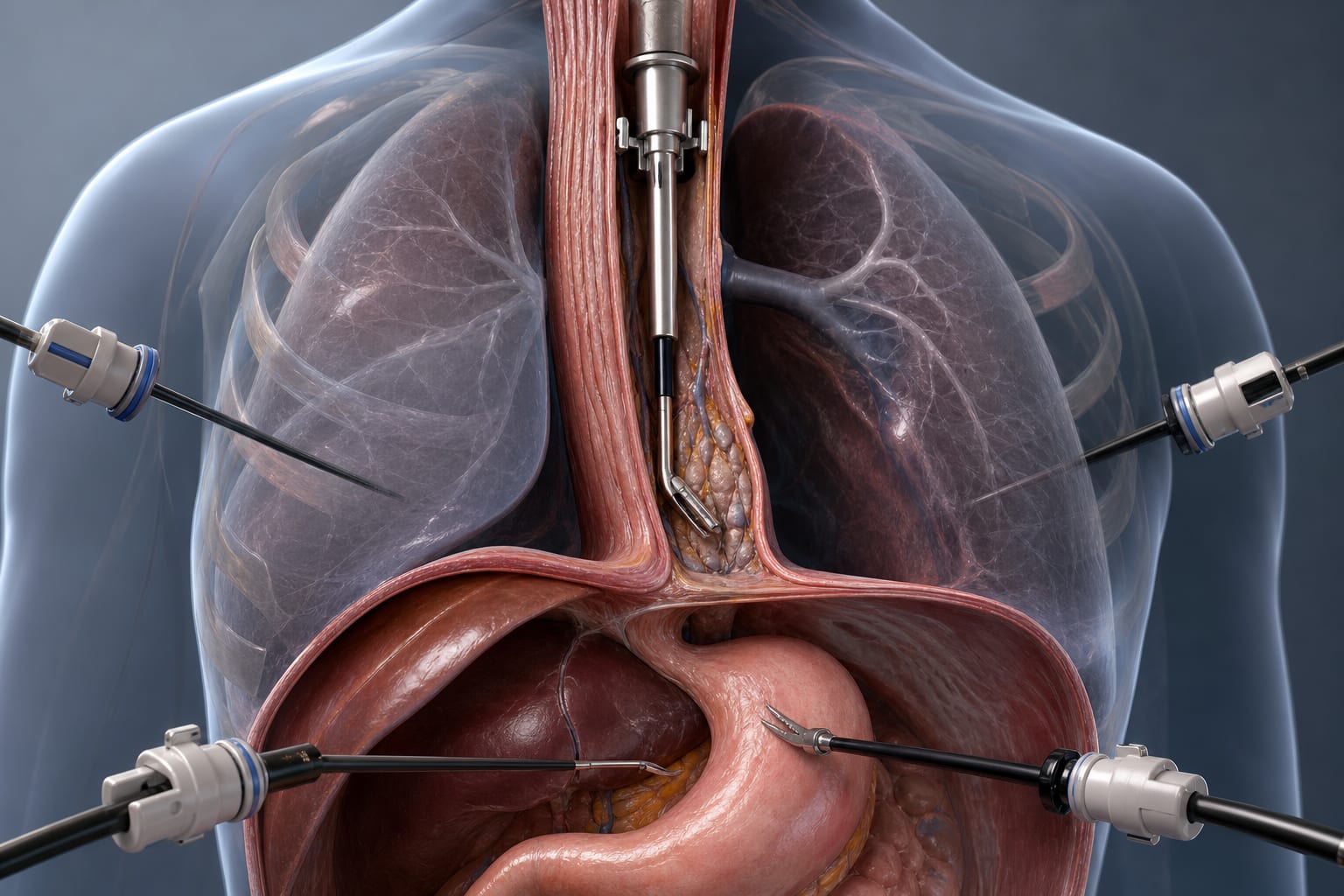
This study compares the learning curves and perioperative outcomes of synchronous versus combined inflatable mediastinoscope-laparoscopic radical esophagectomy using CUSUM analysis.

Background

Esophageal cancer is a significant health challenge, with surgery being a critical component of treatment for resectable cases. The evolution of minimally invasive techniques has improved surgical outcomes and recovery times. Understanding the learning curves associated with these techniques is essential for surgical training.

Data Highlights

GroupPatients
Synchronous Group106
Combined Group106

Key Findings

  • The study involved a total of 229 patients, with 118 in the synchronous group and 111 in the combined group.
  • After propensity score matching, 106 patients were included in each group for final analysis.
  • CUSUM analysis was employed to evaluate the learning curves of both surgical approaches.
  • The synchronous approach aims to reduce mechanical lung injury and inflammatory response compared to the combined approach.
  • Previous studies have utilized CUSUM analysis to assess learning curves in minimally invasive esophagectomy.

Clinical Implications

The study provides insights into the technical demands of synchronous and combined approaches to esophagectomy.

Conclusion

The study evaluates learning curves in surgical techniques for esophageal cancer.

Related Resources & Content

  1. Huaihe Hospital of Henan University, 2023 -- Evaluating the Learning Curve and Surgical Outcomes
  2. ESMO Clinical Practice Guideline interim update, 2024 -- Treatment of locally advanced oesophageal cancer
  3. Minimally invasive versus open oesophagectomy, 2012 -- Randomized controlled trial
  4. Evaluating the Progression of Thoracoscopic Techniques in Esophageal Atresia Repair
  5. Surgical Endoscopy — Comparison of Continuously Sutured and Linear-Stapled Anastomosis Techniques in Robot-Assisted Hybrid Ivor Lewis Esophagectomy After Neoadjuvant Chemoradiotherapy: A Cohort Study from a Single Center
  6. Surgical Endoscopy — Supervised Implementation of Robotic Surgery for Hiatus Hernia: Results and Learning Curves from a High-Volume Center in the UK
  7. ESMO Clinical Practice Guideline interim update on the treatment of locally advanced oesophageal and oesophagogastric junction adenocarcinoma and metastatic squamous-cell carcinoma - PMC
  8. Minimally invasive versus open oesophagectomy for patients with oesophageal cancer: a multicentre, open-label, randomised controlled trial - ScienceDirect
  9. A systematic review and meta-analysis of mediastinoscopy-assisted transhiatal esophagectomy (MATHE) - ScienceDirect

Original Source(s)

Related Content