Functional Connectivity and Local Activity Variations in Patients with Distressing versus Non-Distressing Tinnitus Phenotypes During Resting State
-
By
-
Yongpeng Li
-
Lu Peng
-
Ying Lan
-
Binyu Mo
-
Shihua Yin
-
June 11, 2026
Functional Connectivity and Local Activity Variations in Tinnitus Phenotypes
Overview
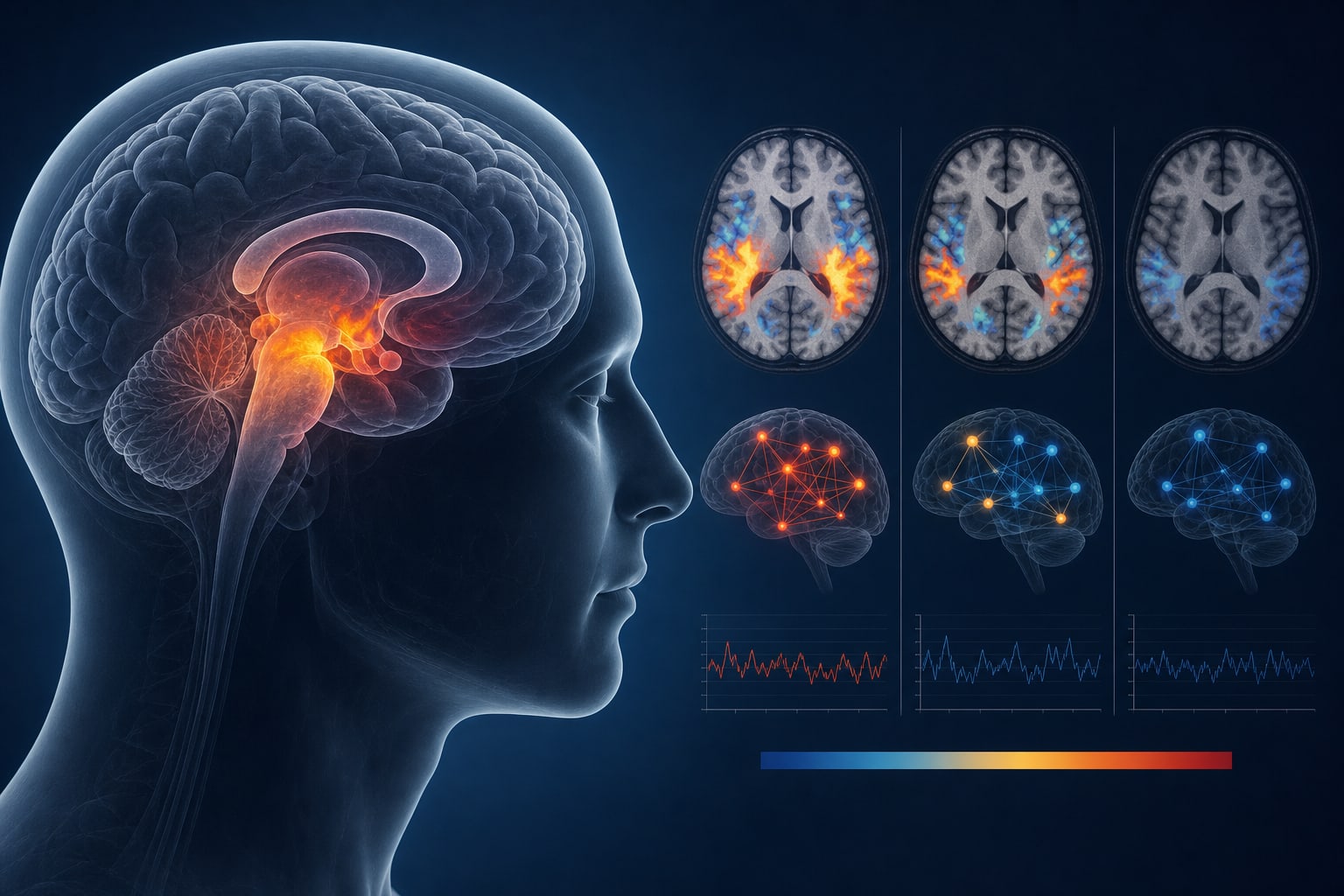
This study identifies significant resting-state functional connectivity differences between bothersome tinnitus (BT) and non-bothersome tinnitus (NBT) patients. Notably, BT exhibited stronger connectivity in specific brain regions compared to NBT, while showing no significant differences from non-tinnitus controls.
Background
Tinnitus, the perception of sound without an external source, affects a significant portion of the population, with bothersome tinnitus (BT) leading to substantial functional impairment. Understanding the neurophysiological differences between BT and non-bothersome tinnitus (NBT) is crucial for developing targeted interventions. This study aims to elucidate these differences through resting-state fMRI analysis.
Data Highlights
| Group | fALFF Differences | ReHo Differences | FC Differences |
|---|---|---|---|
| Bothersome Tinnitus (BT) | Significant across multiple regions | Lower in medial superior frontal gyrus compared to NBT | Stronger connectivity with left ACC/mOFC |
| Non-Bothersome Tinnitus (NBT) | Region-specific differences | Higher than BT and controls | No significant differences from controls |
Key Findings
- BT showed stronger functional connectivity with the left ACC/mOFC compared to NBT.
- ReHo values were lower in NBT than in both BT and non-tinnitus controls.
- fALFF analyses indicated region-specific differences across various brain regions between BT and NBT.
- Most differences between BT and NBT were attenuated when adjusting for tinnitus loudness.
- No significant correlations were found between imaging indices and clinical measures in the BT group.
Clinical Implications
These findings highlight the importance of distinguishing between tinnitus phenotypes for tailored clinical interventions. Understanding the neurophysiological underpinnings of BT can inform treatment strategies aimed at alleviating distress and improving patient outcomes.
Conclusion
Strengthen the conclusion by reiterating the clinical importance of differentiating tinnitus phenotypes.
Related Resources & Content
- VA/DoD Clinical Practice Guideline, 2024 -- Tinnitus
- New Tinnitus Guideline Offers Recommendations to Improve Patient Care, JAMA, 2025
- Smartphone-Based Cognitive Behavioral Therapy and Customized Sound Therapy for Tinnitus, PubMed, 2025
- Effects of Internet-based and mobile device-based cognitive behavioral therapy on tinnitus intervention, PubMed, 2025
- Efficacy and safety of a modified sound therapy for patients with subjective tinnitus, PubMed, 2025
- Hearing Aid Amplification Schemes Adjusted to Tinnitus Pitch, PMC, 2025
- Frontiers in Psychiatry — Altered anterior cingulate cortex functional connectivity in treatment-naïve obsessive-compulsive disorder: a resting-state fMRI study
- Journal of Neuro-Oncology — The connection between abnormal brain activity and functional network connectivity in patients with glioma
- BMC Psychiatry (Springer) — Differential Patterns of Regional Resting-State Brain Activity in High-Functioning versus Low-Functioning Autism Spectrum Disorder
- BMC Psychiatry (Springer) — Exploring Resting-State EEG Patterns Following Deep Brain Stimulation in the Nucleus Accumbens and Anterior Limb of the Internal Capsule: A Preliminary Investigation
- VA/DoD Clinical Practice Guideline for Tinnitus
- New Tinnitus Guideline Offers Recommendations to Improve Patient Care
- Smartphone-Based Cognitive Behavioral Therapy and Customized Sound Therapy for Tinnitus: A Randomized Controlled Trial - PubMed
- Effects of Internet-based and mobile device-based cognitive behavioral therapy on tinnitus intervention: a systematic review and meta-analysis - PubMed
- Efficacy and safety of a modified sound therapy for patients with subjective tinnitus (MOST): a multicentre, double-blind, randomised controlled trial - PubMed
- Hearing Aid Amplification Schemes Adjusted to Tinnitus Pitch: A Randomized Controlled Trial - PMC
- Efficacy of repetitive transcranial magnetic stimulation for subjective chronic tinnitus: a randomized controlled trial meta-analysis - PubMed
- Central functional connectivity reorganization in idiopathic tinnitus - ScienceDirect
- Neuromodulatory effects of dual-site repetitive transcranial magnetic stimulation targeting frontal and temporal cortices in subjective tinnitus: A functional magneti resonance imaging study - ScienceDirect
Based on findings from:
Resting-state functional connectivity and local activity differences across bothersome and non-bothersome tinnitus phenotypes
Yongpeng Li, Lu Peng, Ying Lan, Binyu Mo, Shihua Yin. Frontiers In Neurology, 2026.
https://www.frontiersin.org/journals/neurology/articles/10.3389/fneur.2026.1831863/full
This content is an AI-generated, fully rewritten summary based on a published scholarly article. It does not reproduce the original text and is not a substitute for the original publication. Readers are encouraged to consult the source for full context, data, and methodology.