S-GRAS score and the complementary prognostic value of neutrophil-to-lymphocyte ratio in adrenocortical carcinoma: evidence for a synergistic interaction - Report - MDSpire

S-GRAS score and the complementary prognostic value of neutrophil-to-lymphocyte ratio in adrenocortical carcinoma: evidence for a synergistic interaction

  • By

  • Erik Bényei

  • Gergely Huszty

  • András Laki

  • Zsuzsanna Jakab

  • Gergely Kiss

  • Attila Kristóf Kovács

  • Katalin Borka

  • Andrea Uhlyarik

  • Katalin Eitler

  • Peter Igaz

  • Judit Tőke

  • Miklós Tóth

  • June 8, 2026

  • 0 min

Share

Clinical Report: Evaluating the Prognostic Significance of the S-GRAS Score

Overview

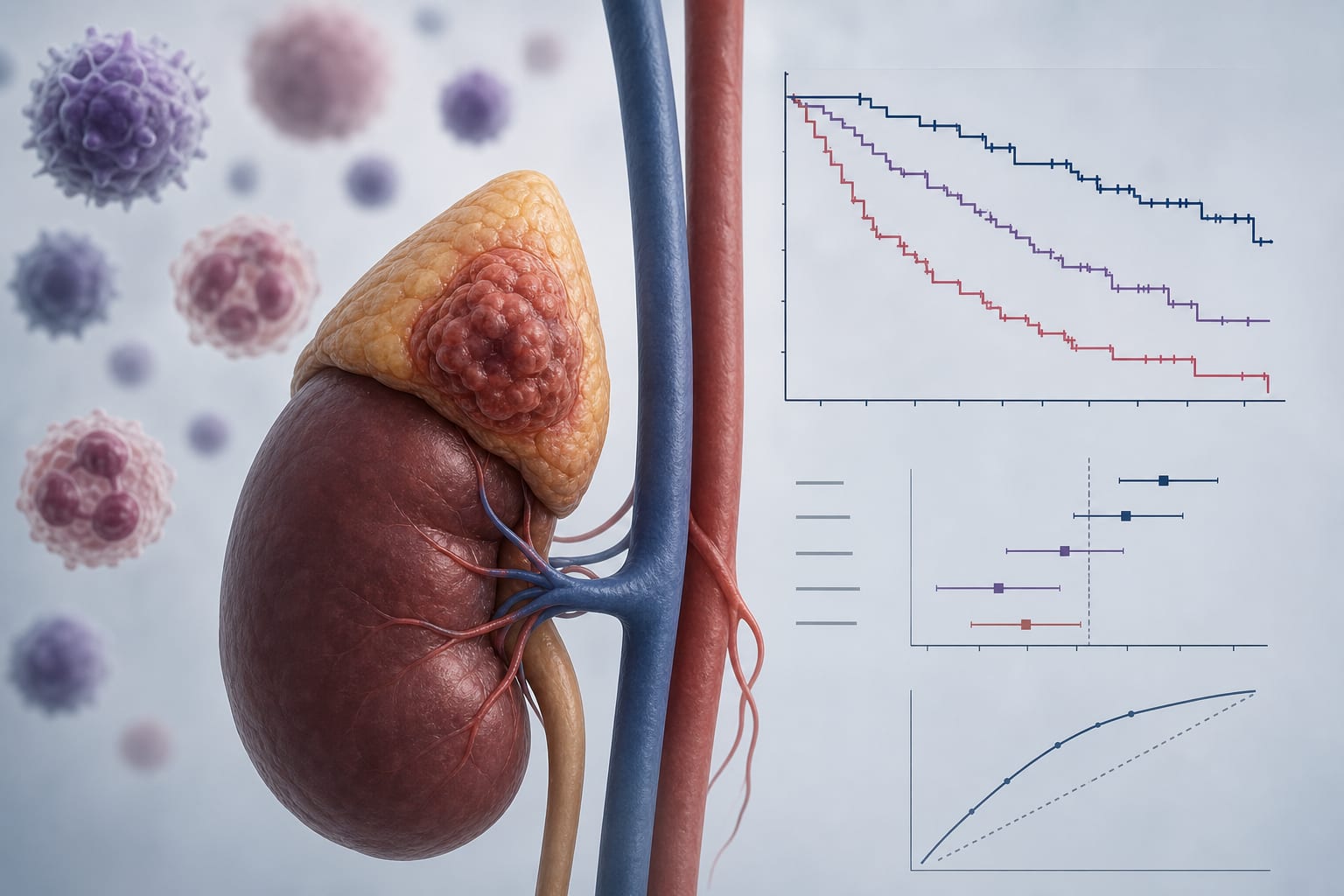
This study evaluates the prognostic significance of the S-GRAS score and the neutrophil-to-lymphocyte ratio (NLR) in adrenocortical carcinoma (ACC). The findings indicate that the combination of S-GRAS and NLR provides superior prognostic discrimination compared to each measure alone.

Background

Adrenocortical carcinoma (ACC) is a rare and aggressive malignancy with a poor prognosis. Accurate prognostic tools are essential for risk stratification and guiding treatment decisions. The S-GRAS score and inflammation-based markers like NLR have emerged as potential predictors of survival in ACC, warranting further investigation into their combined utility.

Data Highlights

MeasureC-indexHRp-value
S-GRAS0.803--
NLR0.7223.10.008
Combined (S-GRAS + NLR)0.8221.1770.009

Key Findings

  • The S-GRAS score demonstrated a C-index of 0.803, indicating strong prognostic ability.
  • NLR was identified as a significant predictor of mortality with an HR of 3.1 (p=0.008).
  • The combination of S-GRAS and NLR provided superior prognostic discrimination (C-index=0.822) compared to either score alone.
  • A significant synergistic interaction between S-GRAS and NLR was observed (HR = 1.177, p=0.009).
  • External validation confirmed the robustness of the S-GRAS score in predicting outcomes in ACC.

Clinical Implications

The findings suggest that incorporating NLR into the S-GRAS scoring system may enhance prognostic accuracy in ACC patients. Clinicians should consider using both metrics together to better stratify patients and tailor treatment approaches.

Conclusion

The study underscores the importance of combining the S-GRAS score with NLR to improve prognostic assessment in adrenocortical carcinoma. This approach may lead to more personalized treatment strategies for patients with this aggressive malignancy.

Related Resources & Content

  1. Libé et al., ESE-ENSAT Guidelines, 2018 -- S-GRAS score for prognostic classification of adrenocortical carcinoma
  2. S-GRAS score for prognostic classification of adrenocortical carcinoma - PMC, 2026
  3. Determining the Ideal Preoperative Neutrophil–Lymphocyte Ratio Cutoff and Its Impact on Postoperative Outcomes in Colorectal Cancer Patients
  4. Preoperative Neutrophil-to-Lymphocyte Ratio as an Independent Prognostic Indicator in Gastric Cancer Patients with Postoperative Complications Following Curative Resection
  5. Diagnostic and Prognostic Value of Neutrophil-Lymphocyte Ratio in Adrenocortical Carcinoma
  6. Serum Albumin-to-Globulin Ratio Before Treatment in Patients Undergoing Neoadjuvant Chemotherapy and Radical Nephroureterectomy for Upper Tract Urothelial Carcinoma
  7. Gastric Cancer — The Role of Inflammatory and Nutritional Biomarkers in Predicting Survival Outcomes for Gastric Cancer Patients Undergoing Neoadjuvant Chemotherapy and D2 Lymphadenectomy
  8. European Society of Endocrinology Clinical Practice
  9. S-GRAS score for prognostic classification of adrenocortical carcinoma - PMC
  10. Diagnostic and Prognostic Value of Neutrophil-Lymphocyte Ratio in Adrenocortical Carcinoma - PubMed

Original Source(s)

Related Content