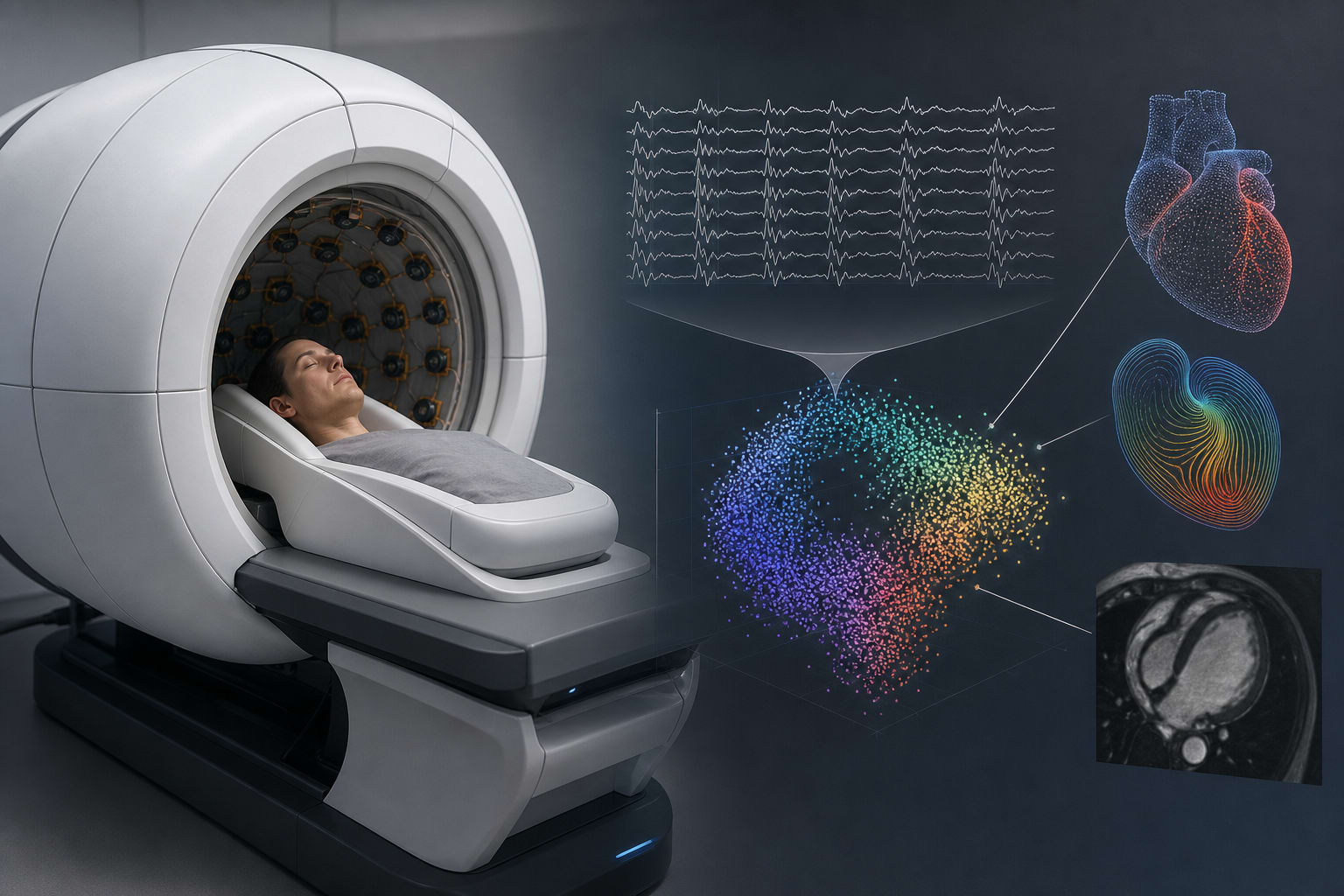
Clinical Report: Self-supervised learning techniques in magnetocardiography
Overview
This study demonstrates the application of self-supervised learning to magnetocardiography (MCG) data, revealing interpretable physiological patterns. The developed MCG2Vec model effectively discriminates between various cardiac conditions using high-dimensional MCG recordings.
Background
Cardiovascular disease is a leading cause of morbidity and mortality, highlighting the need for improved diagnostic tools. Traditional methods like electrocardiography (ECG) have limitations in sensitivity and specificity, while advanced imaging techniques can be resource-intensive. Magnetocardiography (MCG) presents a non-invasive alternative that may provide higher fidelity in capturing cardiac electrophysiological information.
Data Highlights
Condition
AUC
Multivessel coronary artery disease
0.89
Reduced left ventricular ejection fraction
0.81
Atrial fibrillation risk
0.77
Key Findings
MCG2Vec was trained on raw 64-channel MCG recordings from 1732 patients.
Discrimination of multivessel coronary artery disease achieved an AUC of 0.89.
Reduced left ventricular ejection fraction was identified with an AUC of 0.81.
Atrial fibrillation risk assessment yielded an AUC of 0.77.
Attribution analyses revealed temporal and spatial patterns corresponding to key cardiac events.
The study emphasizes the importance of measurement physics in the performance of medical AI systems.
Clinical Implications
The findings suggest that MCG combined with self-supervised learning can enhance the interpretability of cardiac assessments. This approach may facilitate earlier and more accurate identification of cardiac conditions, potentially improving patient outcomes.
Conclusion
The integration of self-supervised learning with MCG data offers a promising avenue for developing interpretable and clinically relevant cardiac representations. This study underscores the potential of advanced sensing technologies in enhancing cardiac diagnostics.
The platform integrates with the CARTO ecosystem and enables physicians to use either pulsed field or radiofrequency energy based on patient anatomy and case complexity.
Patients with lower nonischemic resting full-cycle ratio values had more repeat revascularizations despite similar 2-year major cardiovascular event rates.
National survey findings suggest many US adults report making health decisions based on social media despite widespread concerns about the accuracy of health information shared to the platforms.