MERS-CoV in the Middle East and Africa: from surveillance gaps in humans and dromedary camels to One Health frameworks for spillover, prevention, research and response preparedness - Report - MDSpire
Conexiant’s news site is now MDSpire News. Learn more
Advertisement
MERS-CoV in the Middle East and Africa: Addressing Surveillance Deficiencies in Humans and Dromedary Camels Through One Health Approaches for Spillover Prevention, Research, and Preparedness
Clinical Report: MERS-CoV in the Middle East and Africa: Addressing Surveillance Deficiencies
Background
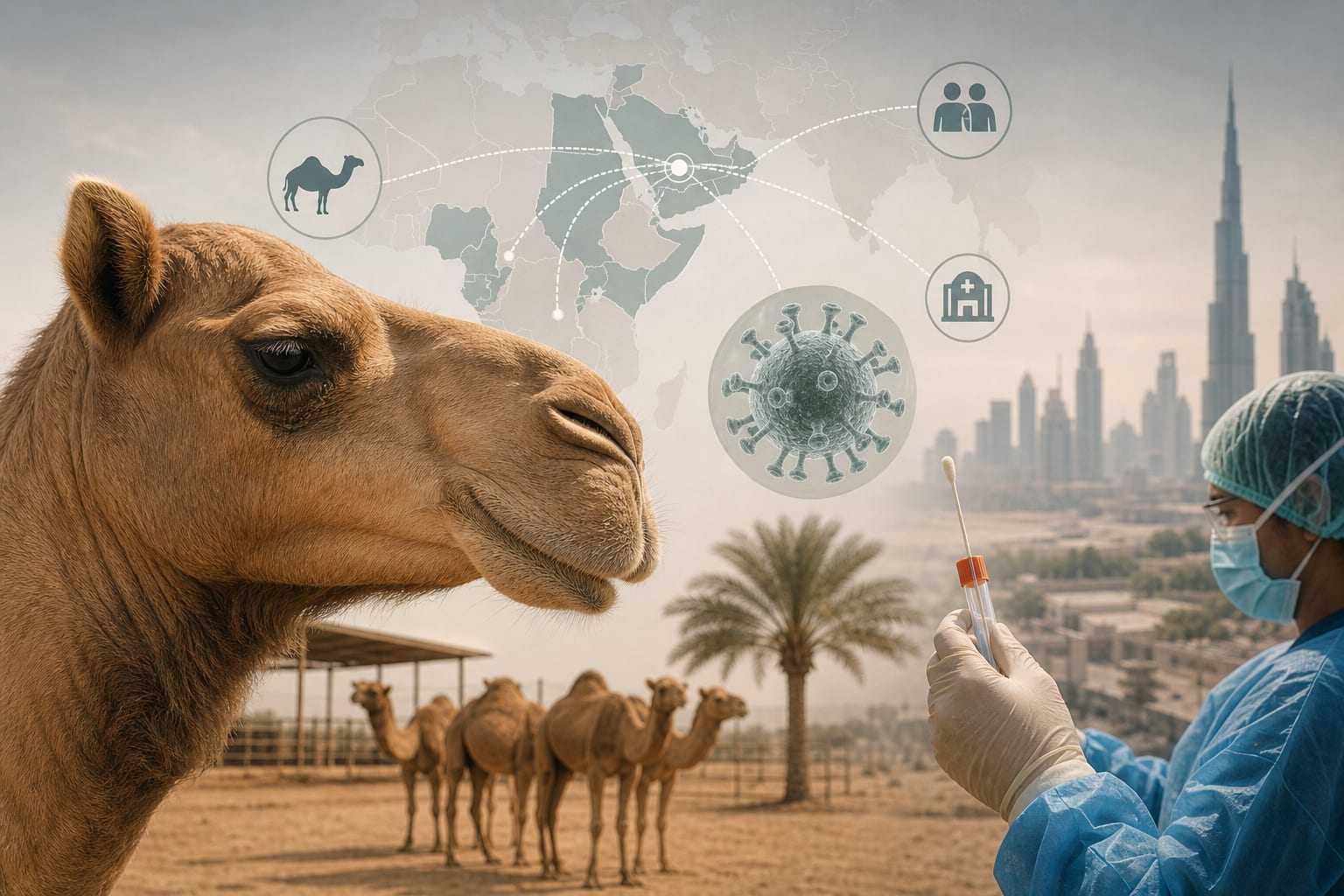
Middle East respiratory syndrome coronavirus (MERS-CoV), first identified in Saudi Arabia in 2012, remains a low-incidence but high-consequence zoonotic threat. Human infection ranges from asymptomatic or mild respiratory illness to severe pneumonia, acute respiratory distress syndrome, renal impairment, multiorgan failure, and death. Extensive MERS-CoV infection or exposure occurs in dromedary camels across the Middle East and multiple African regions, while PCR-confirmed human disease has rarely been reported from Africa, creating what the authors describe as the “Africa paradox.”
Data Highlights
As of July 5, 2026, 2,637 laboratory-confirmed human MERS-CoV cases had been reported to WHO from 27 countries.
Of those reported cases, 965 patients had died, corresponding to a reported case-fatality proportion of 36.6%.
The authors caution that this proportion likely overestimates infection fatality because mild and asymptomatic infections are underdetected.
Dromedary camels across the Arabian Peninsula, North Africa, East Africa, the Horn of Africa, and parts of the Sahel show extensive evidence of MERS-CoV infection or exposure.
Key Findings
Dromedary camels are the principal reservoir for repeated zoonotic transmission of MERS-CoV to humans.
Extensive camel infection or exposure in Africa contrasts with very few PCR-confirmed human cases, an unresolved epidemiologic discrepancy termed the Africa paradox.
The authors identify under-detection as the most plausible explanation for the Africa paradox, while also considering clinical misclassification, viral lineage differences, and exposure, host, or immune factors.
A two-barrier One Health framework is proposed: an upstream barrier to detect and reduce camel-to-human spillover and a downstream healthcare barrier to prevent amplification after human infection.
Surveillance should link human, camel, occupational, clinical, environmental, and genomic data through shared datasets and joint human-animal investigations.
Clinical Implications
Clinicians and public health systems should not interpret the absence of reported human MERS-CoV cases in camel-exposed African settings as evidence that human infection is absent. Surveillance should include camel-exposure histories, testing of severe acute respiratory infection and atypical pneumonia in at-risk populations, rapid diagnostic pathways, and coordinated animal-human investigations.
Conclusion
MERS-CoV preparedness should follow the ecology of the virus rather than only the geography of recognized human cases. The authors call for linked camel and human surveillance, early PCR testing, healthcare infection prevention and control, genomic surveillance, and research-ready systems supported by equitable Middle East–Africa collaboration.
Related Resources & Content
World Health Organization. “WHO MERS-CoV global summary and assessment of risk.” WHO. 2026.
Ogoti B, Riitho V, Wildemann J, Mutono N, Mureithi M, Oyugi J, et al. “Epidemiology and genomic features of MERS coronavirus in Africa: a systematic and meta-analysis review.” International Journal of Infectious Diseases. 2026;165:108456.
Sikkema RS, Farag EABA, Islam M, Atta M, Reusken CBEM, Al-Hajri MM, et al. “Global status of Middle East respiratory syndrome coronavirus in dromedary camels: a systematic review.” Epidemiology and Infection. 2019;147:e84.
Azhar EI, Velavan TP, Rungsung I, Traore T, Hui DS, McCloskey B, et al. “Middle East respiratory syndrome coronavirus—a 10-year (2012–2022) global analysis of human and camel infections, genomic sequences, lineages, and geographical origins.” International Journal of Infectious Diseases. 2023;131:87–94.
Arabi YM, Asiri AY, Assiri AM, Balkhy HH, Al Bshabshe A, Al Jeraisy M, et al. “Interferon beta-1b and lopinavir–ritonavir for Middle East respiratory syndrome.” New England Journal of Medicine. 2020;383:1645–1656.
by Esam I. Azhar, Manaf Alqahtani, Abdullah M. Assiri, Seif S. Al-Abri, Tieble Traore, Francine Ntoumi, Moses Bockarie, Eskild Petersen, Giuseppe Ippolito, David S. Hui, Brian McCloskey, Stanley Perlman, Alimuddin Zumla