Genome-wide association study identifies and validates genetic variation in the RIG-I/MAVS signaling pathway associated with HIV-related Kaposi sarcoma in children and adults - Report - MDSpire
Advertisement
Genome-wide association study identifies and validates genetic variation in the RIG-I/MAVS signaling pathway associated with HIV-related Kaposi sarcoma in children and adults
Genome-wide association analysis reveals genetic variations in the RIG-I/MAVS signaling pathway linked to HIV-related Kaposi sarcoma
Overview
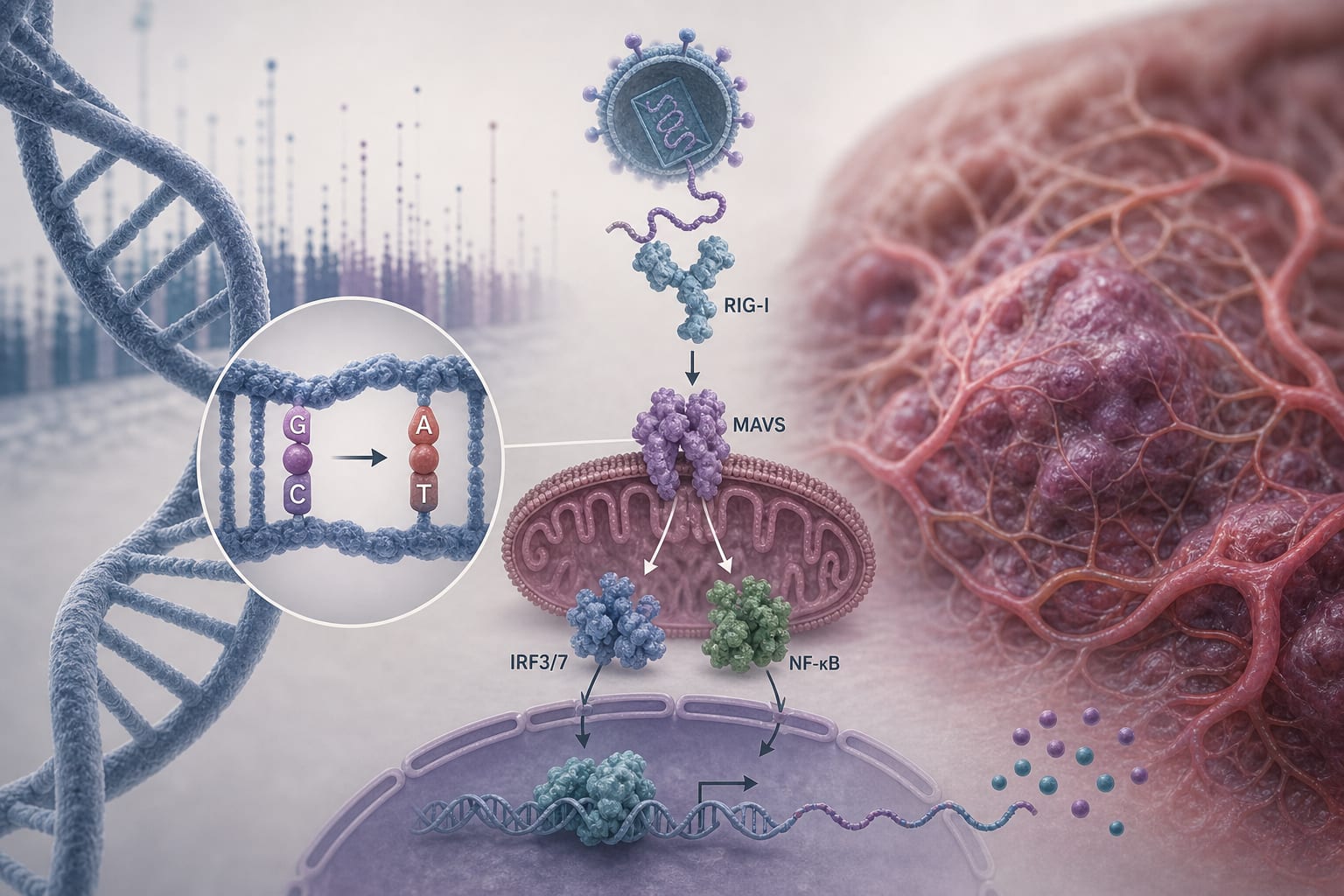
This study identifies genetic variations in the RIG-I/MAVS signaling pathway that are associated with HIV-related Kaposi sarcoma (KS) in both pediatric and adult populations. A missense variant in the MAVS gene was linked to increased KS risk.
Background
Kaposi sarcoma (KS) is the most common HIV-related cancer, particularly in regions where HIV and human herpesvirus-8 (HHV-8) are prevalent. While HHV-8 infection is necessary for KS development, not all individuals with HHV-8 will develop the disease, indicating that additional factors, such as genetic variations, may play a role in susceptibility.
Data Highlights
Population
Variant
Odds Ratio (OR)
95% Confidence Interval (CI)
p-value
Children
rs7269320 (MAVS)
3.8
2.2 - 6.7
9.7×10⁻⁷
Adults
rs7269320 (MAVS)
2.2
1.2 - 3.9
0.006
Key Findings
The study conducted a two-phase genome-wide association study (GWAS) on HIV-related KS.
A missense variant in the MAVS gene (rs7269320) was identified as a significant risk factor for KS in both children and adults.
The variant showed a suggestive allelic association with KS in children (OR 3.8) and a recessive inheritance pattern in adults (OR 2.2).
MAVS is part of the RIG-I/MAVS signaling pathway, which is implicated in the antiviral response to HHV-8.
These findings provide the first pediatric evidence of germline susceptibility to KS.
Further studies are needed to explore the mechanisms underlying the association with MAVS.
Clinical Implications
The identification of genetic variants associated with KS may help in understanding the risk for developing the disease.
Conclusion
This research highlights the importance of genetic factors in the risk of developing HIV-related Kaposi sarcoma.
by Casey L. McAtee, Erin Peckham-Gregory, Pagna Sok, Melissa Richard, Luis Olivares, Deborah Marquez-Do, Grace Kisitu, Jeffrey Martin, Nader Kim El-Mallawany, Carl E. Allen, Joseph Lubega, Michael E. Scheurer