Diabetes-duration-related shifts in inflammation-resolving lipid mediator signatures and their association with 3-month functional outcome in large artery atherosclerotic stroke - Report - MDSpire

Diabetes-duration-related shifts in inflammation-resolving lipid mediator signatures and their association with 3-month functional outcome in large artery atherosclerotic stroke

  • By

  • Wei-Meng Guo

  • Dong-Liang Tian

  • Zhong-Xu Gao

  • Hai-Chao Lv

  • Shuo Sun

  • July 1, 2026

  • 0 min

Share

Clinical Report: Impact of Diabetes Duration on Inflammatory Lipid Mediators

Overview

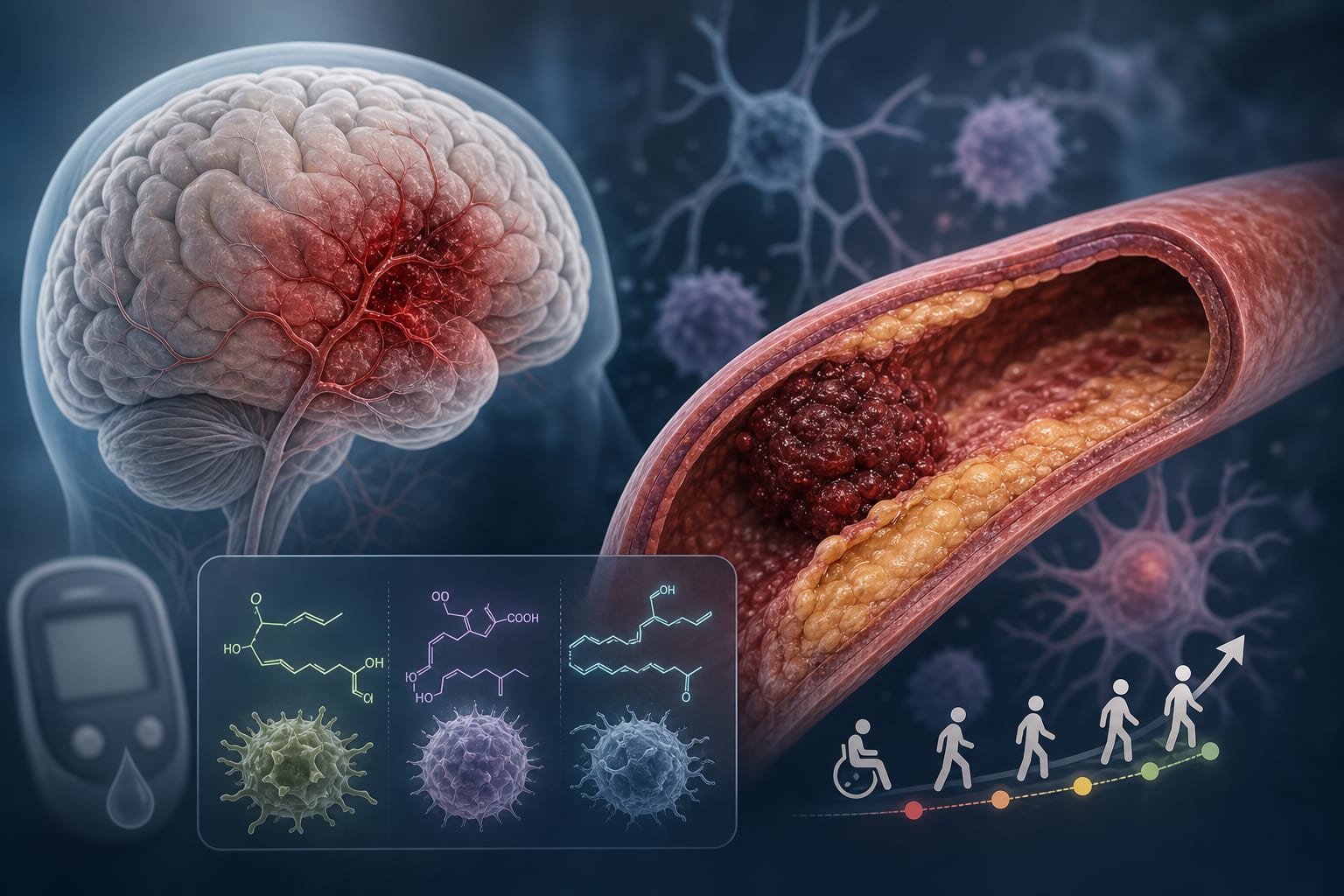
This study investigates the relationship between diabetes duration and inflammatory lipid mediator profiles in patients with large artery atherosclerotic stroke. It finds that longer diabetes duration correlates with specific lipid mediator levels.

Background

Ischemic stroke is a leading cause of mortality and disability, with large artery atherosclerosis being a significant subtype. Type 2 diabetes mellitus (T2DM) is a major risk factor for stroke, and its duration may impact inflammatory responses and clinical outcomes. Understanding the role of inflammatory lipid mediators in this context is crucial for improving stroke management.

Data Highlights

No significant differences in LXA4, LTB4, or RvD2 were observed between patients with and without T2DM. However, within the T2DM subgroup, those with diabetes duration of ≥5 years had higher LXA4 and LTB4 levels compared to those with <5 years.

Key Findings

  • Of 175 patients, 130 had a favorable outcome and 45 had a poor outcome at 3 months.
  • LXA4 levels were higher in the favorable-outcome group, though not statistically significant.
  • No significant differences in lipid mediators were found between T2DM and non-T2DM patients.
  • Diabetes duration positively correlated with LXA4 and LTB4 levels.
  • The RvD2/LTB4 ratio was lower in patients with diabetes duration of ≥5 years.
  • Exploratory analyses indicated LXA4's consistent retention in machine learning models.

Clinical Implications

The findings indicate that diabetes duration may be a relevant factor in understanding post-stroke inflammatory profiles.

Conclusion

The study highlights the relationship between diabetes duration and inflammatory lipid mediator profiles in LAA stroke.
Related Resources & Content

  1. Frontiers in Cardiovascular Medicine, 2026 -- Combined prognostic value of lipoprotein(a) and an integrated inflammatory-lipid index in patients with acute coronary syndrome and type 2 diabetes mellitus
  2. Clinical Research in Cardiology, 2025 -- The Role of Prediabetes in Acute Stroke: Frequency and Influence on Initial Clinical Outcomes
  3. The Journal of Clinical Endocrinology & Metabolism, 2025 -- Strategies for Managing Lipid Levels in Diabetic Patients
  4. Obesity Surgery — Impact of Type 2 Diabetes Mellitus on Subclinical Atherosclerosis in Individuals with Severe Obesity
  5. Standards of Care in Diabetes—2026 | Diabetes Care | American Diabetes Association
  6. ACC/AHA Issue Updated Guideline for Managing Lipids, Cholesterol - American College of Cardiology
  7. 2025 AHA/ACC Guideline for the Prevention, Detection, Evaluation, and Management of High Blood Pressure in Adults
  8. ARISE II Consensus on the Management of Intracranial Atherosclerotic Disease - PubMed
  9. Ticagrelor with aspirin dual antiplatelet therapy combined with intravenous thrombolysis in patients with ischaemic stroke in China (TAPIS): a multicentre, double-blind, randomised controlled trial - ScienceDirect
  10. Dual antiplatelet therapy with ticagrelor vs clopidogrel in patients with TIA or minor stroke with or without symptomatic carotid artery stenosis: a post hoc analysis of the CHANCE-2 trial
  11. Dual Antiplatelet Therapy More Beneficial in Patients With Large-Artery Atherosclerosis Than in Patients Without Large-Artery Atherosclerosis | AHA Blogs
  12. Frontiers | From anti-inflammation to pro-resolution: a new paradigm for specialized pro-resolving mediators in regulating neuroinflammation and repair after cerebral ischemia-reperfusion
  13. Frontiers | Diabetes-duration-related shifts in inflammation-resolving lipid mediator signatures and their association with 3-month functional outcome in large artery atherosclerotic stroke
  14. Association of lipoprotein(a) and composite inflammatory indices with functional outcomes in acute ischemic stroke: a prospective cohort study | Lipids in Health and Disease | Springer Nature Link

Original Source(s)

Related Content