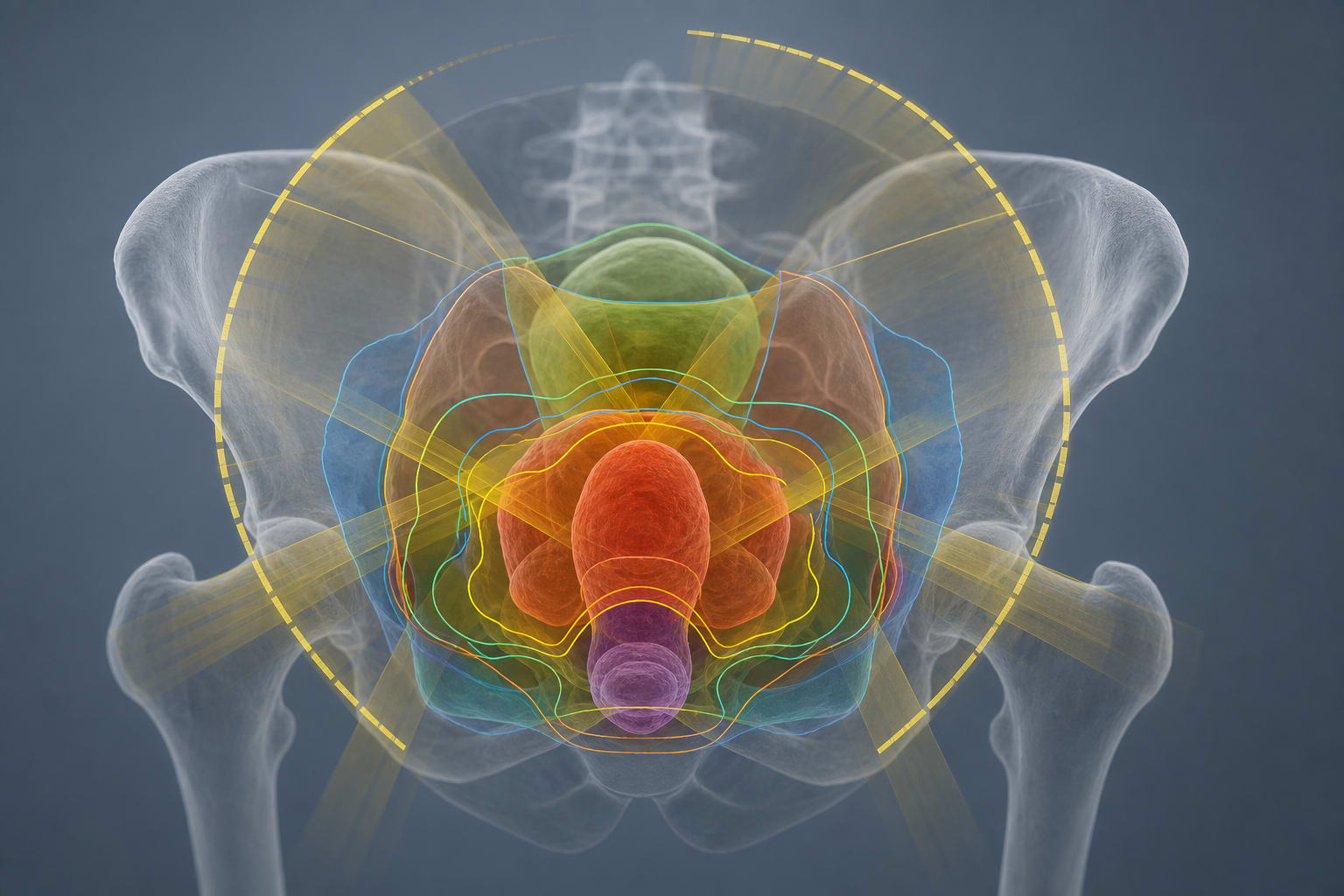
Anatomy-Based Automated Planning Approach for Whole-Pelvic Volumetric Modulated Arc Therapy Using Volume Control
-
By
-
Chih-Yuan Lin
-
An-Cheng Shiau
-
Ti-Hao Wang
-
Shih-Ming Hsu
-
May 7, 2026
Clinical Report: Anatomy-Based Automated Planning for Whole-Pelvic VMAT
Overview
The Volume-Controlled Autoplan (VCAP) demonstrates comparable PTV coverage and improved organ-at-risk (OAR) sparing in whole pelvic radiotherapy (WPRT) compared to traditional planning methods. VCAP significantly reduces planning time, enhancing efficiency while maintaining treatment quality.
Background
Whole pelvic radiotherapy (WPRT) is essential for managing pelvic malignancies but poses risks of toxicity to surrounding organs. Manual planning is labor-intensive and varies between planners, which can affect treatment consistency. Automated planning approaches like VCAP aim to improve efficiency and reduce variability while ensuring effective dose distribution.
Data Highlights
| Dosimetric Endpoint | VCAP | CP | AP | RP |
|---|---|---|---|---|
| PTV Coverage (V95) | ≥95% | ≥95% | ≥95% | ≥95% |
| Rectal Dose (V30) | −24.6% | Baseline | −12% | −13% |
| Bowel Bag Dose (V30) | −20.5% | Baseline | N/A | N/A |
| Mean Planning Time | 21 min | 120 min | N/A | N/A |
Key Findings
- VCAP achieved PTV coverage (V95) consistently above 95%.
- Rectal doses were reduced by an average of 24.6% compared to clinical planning (CP).
- Bowel bag exposure was decreased by more than 20.5% relative to CP.
- Planning time was significantly reduced from approximately 120 minutes with CP to 21 minutes with VCAP.
- VCAP maintained consistent plan quality across the patient cohort.
Clinical Implications
The VCAP approach enhances OAR sparing while ensuring robust PTV coverage, potentially leading to better patient outcomes. Its efficiency in planning time may allow for increased patient throughput in clinical settings.
Conclusion
VCAP represents a significant advancement in automated VMAT planning for WPRT, balancing efficiency and quality in treatment delivery. Further validation is needed to confirm its applicability in broader clinical contexts.
Related Resources & Content
- Intelligent Decision Support System for Radiation Therapy Planning in Head and Neck Cancer Using Multi-Organ Constellation Matching, Springer, 2025 -- Intelligent Decision Support System for Radiation Therapy Planning
- Optimization of Prostate Radiation Therapy Using AI and Ultrasound Guidance, Springer, 2022 -- Optimization of Prostate Radiation Therapy Using AI and Ultrasound Guidance
- Analysis of Tumor Control and Toxicity in Benign Intracranial Tumors Treated with HyperArc Radiosurgery Using a Frameless Linac System, Journal of Neuro-Oncology, 2025 -- Analysis of Tumor Control and Toxicity in Benign Intracranial Tumors
- Advancing Patient-Focused Intelligent Planning in Radiation Therapy, npj Digital Medicine, 2026 -- Advancing Patient-Focused Intelligent Planning in Radiation Therapy
- NCCN Clinical Practice Guidelines in Oncology (NCCN Guidelines®), NCCN, 2025 -- NCCN Clinical Practice Guidelines in Oncology
- The addition of androgen deprivation therapy and pelvic lymph node treatment to prostate bed salvage radiotherapy (NRG Oncology/RTOG 0534 SPPORT): an international, multicentre, randomised phase 3 trial - UROONCO Prostate Cancer, UROONCO, 2025 -- The addition of androgen deprivation therapy and pelvic lymph node treatment
- Knowledge-based planning for fully automated radiotherapy, Radiotherapy and Oncology, 2025 -- Knowledge-based planning for fully automated radiotherapy
- NCCN Clinical Practice Guidelines in Oncology (NCCN Guidelines®)
- The addition of androgen deprivation therapy and pelvic lymph node treatment to prostate bed salvage radiotherapy (NRG Oncology/RTOG 0534 SPPORT): an international, multicentre, randomised phase 3 trial - UROONCO Prostate Cancer
- Radiotherapy and Oncology 202 (2025) 110609
Based on findings from:
A volume-controlled, anatomy-driven autoplanning strategy for whole-pelvic volumetric modulated arc therapy
Chih-Yuan Lin, An-Cheng Shiau, Ti-Hao Wang, Shih-Ming Hsu. Frontiers In Oncology, 2026.
https://www.frontiersin.org/journals/oncology/articles/10.3389/fonc.2026.1836562/full
This content is an AI-generated, fully rewritten summary based on a published scholarly article. It does not reproduce the original text and is not a substitute for the original publication. Readers are encouraged to consult the source for full context, data, and methodology.