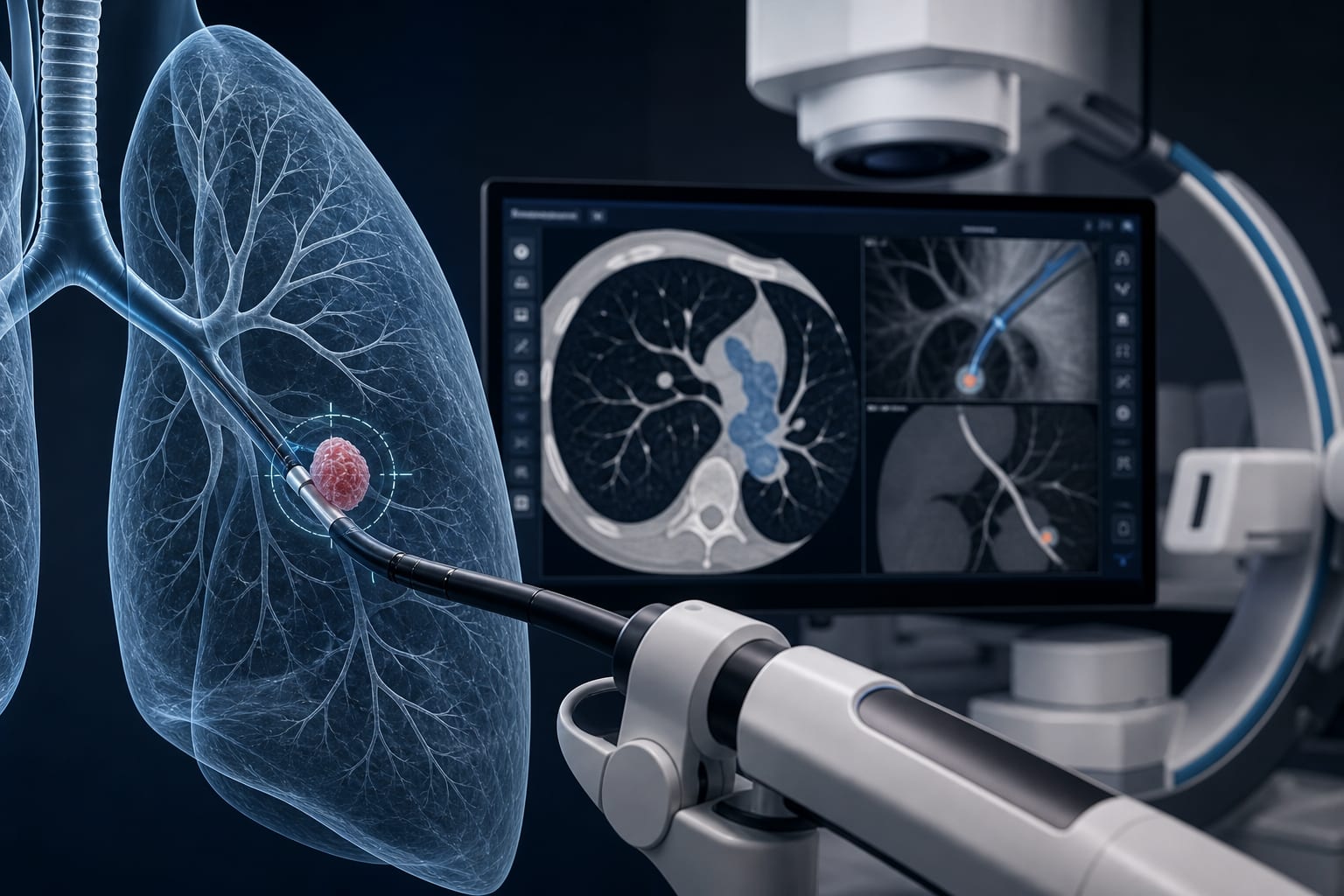
Robotic-assisted bronchoscopy combined with digital tomosynthesis for pulmonary nodules characterization: a single center experience - Report - MDSpire

Integration of Robotic Bronchoscopy and Digital Tomosynthesis for Characterizing Pulmonary Nodules: Insights from a Single-Center Study

  • By

  • Flavio Marco Mirabelli

  • Emma Repaci

  • Gian Piero Bandelli

  • Thomas Galasso

  • Martina Ferioli

  • Marco Ferrari

  • Filippo Natali

  • Tommaso Abbate

  • Teresa Calari

  • Stefania Damiani

  • Francesca Giunchi

  • Mattia Riefolo

  • Lorenzo Scrofani

  • Annalisa Altimari

  • Elisa Gruppioni

  • Daniela Di Luca

  • Federica Pasquali

  • Piero Candoli

  • July 21, 2026

Share

Integration of Robotic Bronchoscopy and Digital Tomosynthesis for Characterizing Pulmonary Nodules

Overview

This study evaluates the efficacy of robotic-assisted bronchoscopy combined with digital tomosynthesis for diagnosing peripheral pulmonary lesions.

Background

The diagnostic evaluation of peripheral pulmonary lesions (PPLs) is critical due to the rising incidence of lung cancer and the limitations of conventional methods such as bronchoscopy and transthoracic needle aspiration. Recent advancements in robotic-assisted bronchoscopy and imaging technologies aim to improve diagnostic accuracy and safety, addressing the challenges posed by small or difficult-to-reach lesions.

Data Highlights

ParameterValue
Number of patients82
Number of lesions sampled94
Median lesion size (mm)14 (IQR 11–18)
Diagnostic yield74.5%
Diagnostic yield for lesions ≥10 mm79.2%
Diagnostic yield for lesions <10 mm59.1%
Overall complication rate3.3%
Median procedure time (min)34.5

Key Findings

  • Diagnostic yield achieved was 74.5% across 94 sampled pulmonary lesions.
  • Lesions ≥10 mm had a higher diagnostic yield of 79.2% compared to 59.1% for smaller lesions.
  • Upper lobe location and lesion visibility on C-arm based computed tomography were significant predictors of diagnostic success.
  • The overall complication rate was low at 3.3%, with no major bleeding reported.
  • The median procedure time was 34.5 minutes, indicating efficiency in the day-hospital setting.

Clinical Implications

The integration of robotic-assisted bronchoscopy with digital tomosynthesis may enhance the diagnostic accuracy for peripheral pulmonary lesions, particularly in anatomically challenging areas. The low complication rate supports its safety profile, making it a viable option for clinicians in interventional pulmonology.

Conclusion

Robotic-assisted bronchoscopy combined with digital tomosynthesis demonstrates promising diagnostic efficacy and safety for peripheral lung lesions, warranting further prospective studies to validate these findings.

Related Resources & Content

  1. NCCN Guidelines® Insights, PubMed, 2025 -- Lung Cancer Screening, Version 1.2025
  2. Guidelines for Management of Incidental Pulmonary Nodules, Radiology, 2017 -- Fleischner Society Recommendations
  3. Assessment of Advanced Diagnostic Bronchoscopy Outcomes, PMC, 2024 -- ATS/ACCP Research Statement
  4. Navigational Bronchoscopy or Transthoracic Needle Biopsy, PubMed, 2023 -- Comparative Effectiveness Study
  5. European Radiology — Utilizing artificial intelligence to identify airway nodules in chest computed tomography images
  6. Surgical Endoscopy — Evaluating Safety and Influential Factors in Diagnostic Outcomes of Modified Virtual Bronchoscopy for Accessing Pulmonary Nodules
  7. European Radiology — Radiological and Histological Correlation Based on Morphology in Ultra-High-Resolution Energy-Integrating Detector CT of Cadaveric Human Lungs: Analysis of Nodules and Airways
  8. European Radiology — Lung nodule detection and potential impact on guideline-based management: a retrospective post-market evaluation of three commercial software systems
  9. Utilizing artificial intelligence to identify airway nodules in chest computed tomography images
  10. Evaluating Safety and Influential Factors in Diagnostic Outcomes of Modified Virtual Bronchoscopy
  11. NCCN Guidelines® Insights: Lung Cancer Screening, Version 1.2025 - PubMed
  12. Guidelines for Management of Incidental Pulmonary Nodules Detected on CT Images: From the Fleischner Society 2017 | Radiology
  13. Assessment of Advanced Diagnostic Bronchoscopy Outcomes for Peripheral Lung Lesions: A Delphi Consensus Definition of Diagnostic Yield and Recommendations for Patient-centered Study Designs. An Official American Thoracic Society/American College of Chest Physicians Research Statement - PMC
  14. American Association for Bronchology and Interventional Pulmonology (AABIP) Evidence-Based Guidelines on Bronchoscopic Diagnosis and Staging of Lung Cancer - PubMed
  15. Navigational Bronchoscopy or Transthoracic Needle Biopsy for Lung Nodules - PubMed
  16. Biopsy of Peripheral Lung Nodules — Inside Out or Outside In? | New England Journal of Medicine
  17. Cone Beam CT Imaging-Guided Bronchoscopy vs CT Imaging-Guided Transthoracic Needle Biopsy for Peripheral Pulmonary Lesion Diagnosis - CHEST
  18. Robotic versus Electromagnetic Bronchoscopy for Peripheral Pulmonary Lesions: A Randomized Trial (RELIANT) - PubMed
  19. Shape-sensing robotic-assisted bronchoscopy with integrated mobile cone-beam CT for small nodules: results from the prospective multicentre CONFIRM study - PubMed
  20. Two-year Diagnostic Accuracy of the Illumisite™ Platform for Electromagnetic Navigational Bronchoscopy | American Journal of Respiratory and Critical Care Medicine | Oxford Academic
  21. Performance Characteristics and Two-Year Outcomes of Digital Tomosynthesis-Assisted Electromagnetic Navigation Bronchoscopy in a Community Hospital - ScienceDirect
  22. Digital tomosynthesis for navigational bronchoscopy: a clinical practice review - Podder - Journal of Thoracic Disease
  23. Radiation exposure trends with augmented fluoroscopy and C-arm-based tomosynthesis for navigated bronchoscopy - PubMed
  24. The match 2 study: Robotic assisted bronchoscopy with integrated imaging with assessment of digital tomosynthesis (DT) and augmented fluoroscopy (AF): Three-Dimensional accuracy as confirmed by cone beam computed tomography (CBCT) - PubMed

Original Source(s)

Related Content