Concomitant transcatheter edge-to-edge treatment for mitral regurgitation and the K-Clip system for tricuspid regurgitation: one case report - Report - MDSpire

Concomitant transcatheter edge-to-edge treatment for mitral regurgitation and the K-Clip system for tricuspid regurgitation: one case report

  • By

  • Cai He

  • Hui Guo

  • Wenwen Chen

  • Wei Wang

  • June 8, 2026

  • 0 min

Share

Clinical Report: Simultaneous Transcatheter Valve Repair for Regurgitation

Overview

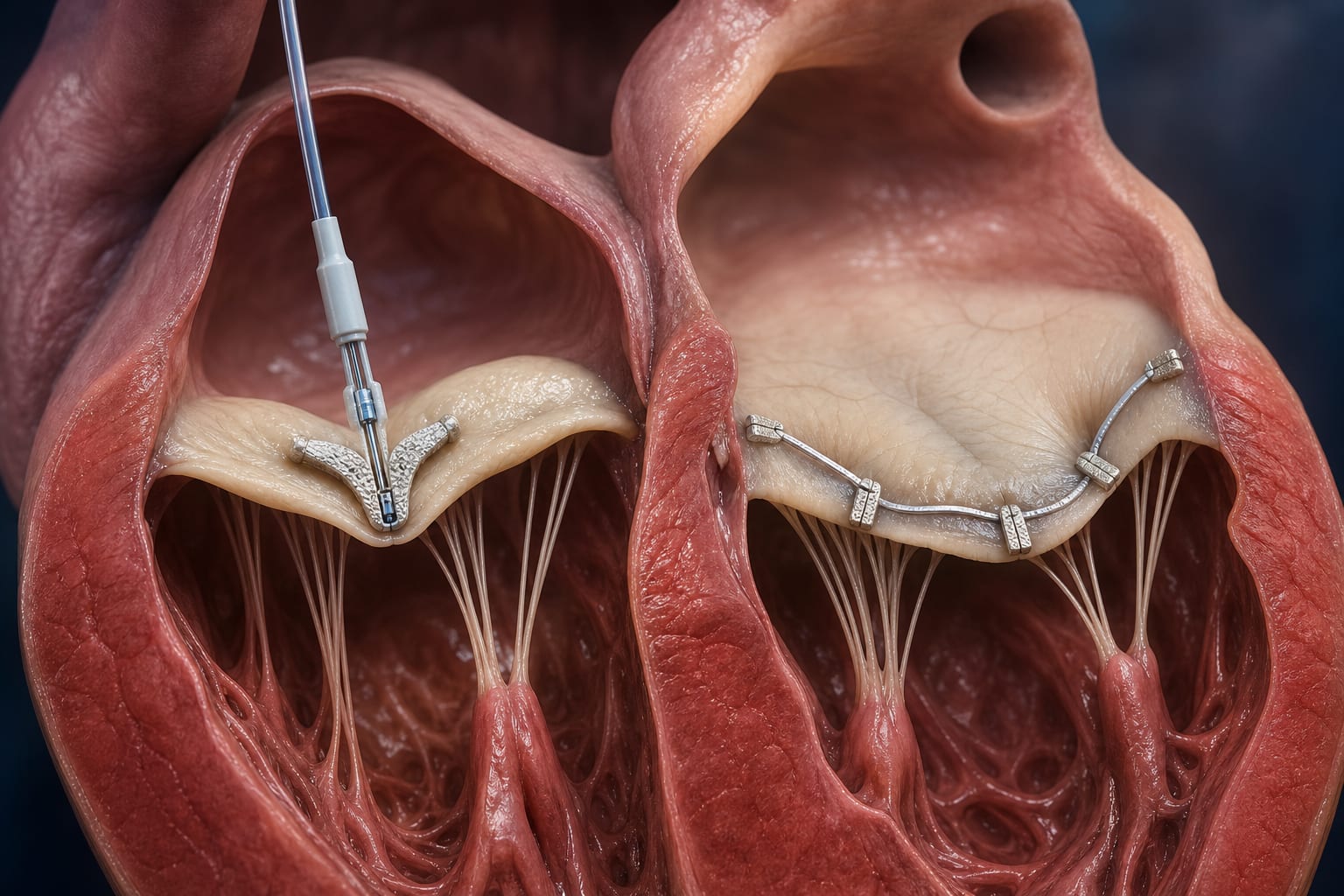
This case report details a 59-year-old female patient who underwent simultaneous transcatheter edge-to-edge repair (TEER) of the mitral valve and K-Clip™ tricuspid annuloplasty, resulting in significant reductions in mitral and tricuspid regurgitation. The postoperative outcomes were satisfactory, suggesting a viable treatment option for patients with severe valvular regurgitation at high surgical risk.

Background

Transcatheter valve repair is increasingly recognized as an alternative for patients with severe valvular regurgitation who are at high risk for surgical interventions. Mitral and tricuspid regurgitation are common conditions that can lead to significant morbidity and mortality. Recent guidelines emphasize the importance of a Heart Team approach and advocate for simultaneous interventions in patients with concurrent valve pathologies.

Data Highlights

No numerical data provided in the article.

Key Findings

  • The patient had severe mitral regurgitation (MR) and tricuspid regurgitation (TR) secondary to atrial dilated cardiomyopathy.
  • Simultaneous TEER and K-Clip™ annuloplasty were performed, significantly reducing MR from 4+ to mild (1+) and TR from severe (4+) to mild.
  • Postoperative follow-up at one month showed satisfactory outcomes and improved quality of life.
  • The Society of Thoracic Surgeons (STS) score indicated a high surgical risk of 7.45% for the patient.
  • Optimal medical therapy prior to intervention included diuretics and heart failure medications, which were insufficient to alleviate symptoms.

Clinical Implications

This case highlights the potential for simultaneous transcatheter interventions to address multiple valvular pathologies in high-risk patients. Clinicians should consider this approach for patients with severe MR and TR who are not candidates for traditional surgery, as it may improve outcomes and quality of life.

Conclusion

The successful application of simultaneous TEER and K-Clip™ annuloplasty in this case suggests a promising strategy for managing severe valvular regurgitation in high-risk patients. Further studies are warranted to validate these findings in larger cohorts.

Related Resources & Content

  1. Clinical Research in Cardiology, 2026 -- Outcomes of transcatheter edge-to-edge repair versus transcatheter valve replacement with the cardiovalve system for tricuspid regurgitation
  2. Clinical Research in Cardiology -- Impact of Previous Cardiac Surgery on Outcomes After Tricuspid Valve Transcatheter Edge-to-Edge Repair: Insights from EuroTR
  3. Clinical Research in Cardiology -- Evaluation of Transcatheter Leaflet Approximation versus Direct Annuloplasty for Managing Tricuspid Regurgitation
  4. Frontiers in Medicine -- Clinical outcomes of tricuspid transcatheter edge-to-edge repair in patients with tricuspid regurgitation
  5. New England Journal of Medicine -- Five-Year Follow-up after Transcatheter Repair of Secondary Mitral Regurgitation
  6. PMC -- Transcatheter annuloplasty with the K-Clip system for tricuspid regurgitation: one-year results from the TriStar study
  7. ESC/EACTS 2025 Guidelines on Valvular Heart Disease
  8. Five-Year Follow-up after Transcatheter Repair of Secondary Mitral Regurgitation | New England Journal of Medicine
  9. Transcatheter annuloplasty with the K-Clip system for tricuspid regurgitation: one-year results from the TriStar study - PMC

Original Source(s)

Related Content