Factors Influencing Disease-Free Survival in Cervical Cancer Patients at a Tertiary Care Facility in India
-
By
-
Bajarang Bahadur
-
Sunil Choudhary
-
Deshna Oswal
-
Tej Singh
-
Shraddha Chaurasiya
-
Mayank Singh
-
July 10, 2026
Factors Influencing Disease-Free Survival in Cervical Cancer Patients
Overview
This study evaluates disease-free survival (DFS) in cervical cancer patients at a tertiary care facility in India, identifying key prognostic factors. Significant associations were found between DFS and variables such as age, tumor size, and locoregional spread.
Background
Cervical cancer is a major public health issue in India, with high incidence and mortality rates, particularly due to late-stage diagnoses. Understanding the determinants of DFS is crucial for optimizing treatment and improving long-term outcomes in resource-limited settings. This study contributes to the limited data on survival outcomes in Indian populations, highlighting the need for targeted interventions.
Data Highlights
| Variable | DFS Impact |
|---|---|
| Age ≤50 years | AHR = 1.64; 95% CI: 1.16–2.34 |
| Tumor size ≥4 cm | AHR = 2.98; 95% CI: 1.44–6.15 |
| Vaginal involvement | AHR = 1.56; 95% CI: 1.06–2.29 |
| Lymph node involvement | p=0.012 |
| Addiction status | p=0.023 |
Key Findings
- The median follow-up duration was 23.4 months (IQR: 10.2–52.6).
- 51.8% of patients were aged ≤50 years, and 68.5% were from rural areas.
- Squamous cell carcinoma was the predominant histology, accounting for 91.8% of cases.
- DFS showed significant differences based on age, tumor size, vaginal involvement, lymph node involvement, and addiction status.
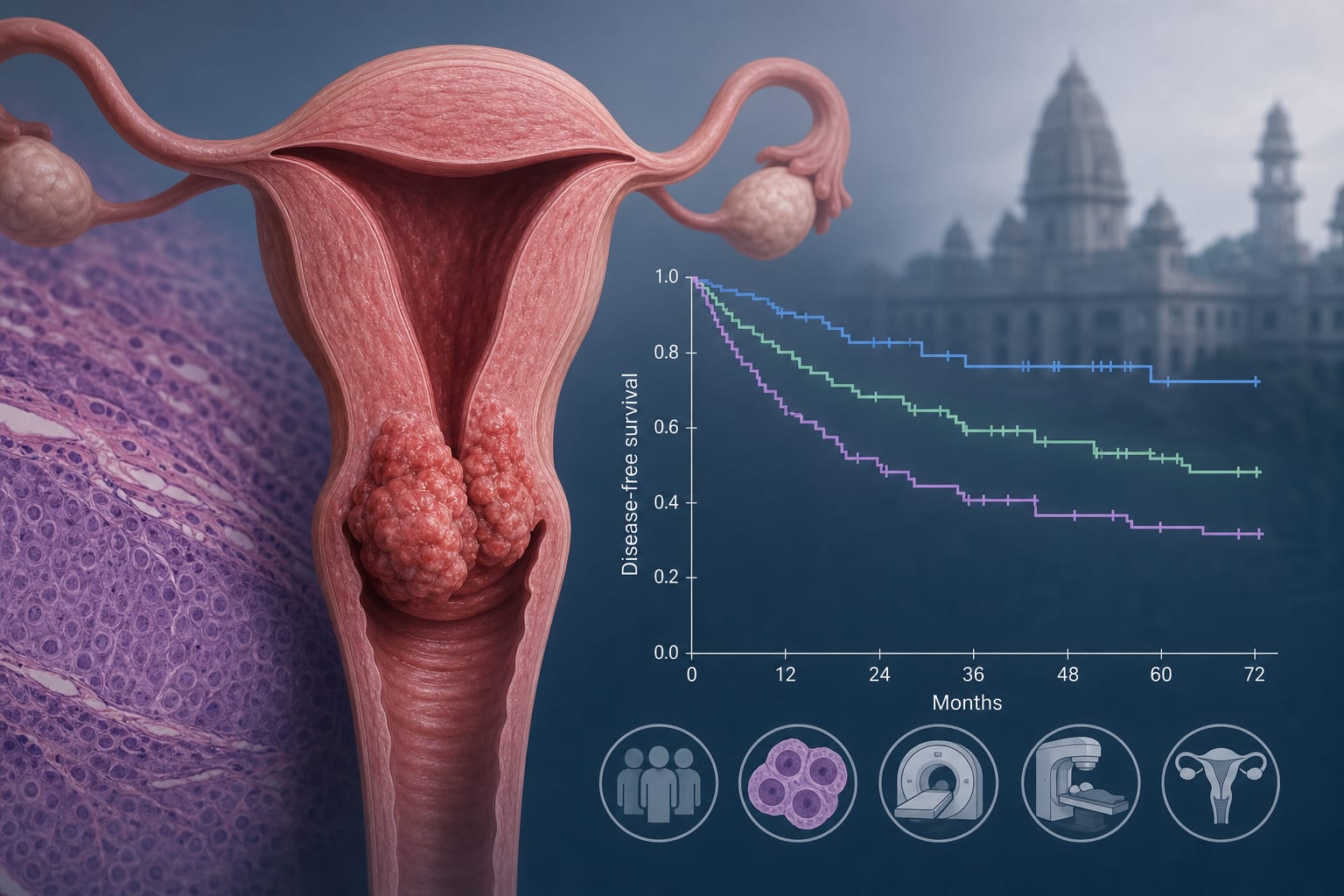
- There was a notable early decline in DFS, indicating higher recurrence risk in the initial years post-treatment.
Clinical Implications
The findings suggest that clinicians should closely monitor younger patients and those with larger tumors or vaginal involvement during the early follow-up period. Enhanced follow-up strategies and targeted interventions may be necessary to address the high recurrence rates observed.
Conclusion
The study highlights the critical role of tumor burden and locoregional spread in influencing DFS in cervical cancer patients. These insights are essential for improving patient management and outcomes in similar healthcare settings.
Related Resources & Content
- Cervical Cancer, Version 2.2026, NCCN Clinical Practice Guidelines In Oncology - PubMed
- ESGO/ESTRO/ESP Guidelines for the management of patients with cervical cancer – Update 2023* - PMC
- European Society of Gynaecological Oncology resource-stratified guidelines for the management of patients with cervical cancer - PubMed
- Pembrolizumab or placebo with chemoradiotherapy followed by pembrolizumab or placebo for newly diagnosed, high-risk, locally advanced cervical cancer (ENGOT-cx11/GOG-3047/KEYNOTE-A18): overall survival results from a randomised, double-blind, placebo-controlled, phase 3 trial
- The ASCO Post — Association of Survival With Treatment Recommendation and Receipt in Older Patients With Early-Stage Cervical Cancer
- the asco post — Association of Survival With Treatment Recommendation and Receipt in Older Patients With Early-Stage Cervical Cancer
- The ASCO Post — Improved Outcomes in Patients With Germ Cell Testicular Tumors in the Modern Era
- Journal of Gastrointestinal Surgery — Impact of Post-Surgical Morbidity Severity Score on Prognosis Following Potentially Curative D2 Gastrectomy for Cancer
- Association of Survival With Treatment Recommendation and Receipt in Older Patients With Early-Stage Cervical Cancer
- Cervical Cancer, Version 2.2026, NCCN Clinical Practice Guidelines In Oncology - PubMed
- ESGO/ESTRO/ESP Guidelines for the management of patients with cervical cancer – Update 2023* - PMC
- European Society of Gynaecological Oncology resource-stratified guidelines for the management of patients with cervical cancer - PubMed
- Pembrolizumab or placebo with chemoradiotherapy followed by pembrolizumab or placebo for newly diagnosed, high-risk, locally advanced cervical cancer (ENGOT-cx11/GOG-3047/KEYNOTE-A18): overall survival results from a randomised, double-blind, placebo-controlled, phase 3 trial
- Simple versus Radical Hysterectomy in Women with Low-Risk Cervical Cancer | New England Journal of Medicine
- Clinicopathological and radiological stratification within FIGO 2018 stages improves risk-prediction in cervical cancer - ScienceDirect
- Risk Factors for Local Failure Following Chemoradiation and Magnetic Resonance Image–Guided Brachytherapy in Locally Advanced Cervical Cancer: Results From the EMBRACE-I Study | Journal of Clinical Oncology
- Impact of the revised FIGO 2018 staging system on survival outcomes with respect to prognostic factors in cervical cancer patients treated in a tertiary care cancer center in South Karnataka - PubMed
Based on findings from:
Survival beyond treatment: patterns and determinants of disease-free survival in cervical cancer at a tertiary care center in India
Bajarang Bahadur, Sunil Choudhary, Deshna Oswal, Tej Singh, Shraddha Chaurasiya, Mayank Singh. Frontiers In Oncology, 2026.
https://www.frontiersin.org/journals/oncology/articles/10.3389/fonc.2026.1872738/full
This content is an AI-generated, fully rewritten summary based on a published scholarly article. It does not reproduce the original text and is not a substitute for the original publication. Readers are encouraged to consult the source for full context, data, and methodology.