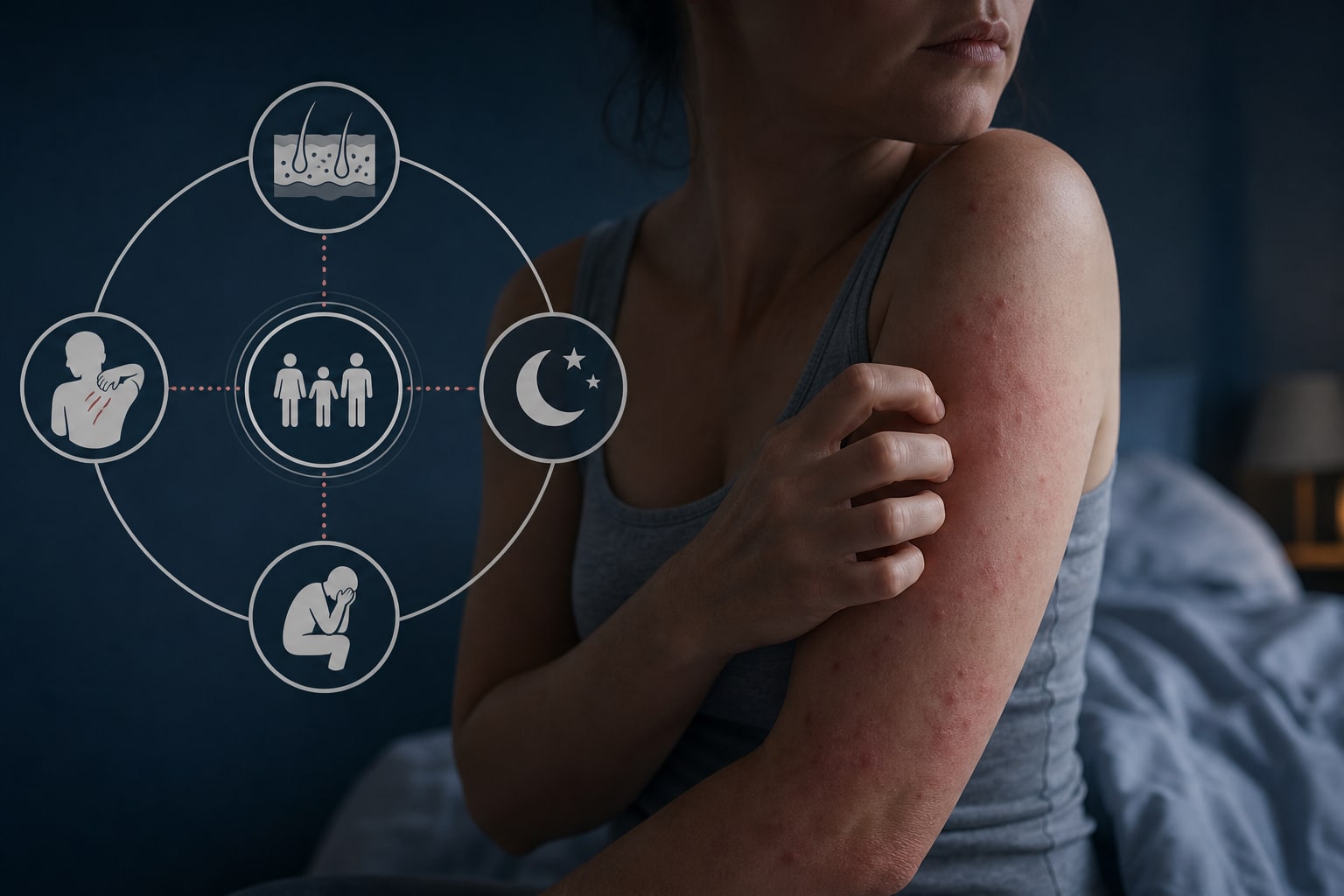
Link Between suPAR Inflammatory Marker and Chronic Pruritus of Unidentified Cause
Overview
The SOMA.PRU study reveals that patients with chronic pruritus of unknown origin (CPUO) exhibit significantly higher serum levels of the inflammatory marker suPAR compared to those with chronic atopic dermatitis. This suggests a potential role of systemic inflammation in the pathophysiology of CPUO.
Background
Chronic pruritus is a common and debilitating symptom affecting a significant portion of the population, often leading to decreased quality of life. Understanding the underlying mechanisms, particularly the role of systemic inflammation, is crucial for developing effective treatments. The soluble urokinase plasminogen activator receptor (suPAR) has emerged as a promising biomarker for chronic inflammation, yet its relationship with chronic pruritus remains underexplored.
Data Highlights
Group
suPAR Levels (ng/ml)
CPUO
3.2 ± 2.5
Controls
2.9 ± 1.1
cAD
2.0 ± 0.9
Key Findings
Patients with CPUO had the highest suPAR levels compared to controls and cAD.
suPAR levels in CPUO were significantly higher than in cAD (p = 0.018).
Higher baseline suPAR levels in CPUO correlated with increased pruritus intensity at follow-up.
Chronic systemic inflammation may play a significant role in the pathophysiology of CPUO.
suPAR could serve as a potential biomarker for monitoring the clinical course of CPUO.
Clinical Implications
The findings suggest that measuring suPAR levels may help in understanding the inflammatory status of patients with CPUO, potentially guiding treatment strategies. Clinicians should consider the role of systemic inflammation in managing chronic pruritus, particularly when the underlying cause is unclear.
Conclusion
This study highlights the association between systemic inflammation and chronic pruritus of unknown origin, suggesting that suPAR may be a valuable biomarker for this condition. Further research is warranted to explore its clinical utility.
by Stefan M. Kahnert, Lara Jürgens, Leonie Dreher, Christian Schmidt-Lauber, Ansgar Koechel, Gina L. Frank, Tobias B. Huber, Meike Shedden-Mora, Sonja Ständer, Markus Ramm, Gudrun Schneider, Rupert Conrad