Simultaneous Burr hole drainage and middle meningeal artery occlusion through a single incision for chronic subdural hematoma guided by 3D reconstruction - Report - MDSpire

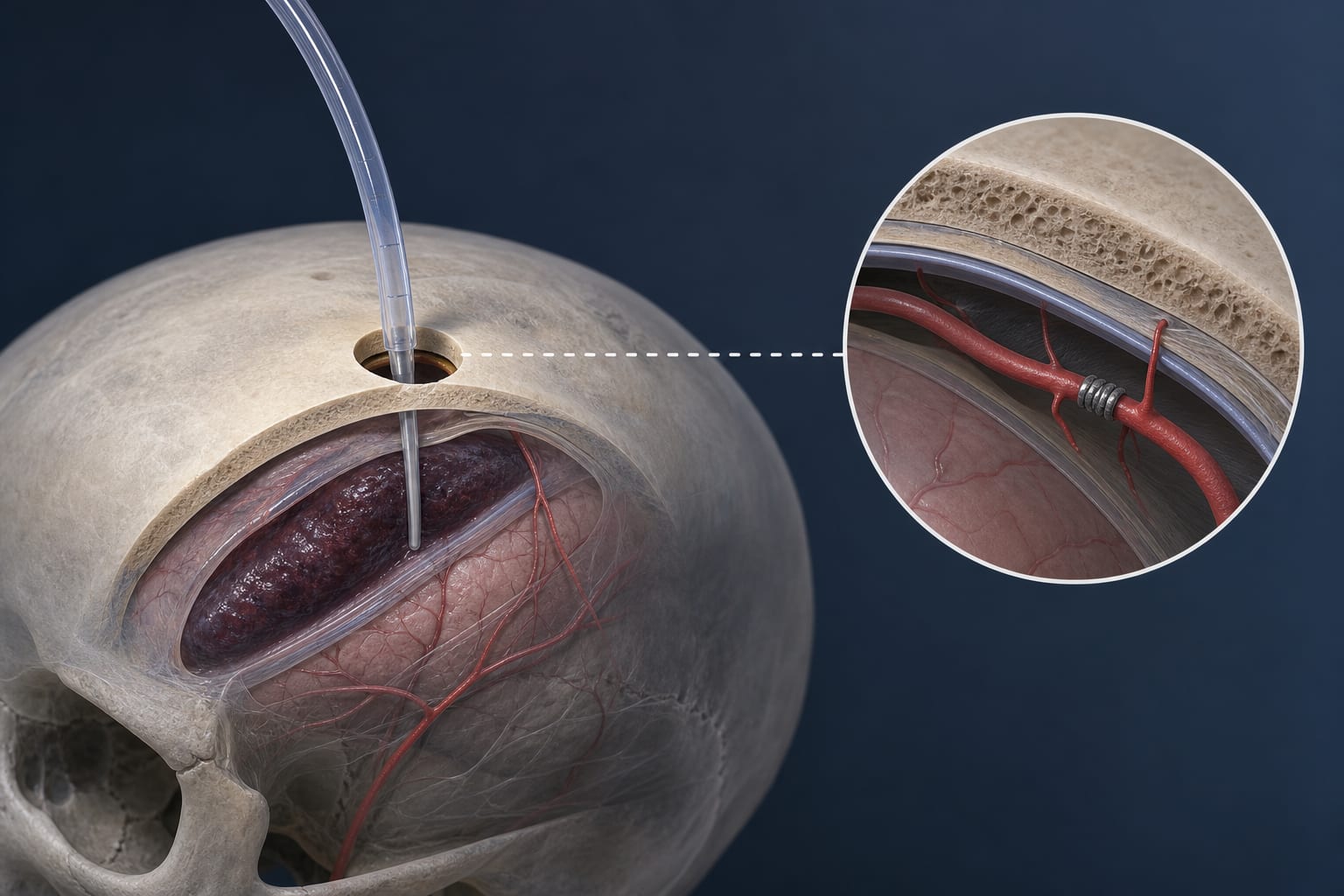
Simultaneous Burr hole drainage and middle meningeal artery occlusion through a single incision for chronic subdural hematoma guided by 3D reconstruction

  • By

  • Sen He

  • Taise Mosso Ramos

  • Fang Xue

  • Wenyan Zhang

  • Fei Xie

  • July 14, 2026

Share

Clinical Report: Combined Burr Hole Drainage and MMA Occlusion for CSDH

Overview

This study evaluates the outcomes of a novel surgical technique combining burr hole drainage (BHD) and middle meningeal artery (MMA) occlusion for chronic subdural hematoma (CSDH). The results indicate reduced hematoma recurrence and shorter hospitalization compared to traditional methods.

Background

Chronic subdural hematoma (CSDH) is increasingly prevalent, particularly among the elderly, and is associated with high recurrence rates post-surgery. Burr hole drainage (BHD) is a common treatment, yet recurrence remains a significant clinical challenge. This study explores an innovative approach that combines BHD with MMA occlusion to potentially improve patient outcomes.

Data Highlights

GroupHematoma Recurrence Rate at 6 MonthsDrainage DurationHospitalization Duration
Observation (BHD + MMA)4.9%ShorterShorter
Control (Traditional BHD)20.0%LongerLonger

Key Findings

  • The observation group had a significantly lower hematoma recurrence rate at 6 months (4.9% vs. 20.0%, p = 0.030).
  • Shorter drainage and hospitalization durations were observed in the observation group (p < 0.001).
  • Both groups had comparable demographic characteristics and intraoperative indicators.
  • No significant differences in perioperative complications or mRS scores at 6 months were noted between the groups.
  • The observation group had less hematoma residual volume at 1 month postoperatively (p < 0.001).

Clinical Implications

Further studies are warranted to validate these findings.

Conclusion

This surgical approach, which involved BHD and MMA through a single point under 3D reconstruction technique, led to better drainage of hematoma for CSDH patients compared to the conventional method.

Related Resources & Content

  1. Frontiers in Surgery, 2026 -- Modified surgical technique for recurrent organized chronic subdural hematoma: a preliminary retrospective case series
  2. Surgical Techniques for the Management of High-Flow Dural Arteriovenous Fistulas in the Foramen Magnum Area
  3. Frontiers in Neurology, 2026 -- Triple-modality management of complex septated chronic subdural hematoma: a preliminary technical note on feasibility and safety
  4. Comparative Analysis of Clinical Outcomes for Subdural and Subgaleal Drains Following Burr-Hole Drainage in Chronic Subdural Hematoma Cases
  5. Management of chronic subdural hematoma: a consensus statement from the 2024 Copenhagen joint iCORIC/DACSUHS symposium | Acta Neurochirurgica | Springer Nature Link
  6. Middle Meningeal Artery Embolization With n-Butyl Cyanoacrylate in Patients With Chronic Subdural Hematoma: A Randomized Clinical Trial | Trials | JAMA Neurology
  7. Frontiers | Simultaneous Burr Hole Drainage and Middle Meningeal Artery Occlusion through a Single Incision for Chronic Subdural Hematoma Guided by 3D Reconstruction
  8. Management of chronic subdural hematoma: a consensus statement from the 2024 Copenhagen joint iCORIC/DACSUHS symposium | Acta Neurochirurgica | Springer Nature Link
  9. Middle Meningeal Artery Embolization With n-Butyl Cyanoacrylate in Patients With Chronic Subdural Hematoma: A Randomized Clinical Trial | Trials | JAMA Neurology | JAMA Network
  10. Frontiers | Simultaneous Burr Hole Drainage and Middle Meningeal Artery Occlusion through a Single Incision for Chronic Subdural Hematoma Guided by 3D Reconstruction

Original Source(s)

Related Content