Habitat imaging based on DCE-MRI for differentiating luminal and non-luminal subtypes of breast cancer: a two-center study - Report - MDSpire
Coming Soon: Introducing MDSpire News. Learn more
Conexiant’s news site is now MDSpire News. Learn more

Utilizing DCE-MRI Habitat Imaging to Distinguish Between Luminal and Non-Luminal Breast Cancer Subtypes: Findings from a Dual-Center Investigation

  • By

  • Zhang Qing

  • Qin Xiao-Tao

  • Zhou Xia

  • Zhang Xiu-Lan

  • Peng Jie

  • Li Yun

  • Wang Wei-Bing

  • September 7, 2026

Share

Clinical Report: Utilizing DCE-MRI Habitat Imaging to Distinguish Breast Cancer Subtypes

Overview

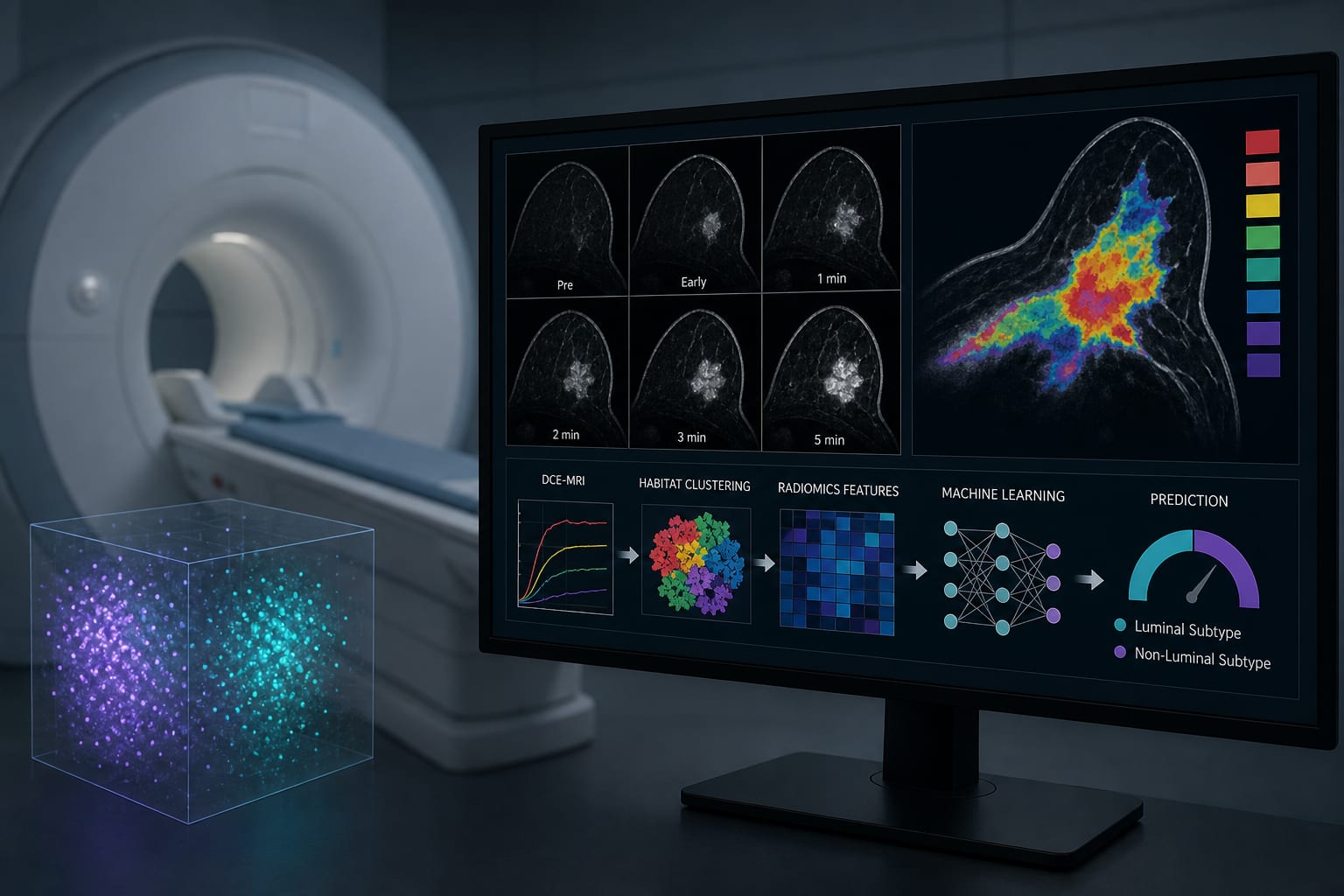
This study evaluates the effectiveness of DCE-MRI-based habitat imaging in differentiating luminal from non-luminal breast cancer subtypes.

Background

Breast cancer is the leading cause of cancer-related mortality among women, characterized by its biological heterogeneity. Accurate preoperative identification of breast cancer subtypes is crucial for personalized treatment strategies. Current methods primarily rely on immunohistochemistry.

Data Highlights

ModelArea Under Curve (AUC)
Stacking Model0.840
Habitat Model0.830
Conventional Radiomics Model0.805
Clinical ModelNot specified

Key Findings

  • The stacking model achieved the highest AUC of 0.840 for distinguishing breast cancer subtypes.
  • Both habitat and conventional radiomics models outperformed the clinical model (p < 0.05).
  • Calibration curves indicated good calibration for the stacking model.
  • Decision curve analysis demonstrated favorable net clinical benefit for the stacking model.
  • SHAP analysis highlighted the significant contribution of habitat-LGBM within the stacking model.

Clinical Implications

The findings suggest that DCE-MRI-based habitat imaging may enhance the accuracy of breast cancer subtype classification. This could potentially lead to improved individualized treatment planning and patient outcomes.

Conclusion

DCE-MRI habitat imaging presents a method for distinguishing between luminal and non-luminal breast cancer subtypes.

Related Resources & Content

  1. European Radiology, 2025 -- Radiomics Utilizing Deep Learning Fails to Enhance Prediction of Residual Cancer Burden Following Chemotherapy in the LIMA Breast MRI Study
  2. Frontiers in Oncology, 2026 -- A study on the prognostic assessment of triple-negative breast cancer using habitat analysis of preoperative DCE-MRI subtraction maps
  3. European Radiology, 2025 -- Enhancing Diagnostic Accuracy in Contrast-Enhanced Mammography via Lesion Visibility and Enhancement Measurement
  4. Breast Cancer, Version 4.2026, NCCN Clinical Practice Guidelines In Oncology
  5. European Radiology — Enhanced Utility of EUSOBI Diffusion Metrics in Breast MRI
  6. ACR Breast Imaging Reporting & Data System (BI-RADS®)
  7. Current CAP Guidelines - CAP
  8. Breast Cancer, Version 4.2026, NCCN Clinical Practice Guidelines In Oncology.
  9. St. Gallen/Vienna 2025 Summary of Key Messages on Therapy in Early Breast Cancer from the 2025 St. Gallen International Breast Cancer Conference
  10. MRI Exam-Specific Parameters: Breast (Revised 3-19-2025) : Accreditation Support
  11. The QIBA Profile for Diffusion-Weighted MRI: Apparent Diffusion Coefficient as a Quantitative Imaging Biomarker | Radiology
  12. Ultrafast breast MRI to differentiate between molecular subtypes of breast cancer: a systematic review and meta-analysis - ScienceDirect
  13. Intratumoral and peritumoral radiomics signature based on DCE-MRI can distinguish between luminal and non-luminal breast cancer molecular subtypes | Scientific Reports
  14. Frontiers | MRI-based habitat radiomics for preoperative prediction of axillary pathological complete response in breast cancer after neoadjuvant therapy: a multicenter study

Original Source(s)

Related Content