Chronic Pain as a Disorder of Brain Network Dynamics: A Systems Model Incorporating Physiological Regulation and Self-Organization
-
By
-
Tim Ho
-
Mark Ryan
-
June 22, 2026
Chronic Pain as a Disorder of Brain Network Dynamics
Overview
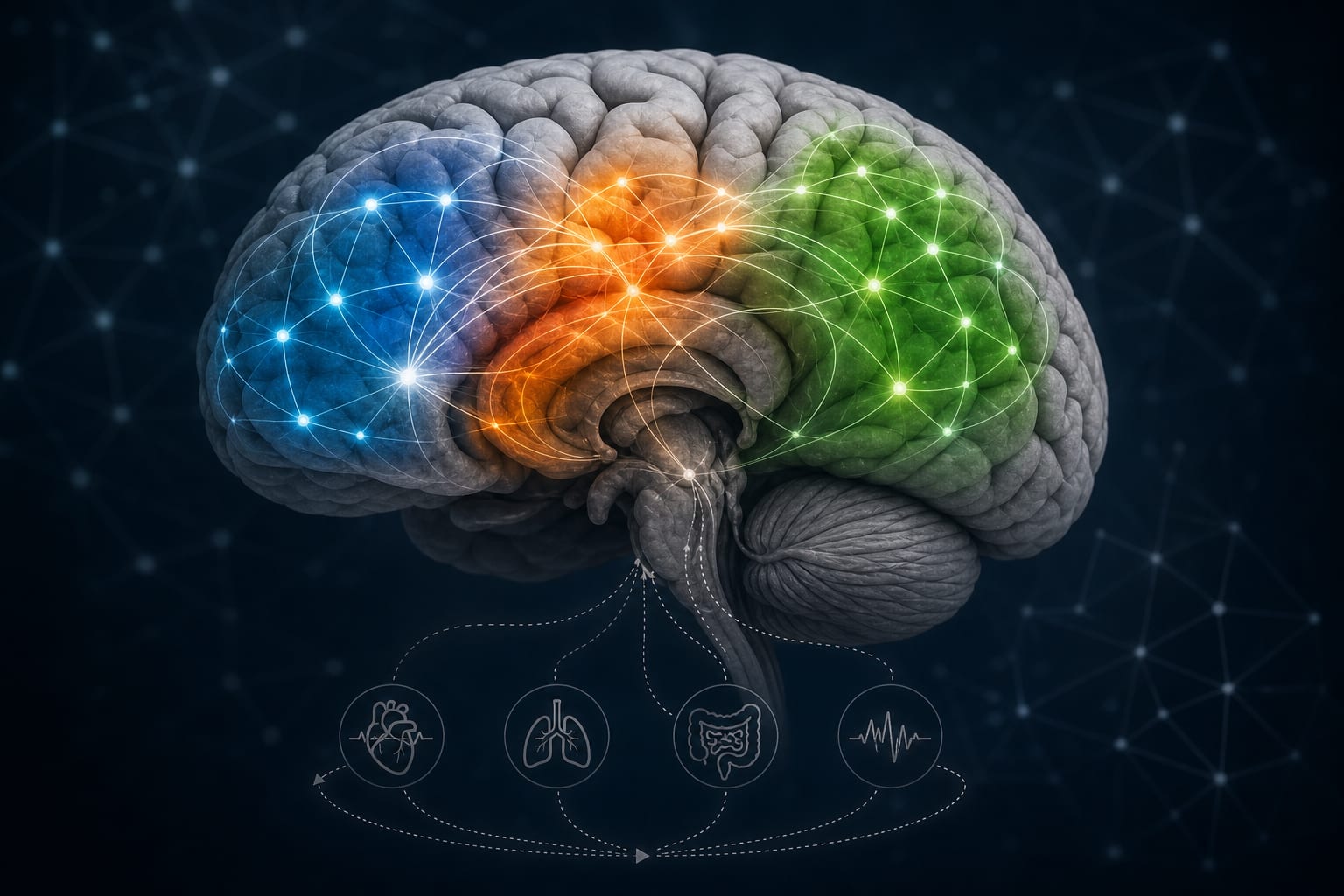
Chronic pain is conceptualized as a disorder of brain network organization, influenced by physiological regulation. The proposed model integrates the salience network, default mode network, and central executive network, highlighting their interactions in chronic pain states.
Background
Chronic pain is increasingly recognized as a complex condition involving alterations in brain network dynamics rather than merely a result of ongoing nociceptive input. Understanding these dynamics is crucial, as current models often overlook the role of physiological regulation in pain persistence and variability.
Data Highlights
No numerical data or trial data provided in the source material.
Key Findings
- Chronic pain is associated with alterations in the salience network (SN), default mode network (DMN), and central executive network (CEN).
- Increased SN activity and altered DMN connectivity are observed in individuals with chronic pain.
- Physiological regulation, including sleep architecture and autonomic balance, influences brain network dynamics.
- The proposed model suggests that chronic pain emerges from the interaction of physiological regulation and brain network dynamics.
- Neuromodulatory interventions like repetitive transcranial magnetic stimulation (rTMS) may enhance network flexibility.
Clinical Implications
This model emphasizes the importance of considering physiological regulation in the assessment and treatment of chronic pain.
Conclusion
The proposed state-constrained triple-network model offers a framework for understanding chronic pain, linking brain network dynamics with physiological regulation.
Related Resources & Content
- Author(s)/Org, Source, Year -- Title
- Author(s)/Org, Source, Year -- Title
- Author(s)/Org, Source, Year -- Title
- Author(s)/Org, Source, Year -- Title
- Cal. Code Regs. Tit. 8, § 9792.24.2 - Chronic Pain Guidelines | State Regulations | US Law | LII / Legal Information Institute
- NIH HEAL Initiative®: A Promising Path Forward for Pain Research | National Institute of Neurological Disorders and Stroke
- Common neural correlates of chronic pain – A systematic review and meta-analysis of resting-state fMRI studies - ScienceDirect
- Brain network properties in chronic pain—a systematic review and meta-analysis of graph-based connectivity metrics
- Multimodal abnormalities of brain function in chronic low back pain: a systematic review and meta-analysis of neuroimaging studies
- Efficacy and safety of non-invasive brain stimulation for chronic low back pain: a systematic review and meta-analysis of randomised controlled trials | Journal of NeuroEngineering and Rehabilitation | Springer Nature Link
- Repetitive Transcranial Magnetic Stimulation and Motor Control Exercise for Chronic Low Back Pain: The ExTraStim Randomized Placebo-Controlled Trial - PubMed
- A Randomized, Controlled Neuroimaging Trial of Cognitive-Behavioral Therapy for Fibromyalgia Pain - PMC
- Personalizing neuromodulation for chronic pain: A connectivity-guided randomized trial | medRxiv
- Cal. Code Regs. Tit. 8, § 9792.24.2 - Chronic Pain Guidelines | State Regulations | US Law | LII / Legal Information Institute
- NIH HEAL Initiative®: A Promising Path Forward for Pain Research | National Institute of Neurological Disorders and Stroke
- Common neural correlates of chronic pain – A systematic review and meta-analysis of resting-state fMRI studies - ScienceDirect
- Brain network properties in chronic pain—a systematic review and meta-analysis of graph-based connectivity metrics
- Frontiers | Multimodal abnormalities of brain function in chronic low back pain: a systematic review and meta-analysis of neuroimaging studies
- Efficacy and safety of non-invasive brain stimulation for chronic low back pain: a systematic review and meta-analysis of randomised controlled trials | Journal of NeuroEngineering and Rehabilitation | Springer Nature Link
- Repetitive Transcranial Magnetic Stimulation and Motor Control Exercise for Chronic Low Back Pain: The ExTraStim Randomized Placebo-Controlled Trial - PubMed
- A Randomized, Controlled Neuroimaging Trial of Cognitive-Behavioral Therapy for Fibromyalgia Pain - PMC
- Personalizing neuromodulation for chronic pain: A connectivity-guided randomized trial | medRxiv
Based on findings from:
Chronic pain as a state-constrained brain network disorder: a dynamical systems model integrating physiological regulation and self-organisation
Tim Ho, Mark Ryan. Frontiers In Pain Research, 2026.
https://www.frontiersin.org/journals/pain-research/articles/10.3389/fpain.2026.1825571/full
This content is an AI-generated, fully rewritten summary based on a published scholarly article. It does not reproduce the original text and is not a substitute for the original publication. Readers are encouraged to consult the source for full context, data, and methodology.