Development and preliminary validation of a WeChat-based auditory-speech rehabilitation system for Mandarin-speaking cochlear implant users - Report - MDSpire

Development and preliminary validation of a WeChat-based auditory-speech rehabilitation system for Mandarin-speaking cochlear implant users

  • By

  • Xuyuan Peng

  • Ran Cao

  • Pengjun Wang

  • Zheng Han

  • Yini Li

  • Jingjing Wang

  • Shujian Huang

  • Wen Lu

  • Yuli Hu

  • Jing Wang

  • Zhengnong Chen

  • Wendi Shi

  • Lihui Tao

  • Jun Zhan

  • Kun Ni

  • Dongzhen Yu

  • Haibo Shi

  • June 24, 2026

  • 0 min

Share

Creation and initial assessment of a WeChat-based auditory rehabilitation platform

Overview

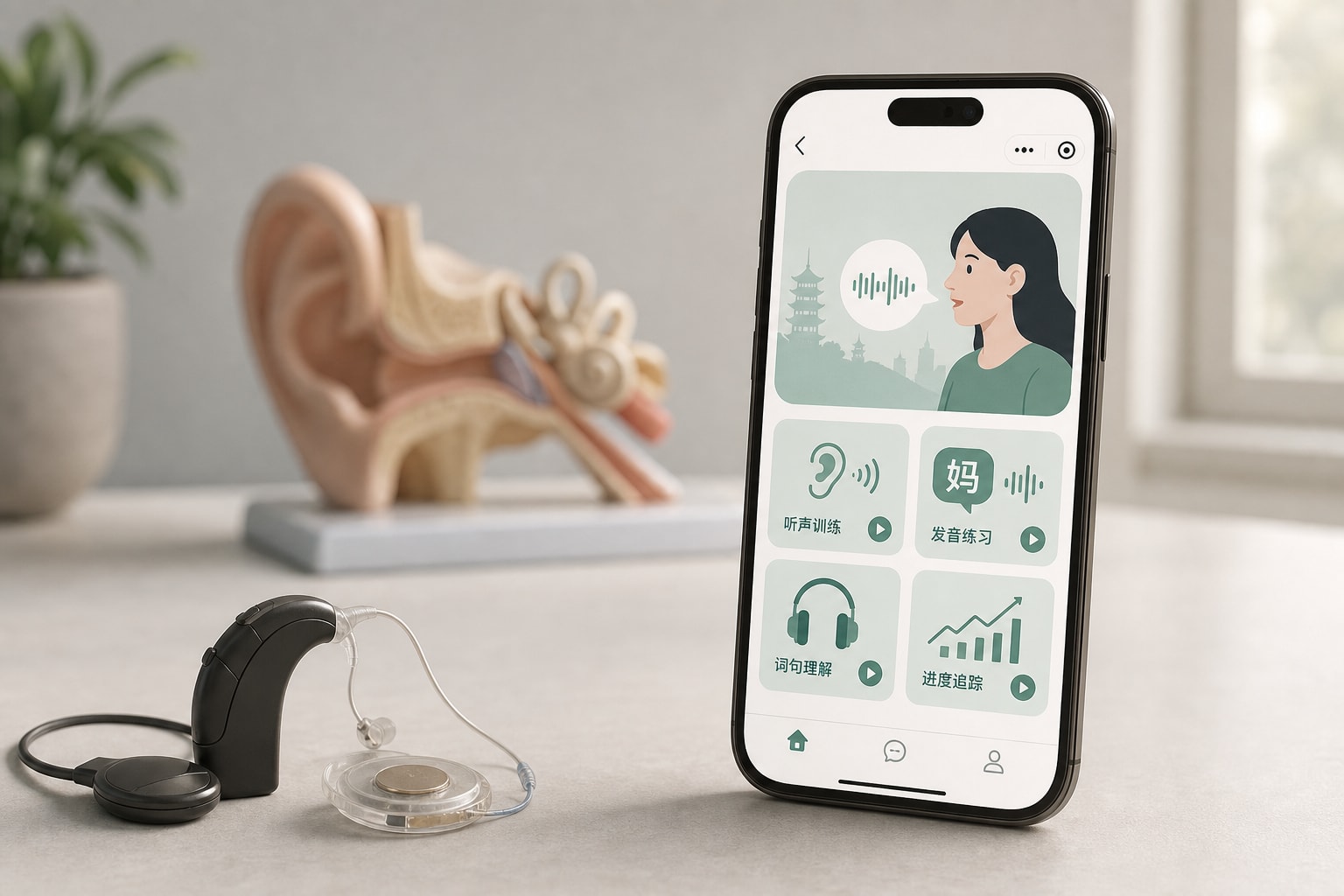
This study presents the development and preliminary validation of the 'Miao Yan Hui' Mini Program, an auditory-speech rehabilitation system for Mandarin-speaking cochlear implant users.

Background

Hearing loss significantly impacts communication and social participation, with millions affected globally. Cochlear implants are a primary intervention for severe hearing loss, yet the effectiveness of these devices is contingent on quality postoperative rehabilitation. Digital platforms like WeChat offer innovative solutions to enhance the accessibility of auditory-speech rehabilitation services.

Data Highlights

This study involved 20 Mandarin-speaking cochlear implant users recruited for preliminary validation of the WeChat-based rehabilitation platform.

Key Findings

  • The 'Miao Yan Hui' Mini Program was developed to provide individualized auditory-speech rehabilitation for adult Mandarin-speaking CI users.
  • The platform integrates rehabilitation and assessment, addressing the unique phonological needs of Mandarin speakers.
  • Participants underwent a baseline auditory-speech assessment to tailor rehabilitation efforts.
  • The interdisciplinary team included software engineers, speech therapists, and otolaryngologists to ensure comprehensive system design.
  • Digital remote rehabilitation is shown to be a feasible approach for CI users.

Clinical Implications

The development of the 'Miao Yan Hui' Mini Program highlights the potential for digital platforms to improve rehabilitation outcomes for cochlear implant users.

Conclusion

The preliminary validation of the WeChat-based auditory rehabilitation platform indicates its potential to meet the rehabilitation needs of Mandarin-speaking cochlear implant users.
Related Resources & Content

  1. Frontiers in Digital Health, 2026 -- The role of perceived competence in remote cochlear implant aftercare: a mixed-methods study
  2. conexiant, 2023 -- New Tool Clarifies CI Eligibility
  3. Int. Journal of Computer Assisted Radiology and Surgery, 2026 -- Simulation of apically grounded cochlear implant stimuli using neural stimulation models
  4. Frontiers in Digital Health, 2026 -- Portable automated rapid testing for auditory assessment: repeated at-home testing in older adults
  5. A Consensus to Revise the Minimum Speech Test Battery–Version 3 | American Journal of Audiology, 2024
  6. Cochlear Implants - StatPearls - NCBI Bookshelf
  7. Mobile game-based auditory training as an adjunct to aural rehabilitation in preschool children with cochlear implants: a randomised feasibility trial - PubMed, 2026
  8. Computer-based Auditory Training by New Adult Cochlear Implant Recipients Is Associated with Durable Improvements in Cochlear Implant Quality of Life - PMC
  9. JMIR mHealth and uHealth - Hearing Rehabilitation With a Chat-Based Mobile Auditory Training Program in Experienced Hearing Aid Users: Prospective Randomized Controlled Study
  10. Assessment of cochlear implant performance with Mandarin Hearing In Noise Test - PubMed
  11. Effects of harmonicity on Mandarin speech perception in cochlear implant users - ScienceDirect
  12. A Consensus to Revise the Minimum Speech Test Battery–Version 3 | American Journal of Audiology
  13. https://ciicanet.org/wp-content/uploads/2023/07/Living-Guidelines-for-Adult-Cochlear-Implantation-FINAL.pdf
  14. Cochlear Implants - StatPearls - NCBI Bookshelf
  15. Mobile game-based auditory training as an adjunct to aural rehabilitation in preschool children with cochlear implants: a randomised feasibility trial - PubMed
  16. Computer-based Auditory Training by New Adult Cochlear Implant Recipients Is Associated with Durable Improvements in Cochlear Implant Quality of Life - PMC
  17. JMIR mHealth and uHealth - Hearing Rehabilitation With a Chat-Based Mobile Auditory Training Program in Experienced Hearing Aid Users: Prospective Randomized Controlled Study
  18. [Assessment of cochlear implant performance with Mandarin Hearing In Noise Test] - PubMed
  19. Effects of harmonicity on Mandarin speech perception in cochlear implant users - ScienceDirect

Original Source(s)

Related Content