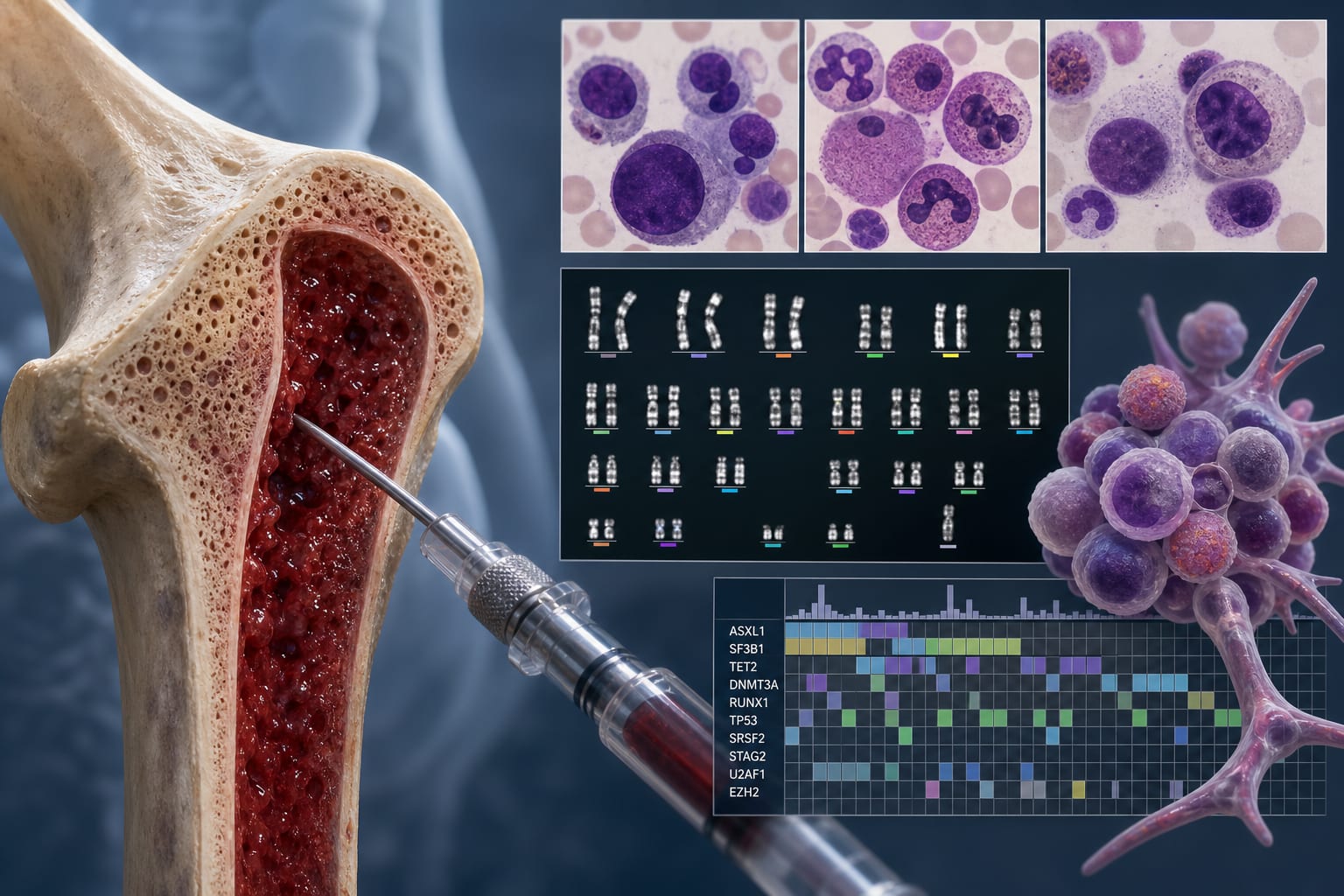
Myelodysplastic Syndromes: Insights on Diagnosis, Risk Assessment, and Treatment Approaches for 2026
-
By
-
Guillermo Garcia-Manero
-
July 3, 2026
Clinical Report: Myelodysplastic Syndromes: Insights on Diagnosis, Risk Assessment, and Treatment Approaches for 2026
Overview
Myelodysplastic syndromes (MDS) are a group of clonal myeloid malignancies characterized by ineffective hematopoiesis. Diagnosis relies on cytopenia and bone marrow analysis, with risk stratification using established scoring systems such as IPSS and IPSS-R.
Background
MDS represents a significant clinical challenge due to its heterogeneous nature. The prevalence of MDS increases with age, particularly in individuals over 60.
Data Highlights
Recent studies indicate that the incidence of MDS is approximately 4.5 cases per 100,000 person-years, with a notable increase in older populations. The median age at diagnosis is around 70 years, and the disease is associated with various genetic mutations, including those in the TP53 and ASXL1 genes.
Key Findings
MDS affects 3 to 4 individuals per 105 in the US population, with higher prevalence in older adults.
Diagnosis is confirmed through bone marrow aspiration and biopsy, focusing on dysplasia and blast percentage.
Risk assessment utilizes the IPSS and IPSS-R scoring systems, which categorize patients into lower and higher risk groups.
New cytogenetic techniques, such as optical genome mapping, enhance diagnostic accuracy.
Clinical Implications
Clinicians should utilize established scoring systems for accurate risk stratification in MDS patients. Awareness of the relationship between comorbidities and MDS is essential for comprehensive patient management.
Conclusion
MDS remains a complex condition requiring a multifaceted approach to diagnosis and treatment.
Related Resources & Content
Blood Cancer Journal, 2022 -- Approaches to the Care of Patients with Lower-Risk Myelodysplastic Syndromes
Blood Cancer Journal, 2023 -- Assessment of the International Prognostic Scoring System for Myelodysplastic Syndromes Based on Consensus Classification Criteria
Blood Cancer Journal, 2016 -- Survival trends in primary myelodysplastic syndromes: a comparative analysis of 1000 patients by year of diagnosis and treatment
The 5th edition of the World Health Organization Classification of Haematolymphoid Tumours: Myeloid and Histiocytic/Dendritic Neoplasms | Leukemia
FDA approves imetelstat for low- to intermediate-1 risk myelodysplastic syndromes with transfusion-dependent anemia
The ASCO Post — Forward Progress in Myelodysplastic Syndromes Is Largely in Genetics
The 5th edition of the World Health Organization Classification of Haematolymphoid Tumours: Myeloid and Histiocytic/Dendritic Neoplasms | Leukemia
FDA approves imetelstat for low- to intermediate-1 risk myelodysplastic syndromes with transfusion-dependent anemia | FDA
Luspatercept versus epoetin alfa in erythropoiesis-stimulating agent-naive, transfusion-dependent, lower-risk myelodysplastic syndromes (COMMANDS): primary analysis of a phase 3, open-label, randomised, controlled trial - ScienceDirect
NCCN Guidelines® Insights: Myelodysplastic Syndromes, Version 2.2025 - PubMed
Magrolimab Plus Azacitidine Versus Placebo Plus Azacitidine in Patients With Untreated Higher-Risk Myelodysplastic Syndromes: The Phase III ENHANCE Study | Journal of Clinical Oncology
The EBMT Handbook - NCBI Bookshelf
Based on findings from:
Myelodysplastic Syndromes: 2026 Update on Diagnosis, Risk-Stratification and Management
Guillermo Garcia-Manero. American Journal Of Hematology, 2026.
https://onlinelibrary.wiley.com/doi/10.1002/ajh.70405
This content is an AI-generated, fully rewritten summary based on a published scholarly article. It does not reproduce the original text and is not a substitute for the original publication. Readers are encouraged to consult the source for full context, data, and methodology.