Utilizing Vacuum Sealing Drainage in Conjunction with Surgical Debridement for Pediatric Acute Hematogenous Osteomyelitis: A Retrospective Cohort Analysis
-
By
-
Zishuangyi Liu
-
Zhenjiang Liu
-
July 1, 2026
Clinical Report: Utilizing Vacuum Sealing Drainage in Pediatric AHO
Overview
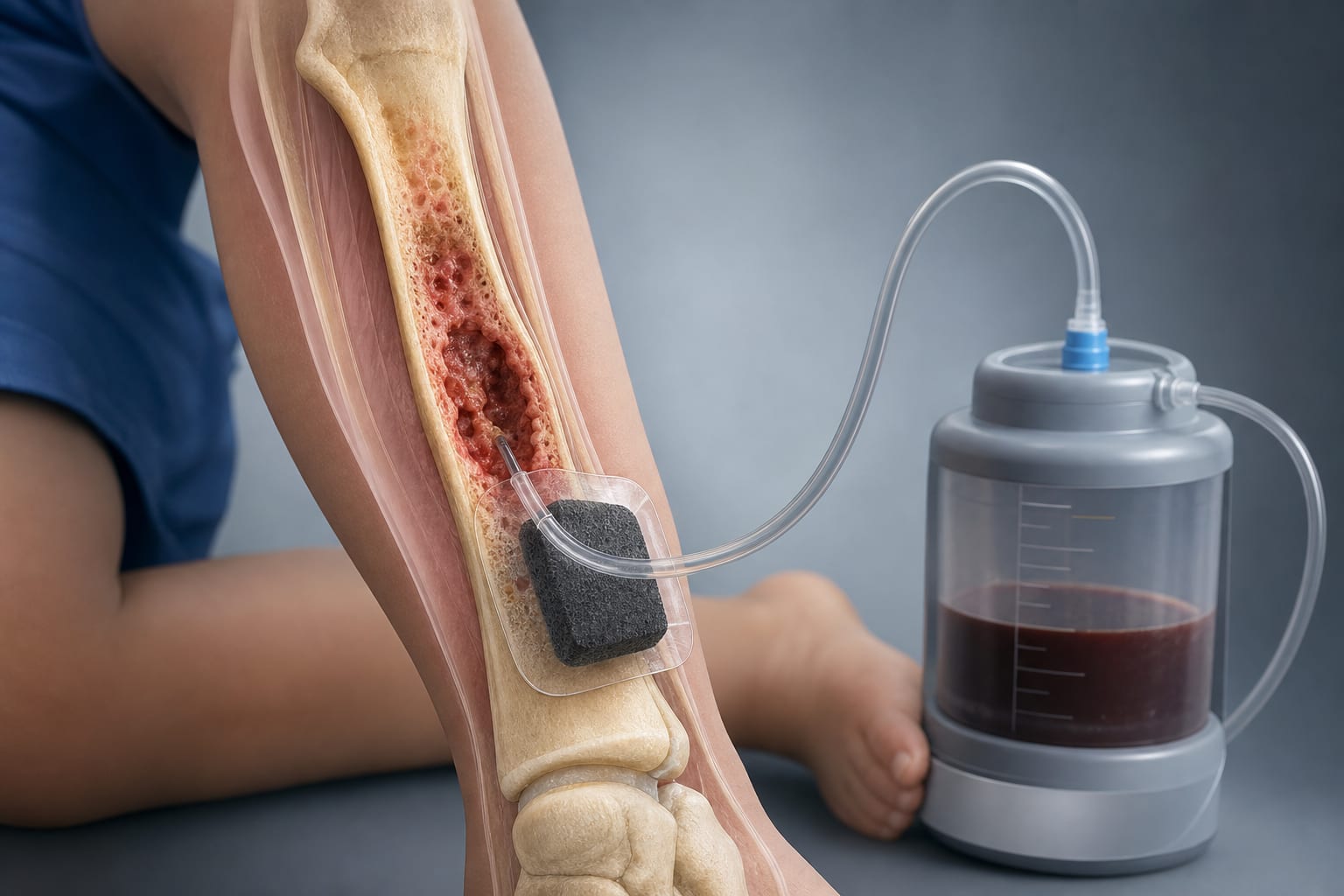
This study evaluates the use of vacuum sealing drainage (VSD) in children with acute hematogenous osteomyelitis (AHO). Results indicate that VSD is associated with longer hospital stays and more surgical procedures compared to conventional treatment, without measurable improvements in infection control or recurrence rates.
Background
Acute hematogenous osteomyelitis (AHO) is a significant bacterial infection in children, with potential for chronic complications if not treated effectively. Current management strategies include timely surgical debridement and appropriate antibiotic therapy. The role of vacuum sealing drainage (VSD) in pediatric AHO remains unclear, with limited evidence supporting its efficacy compared to conventional treatment.
Data Highlights
| Outcome | VSD Group | Control Group | P-value |
|---|---|---|---|
| Length of Hospital Stay (days) | 33.2 ± 19.3 | 21.0 ± 9.5 | 0.003 |
| Number of Surgical Procedures | 3.6 ± 1.5 | 1.0 ± 0 | < 0.001 |
| IV Antibiotic Duration (days) | Not reported | Not reported | 0.51 |
| Superinfection Rate | Not reported | Not reported | 0.45 |
| 3-Month Recurrence | 0% | 0% | N/A |
Key Findings
- VSD was associated with a longer hospital stay (mean difference: 10.1 days; P = 0.009).
- Patients in the VSD group underwent more surgical procedures (mean difference: 2.5; P < 0.001).
- No significant differences in intravenous antibiotic duration or superinfection rates between groups.
- Both groups achieved infection control without progression to chronic osteomyelitis.
Clinical Implications
The study findings indicate that while VSD is used in pediatric AHO, it does not improve outcomes related to infection control or recurrence.
Conclusion
In pediatric AHO, the use of VSD does not appear to enhance treatment outcomes compared to conventional debridement alone.
Related Resources & Content
- Author(s)/Org, Source, Year -- Title
- Clinical characteristics and risk factors for poor prognosis in children with complicated acute hematogenous osteomyelitis treated with vacuum sealing drainage | BMC Musculoskeletal Disorders | Springer Nature Link
- Frontiers in Surgery — Is submuscular drainage mandatory for posterior spinal fusion in adolescent idiopathic scoliosis? A retrospective clinical study
- Frontiers in Pediatrics — Modified Single-Site Two-Port Laparoscopic Appendectomy with Single-Instrument Knotting and Absorbable Clips in Children: A Retrospective Study
- Factors Influencing Cranioplasty Outcomes in Pediatric Patients: A Meta-Analytical Study Beyond Decompression
- Frontiers in Pediatrics — Partly intraoperative cell salvage in pediatric craniocerebral trauma: effects on coagulation function, allogeneic blood requirements, and clinical outcomes — a propensity score-matched retrospective cohort study
- Dell Children's Acute Osteomyelitis Pathway
- https://www.idsociety.org/globalassets/idsa/practice-guidelines/piab027.pdf
- Clinical characteristics and risk factors for poor prognosis in children with complicated acute hematogenous osteomyelitis treated with vaccum sealing drainage | BMC Musculoskeletal Disorders | Springer Nature Link
Based on findings from:
Vacuum sealing drainage as an adjunct to surgical debridement in pediatric acute hematogenous osteomyelitis: a retrospective cohort study
Zishuangyi Liu, Zhenjiang Liu. Frontiers In Pediatrics, 2026.
https://www.frontiersin.org/journals/pediatrics/articles/10.3389/fped.2026.1851350/full
This content is an AI-generated, fully rewritten summary based on a published scholarly article. It does not reproduce the original text and is not a substitute for the original publication. Readers are encouraged to consult the source for full context, data, and methodology.