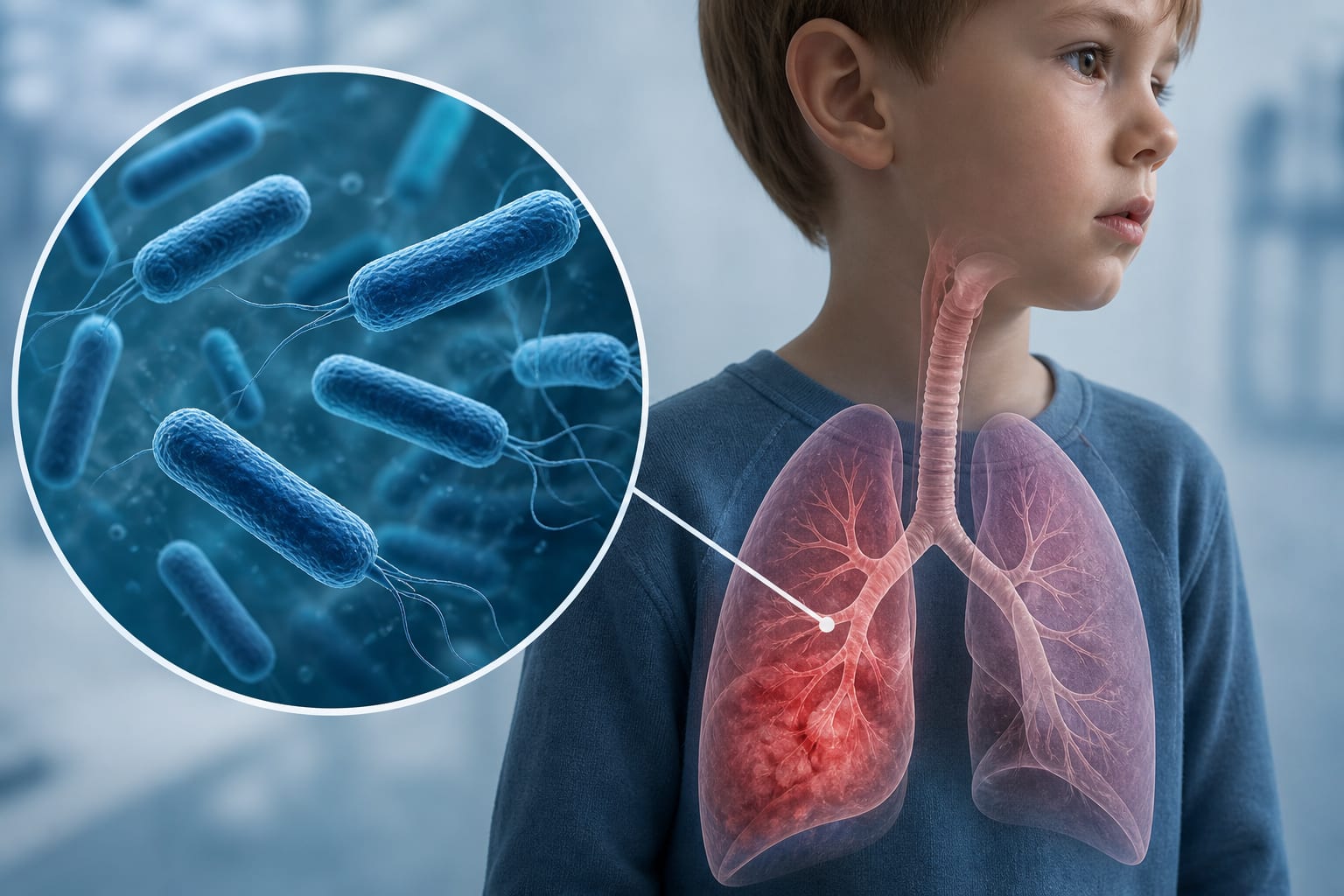
Clinical Report: Legionnaires’ Disease in Children: A Case Study and Literature Review
Background
Legionnaires’ disease (LD) is a severe pneumonia caused by Legionella species, most commonly Legionella pneumophila. LD primarily affects adults, while pediatric cases are rare. This study provides an updated review of pediatric LD and reports a severe case in a previously healthy 15-month-old girl.
Data Highlights
The review included 44 pediatric LD cases from 36 publications.
Sixty-four percent of cases occurred in children aged 1 year or younger, and 34% occurred in neonates.
Comorbidities were present in 61% of cases, and immune deficiencies or immunosuppression were present in 41%.
Among cases with available acquisition data, 55% were healthcare-associated.
Overall mortality was 23%.
Key Findings
Children account for less than 1% of notified Legionnaires’ disease cases in Europe.
The European LD notification rate reached 2.6 cases per 100,000 people in 2022.
PCR was positive in 93% of cases with available data, while culture supported diagnosis in 57%.
Targeted antimicrobial treatment was reported in 91% of cases and was associated with lower odds of death in exploratory univariate analysis.
Legionella can occur in natural and artificial aquatic environments and is transmitted through inhalation of aerosolized particles.
Clinical Implications
The findings support considering Legionella testing in children with severe pneumonia, particularly newborns, immunocompromised patients, healthcare-associated cases, and those who do not respond to beta-lactam antibiotics after 48 hours. Complementary diagnostic approaches may be important because reliance on a single diagnostic method may underestimate the role of non–serogroup 1 infections.
Conclusion
Pediatric Legionnaires’ disease is rare but potentially severe, particularly in very young children and those with underlying conditions or healthcare exposure. Early recognition and timely targeted treatment may improve outcomes, and the high proportion of healthcare-associated cases underscores the need for strengthened prevention and infection-control strategies.
Related Resources & Content
Greenberg D, Chiou CC, Famigilleti R, Lee TC, Yu VL. “Problem pathogens: paediatric legionellosis—Implications for improved diagnosis.” The Lancet Infectious Diseases. 2006;6:529–535. Earlier pediatric LD review that the current study updates.
Rello J, Allam C, Ruiz-Spinelli A, Jarraud S. “Severe legionnaires’ disease.” Annals of Intensive Care. 2024;14:51. Cited in the current review in its discussion of Legionella diagnostic test performance.
Ha R, Heilmann A, Lother SA, Turenne C, Alexander D, Keynan Y, et al. “The adequacy of current Legionnaires’ disease diagnostic practices in capturing the epidemiology of clinically relevant Legionella: a scoping review.” Pathogens. 2024;13:857. Cited in the discussion of urinary antigen testing and its diagnostic limitations.
Kanarek P, Bogiel T, Breza-Boruta B. “Legionellosis risk—An overview of Legionella spp. habitats in Europe.” Environmental Science and Pollution Research. 2022;29:76532–76542. Cited in the discussion of healthcare-associated Legionella exposure, water-system surveillance, and prevention.
European Centre for Disease Prevention and Control. “Legionnaires’ disease.” In ECDC Annual Epidemiological Report for 2022. Stockholm: ECDC; 2026. Source of European notification data cited in the review.
Centers for Disease Control and Prevention. “Legionellosis surveillance and trends.” Legionella (Legionnaires’ Disease and Pontiac Fever). 2026. Surveillance resource cited by the authors; accessed March 11, 2026.