Deep brain stimulation for pediatric dystonia under general anesthesia with endotracheal intubation: case series in a tertiary hospital - Report - MDSpire

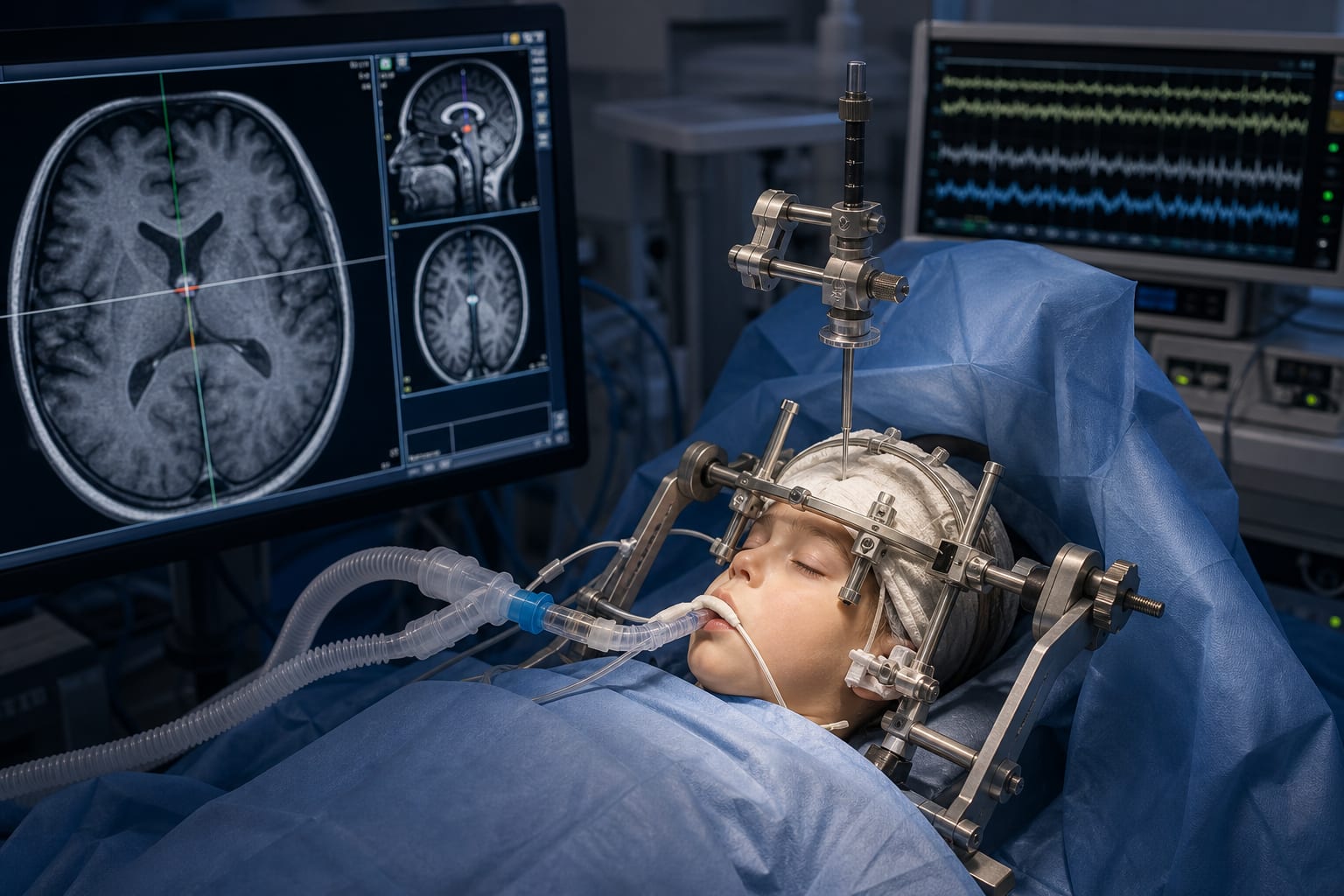
Deep brain stimulation for pediatric dystonia under general anesthesia with endotracheal intubation: case series in a tertiary hospital

  • By

  • Zi-Fang Zhao

  • Lei Du

  • Guo-Jun Wang

  • Sai Tang

  • Jia-Qi Su

  • Hong-Xin Yao

  • Hai-Bo Yang

  • Dong-Xin Wang

  • June 25, 2026

  • 0 min

Share

Clinical Report: General Anesthesia for Deep Brain Stimulation in Pediatric Dystonia

Overview

This study evaluates the anesthetic management of 32 pediatric patients undergoing deep brain stimulation (DBS) for dystonia, highlighting the use of general anesthesia with endotracheal intubation. It addresses challenges posed by comorbidities and the impact of anesthetics on intraoperative microelectrode recording quality.

Background

Deep brain stimulation (DBS) is an established treatment for pediatric patients with medically refractory dystonia, a movement disorder characterized by involuntary muscle contractions. Many pediatric patients cannot tolerate DBS procedures under local or awake anesthesia due to severe symptoms and comorbid conditions, necessitating the use of general anesthesia.

Data Highlights

No numerical data or trial data presented in the article.

Key Findings

  • General anesthesia with endotracheal intubation is used for pediatric dystonia patients undergoing DBS.
  • Challenges include the potential negative impact of general anesthetics on the quality of intraoperative microelectrode recordings.
  • Pediatric dystonia patients often present with comorbidities that complicate perioperative management.
  • Perioperative monitoring is essential to prevent complications associated with anesthesia and comorbid conditions.
  • Special attention is required for hereditary metabolic disorders in this patient population.

Clinical Implications

Anesthetic management for DBS in pediatric dystonia requires consideration of the patient's comorbidities and the effects of general anesthesia on intraoperative monitoring.

Conclusion

The findings indicate that general anesthesia can be utilized in pediatric patients undergoing DBS for dystonia, although management of associated risks is necessary.

Related Resources & Content

  1. FDA, Medtronic Active Neurostimulator for Dystonia Treatment, 2025 -- Executive Summary
  2. Vogt et al., Annals of Neurology, 2024 -- Deep Brain Stimulation for Refractory Status Dystonicus in Children: Multicenter Case Series and Systematic Review
  3. Long-Term Globus Pallidus Internus Deep Brain Stimulation in Pediatric Non-Degenerative Dystonia -- PubMed
  4. Deep brain stimulation for dystonia treatment in cerebral palsy: efficacy exploration -- PubMed
  5. Anesthesia Techniques for Implanting Deep Brain Stimulation Systems: Customized Approaches for Awake and Sleep Surgery Utilizing Microelectrode Recordings
  6. Stereotactic Frame-Assisted Intraventricular Baclofen Administration for Persistent Spasticity and Secondary Dystonia: A Case Series Analysis
  7. Deep Brain Stimulation of the Globus Pallidus Pars Internus for Dystonia: Insights from a Retrospective Study Utilizing Microelectrode Recordings Under General Anesthesia
  8. Efficacy and Dependability of Hypnosis in Stereotactic Procedures: A Randomized Trial
  9. Medtronic Active Neurostimulator for Dystonia Treatment (H0200007) 2025 Executive Summary
  10. Deep Brain Stimulation for Refractory Status Dystonicus in Children: Multicenter Case Series and Systematic Review - Vogt - 2024 - Annals of Neurology - Wiley Online Library
  11. Long-Term Globus Pallidus Internus Deep Brain Stimulation in Pediatric Non-Degenerative Dystonia: A Cohort Study and a Meta-Analysis - PubMed
  12. Deep brain stimulation for dystonia treatment in cerebral palsy: efficacy exploration - PubMed
  13. Beyond the Globus Pallidus: A Systematic Review of Deep Brain Stimulation of Extrapallidal Targets for Pediatric Movement Disorders - PubMed
  14. ‘Asleep’ deep brain stimulation targeting ventral intermediate thalamus in essential tremor: systematic review: British Journal of Neurosurgery: Vol 40 , No 3 - Get Access
  15. The graded effect of propofol in electrophysiology-guided navigation during deep brain stimulation surgery - PMC
  16. Intraoperative microelectrode recording during asleep deep brain stimulation of subthalamic nucleus for Parkinson Disease. A case series with systematic review of the literature | Neurosurgical Review | Springer Nature Link

Original Source(s)

Related Content