Cholesterol and docosahexaenoic acid likely protect against alcohol-induced constriction of cerebral arteries via a common pathway - Report - MDSpire

Cholesterol and docosahexaenoic acid may offer protection against alcohol-related constriction of cerebral arteries through a shared mechanism

  • By

  • Shiwani Thapa

  • Steven Mysiewicz

  • Alex M. Dopico

  • Anna N. Bukiya

  • July 17, 2026

Share

Cholesterol and DHA May Protect Against Alcohol-Induced Cerebral Artery Constriction

Overview

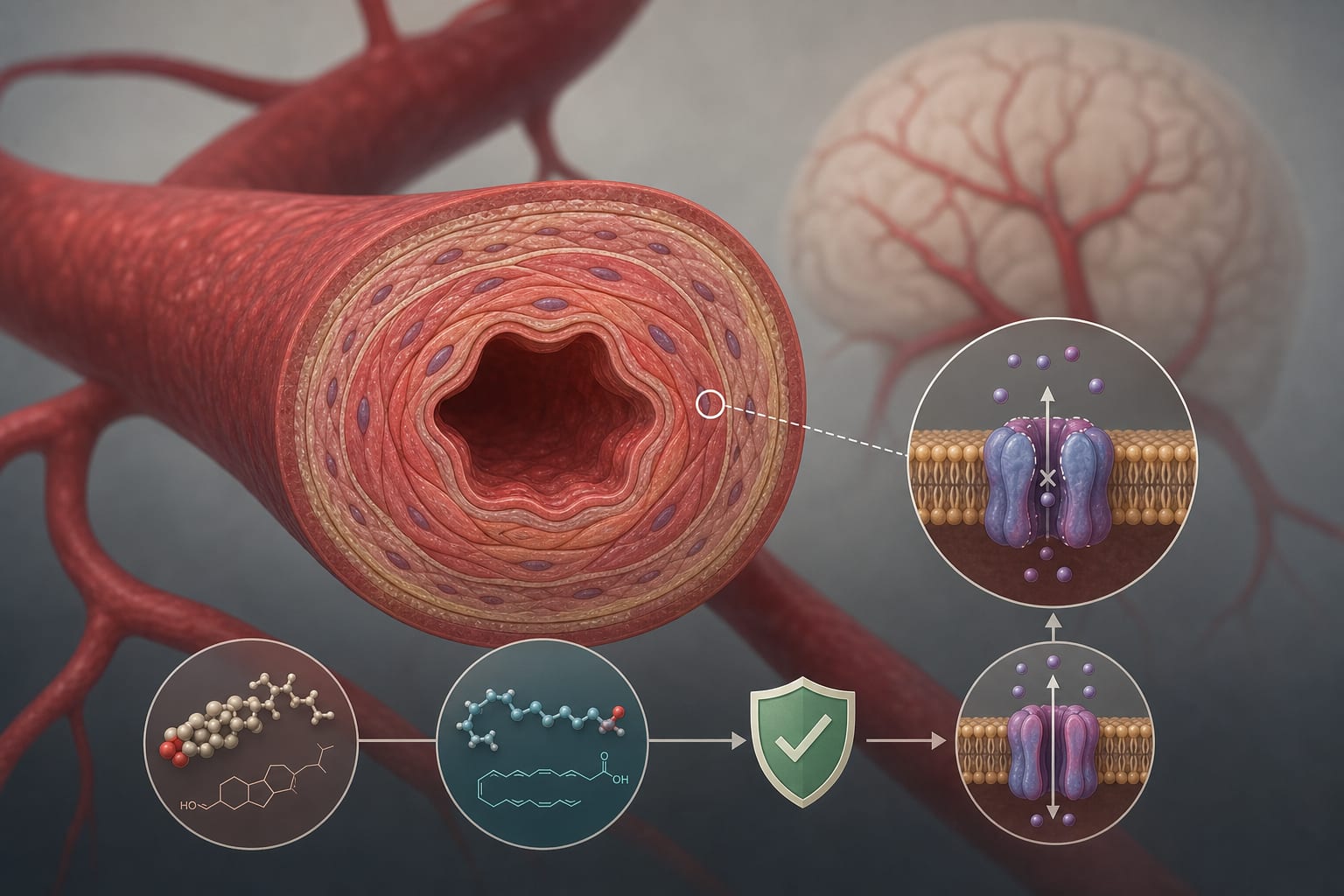
This study investigates the protective effects of cholesterol and docosahexaenoic acid (DHA) against alcohol-induced constriction of cerebral arteries. Both interventions operate through a shared mechanism involving the BK channel α-subunit.

Background

Binge drinking is linked to cerebrovascular dysfunction and increased stroke risk. Alcohol constricts cerebral arteries by inhibiting BK channels in smooth muscle cells.

Data Highlights

No numerical data or trial data were provided in the source material.

Key Findings

  • High-cholesterol diet and DHA supplementation independently protect against alcohol-induced constriction of cerebral arteries.
  • DHA did not enhance the protective effects of a high-cholesterol diet.
  • The BK channel α-subunit (slo1) residue Y450 is implicated in cholesterol's protective action against alcohol.
  • DHA protection against alcohol-induced constriction is absent in male slo1Y450F knock-in mice but present in female counterparts.
  • These findings indicate a sexually dimorphic pathway in the response to alcohol and dietary interventions.

Clinical Implications

Understanding the mechanisms involved may inform future research on alcohol-related vascular risks.

Conclusion

Cholesterol and DHA may protect against alcohol-induced constriction of cerebral arteries through shared mechanisms.

Related Resources & Content

  1. European Journal of Preventive Cardiology, 2023 -- Association between alcohol consumption and peripheral artery disease: two de novo prospective cohorts and a systematic review with meta-analysis
  2. Frontiers in Psychiatry, 2026 -- Astrocytic connexins in alcohol use disorder: mechanisms of neuroinflammation and therapeutic potential
  3. Frontiers in Cardiovascular Medicine, 2026 -- The mediating effect of DHA-mediated MPV improvement on coronary artery stenosis and its prognostic value
  4. European Journal of Preventive Cardiology — Higher eicosapentaenoic acid levels and eicosapentaenoic acid/docosahexaenoic acid ratios are associated with lower cardiovascular mortality post-myocardial infarction
  5. Alcohol Use and Cardiovascular Disease | American Heart Association
  6. Risk Factors for Stroke | Stroke | CDC
  7. Alcohol Use and Your Health | Alcohol Use | CDC
  8. Stroke
  9. 2026 ACC/AHA/AACVPR/ABC/ACPM/ADA/AGS/APhA/ASPC/NLA/PCNA Guideline on the Management of Dyslipidemia: A Report of the American College of Cardiology/American Heart Association Joint Committee on Clinical Practice Guidelines | Circulation
  10. 2026 AHA/ACC/ADA/ASN Guideline for the Prevention, Detection, Evaluation, and Management of Cardiovascular-Kidney-Metabolic Syndrome: A Report of the American College of Cardiology/American Heart Association Joint Committee on Clinical Practice Guidelines | Circulation
  11. Formulation-Specific Cardiovascular Outcomes with High-Dose Eicosapentaenoic Acid: A Systematic Review and Meta-analysis - PubMed
  12. Effect of omega‐3 fatty acids on cardiovascular disease risk: A systematic review and meta‐analysis with meta‐regression - Mattumpuram - 2025 - Clinical and Translational Discovery - Wiley Online Library
  13. Omega-3 Fatty Acid Supplementation and Vascular Health Biomarkers - A Systematic Review and Meta-Analysis - PubMed
  14. The impact of alcohol consumption on stroke prognosis: a systematic review and meta-analysis - PubMed

Original Source(s)

Related Content