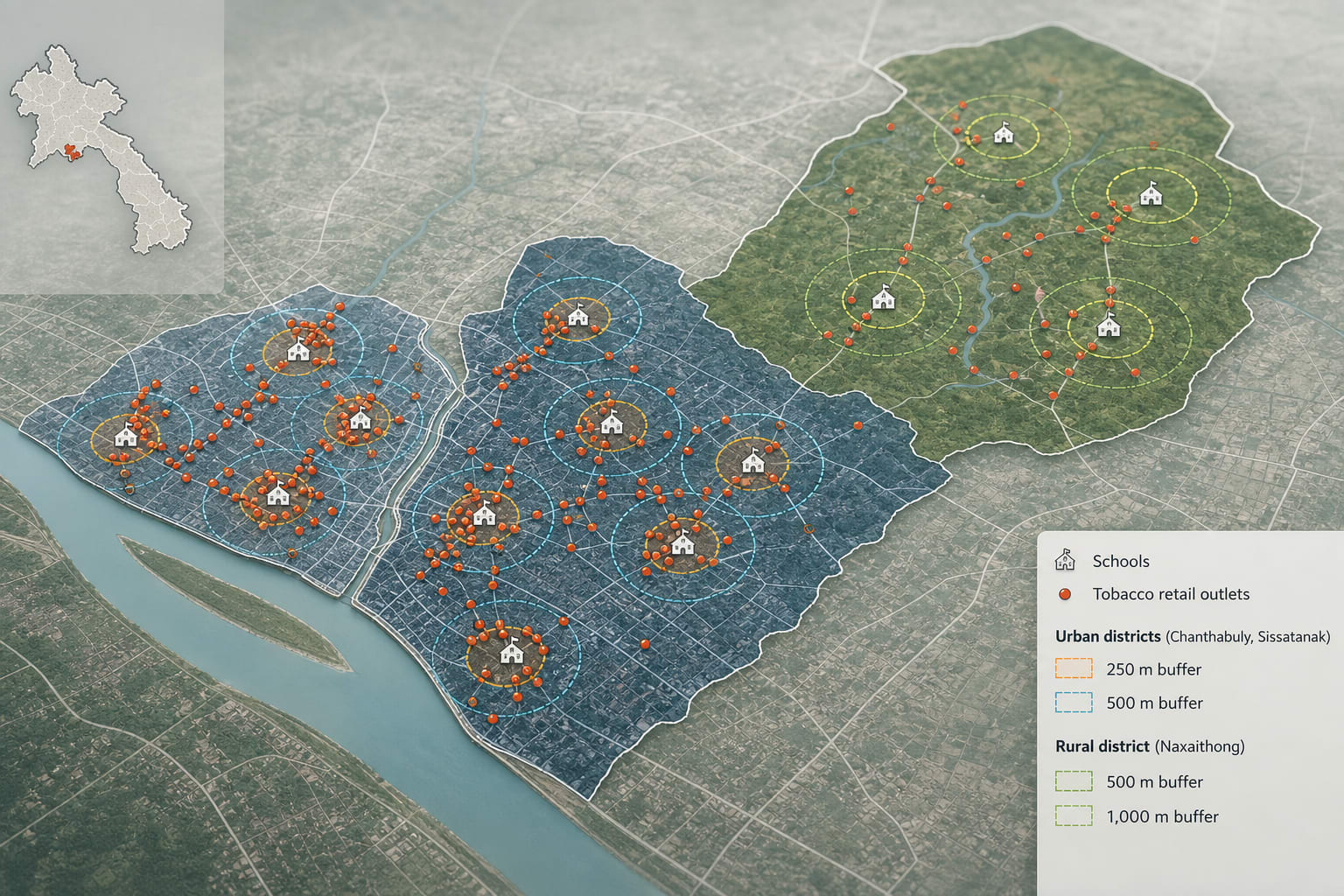
Clinical Report: Geospatial Assessment of Tobacco Retail Outlet Density Near Schools
Overview
This study provides the first geospatial evidence of tobacco retail outlet (TRO) density around schools in Lao PDR, highlighting significant differences between urban and rural areas. The findings indicate a higher concentration of TROs in urban districts, raising concerns about youth exposure to tobacco advertising and access.
Background
Tobacco smoking is a leading cause of morbidity and mortality, particularly in Southeast Asia, where high smoking prevalence is observed. The proximity of tobacco retail outlets to schools can facilitate youth smoking initiation, making it crucial to understand the spatial distribution of these outlets. This study aims to inform tobacco control policies by assessing TRO density and proximity to educational institutions in Lao PDR.
TRO density was significantly higher in Chanthabuly compared to Sissatanak (p = 0.01).
The median distance between TROs and schools was shorter in Sissatanak than in Chanthabuly (p = 0.04).
The closest TRO without age verification signage was 21.58 m from a school.
Outdoor cigarette advertisements were found as close as 9.95 m from schools.
In rural areas, TRO density was higher within the 500-1000 m buffer compared to the 500 m buffer.
Clinical Implications
The findings underscore the need for stricter regulations on tobacco retail outlets, particularly near schools, to mitigate youth exposure to tobacco products. Implementing comprehensive tobacco control measures could significantly reduce smoking initiation rates among adolescents in Lao PDR.
Conclusion
This study highlights the critical need for enhanced tobacco control policies in Lao PDR, particularly in urban areas where TRO density is high. Addressing the proximity of TROs to schools is essential for protecting youth from tobacco exposure.
by Shweta Kulkarni, Thanh Cong Bui, Phonepadith Xangsayarath, Khatthanaphone Phangdouangsy, Chanthavy Soulaphy, Khanittha Sengdara, Sydney Martinez, Amanda Janitz, Summer G. Frank-Pearce, Laura A. Beebe