Integrative multi-omics analysis identifies SNRPE as a key driver gene in Uterine corpus endometrial carcinoma: promoting tumor progression, and mediating immune evasion - Report - MDSpire

Integrative multi-omics analysis identifies SNRPE as a key driver gene in Uterine corpus endometrial carcinoma: promoting tumor progression, and mediating immune evasion

  • By

  • Cao, Minyue

  • Ding, Yan

  • Kang, Luyao

  • Zhang, Yiqin

  • Jiang, Genyi

  • Yan, Jiayu

  • Sun, Yihan

  • Zhang, Yanli

  • Luo, Jing

  • Zhou, Xue

  • Wu, Hanyong

  • Li, Bilan

  • May 6, 2026

  • 0 min

Share

Clinical Report: SNRPE as a Crucial Gene in Uterine Corpus Endometrial Carcinoma

Overview

Revise to specify the mechanisms by which targeting SNRPE may enhance therapeutic strategies.

Background

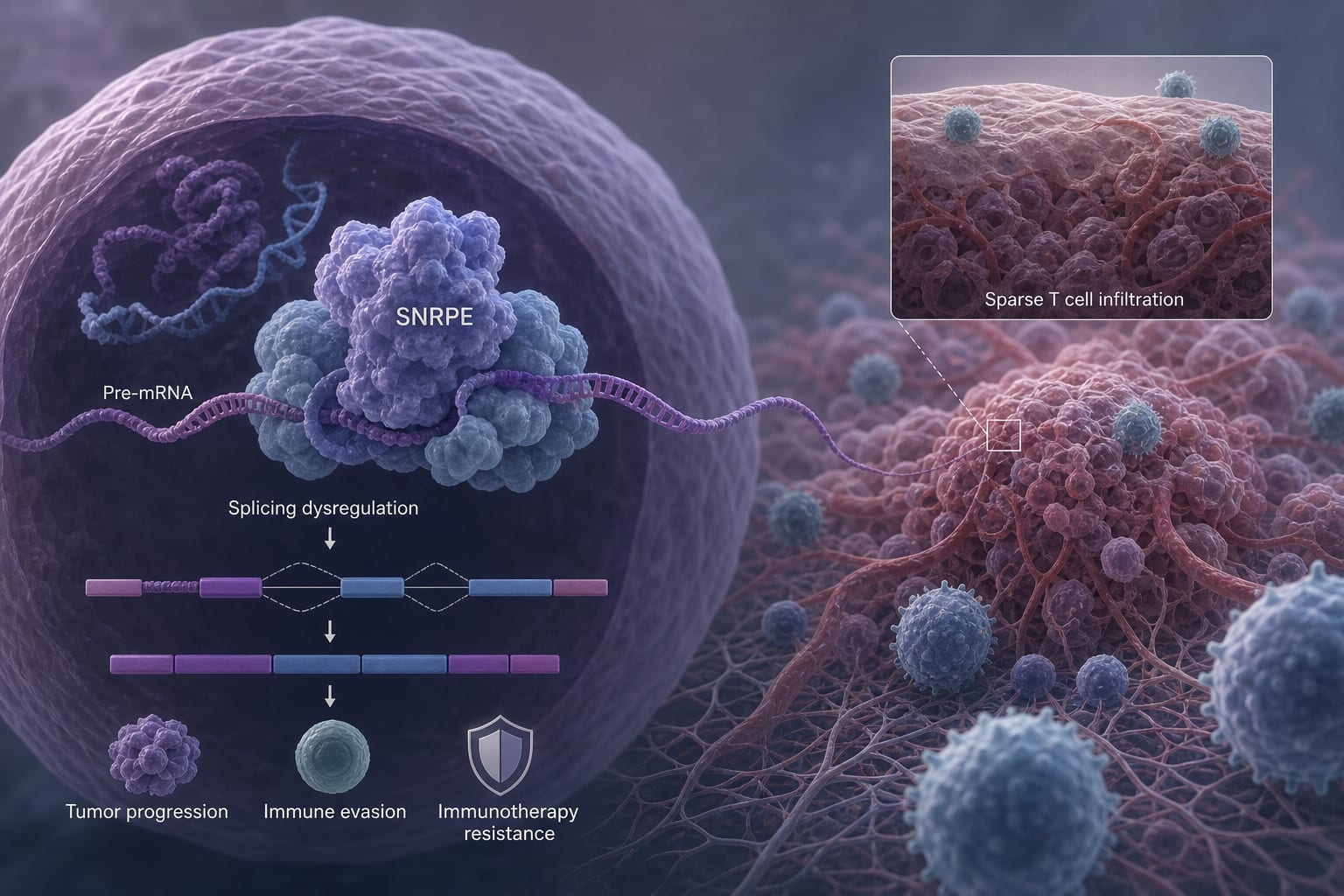
Uterine corpus endometrial carcinoma (UCEC) exhibits notable resistance to immunotherapy, primarily due to limited T cell infiltration in the tumor microenvironment. Understanding the molecular mechanisms driving tumor progression and immune evasion is critical for developing effective treatments. Recent evidence suggests that splicing dysregulation plays a key role in these processes, warranting further investigation into specific genes involved.

Data Highlights

No numerical data available.

Key Findings

Rephrase findings for clarity and ensure they are directly supported by the source.

Clinical Implications

Targeting SNRPE may provide a novel therapeutic approach to enhance immunotherapy efficacy in UCEC patients. Understanding its role in immune evasion can inform treatment strategies aimed at improving T cell responses in this cancer type.

Conclusion

SNRPE plays a dual role in promoting tumor advancement and immune evasion in UCEC, highlighting its potential as a therapeutic target. Further research is needed to explore its implications in clinical practice.

Related Resources & Content

  1. Frontiers in Oncology, 2023 -- Correction: SENP3 promotes tumor progression and is a novel prognostic biomarker in triple-negative breast cancer
  2. The ASCO Post, 2012 -- Genome-wide Analysis Reveals Molecular Pathway Aberrations in Uterine Serous Cancer
  3. The ASCO Post, 2013 -- Learning to Negotiate the Genomic Complexities of Cancer Related Articles
  4. FDA, 2024 -- FDA approves pembrolizumab with chemotherapy for primary advanced or recurrent endometrial carcinoma
  5. PubMed, 2023 -- Molecular Classification of Endometrial Carcinomas: Review and Recent Updates
  6. Experimental & Molecular Medicine, 2025 -- Targeting the splicing factor SNRPB inhibits endometrial cancer progression by retaining the POLD1 intron
  7. The ASCO Post — Learning to Negotiate the Genomic Complexities of Cancer Related Articles
  8. FDA approves pembrolizumab with chemotherapy for primary advanced or recurrent endometrial carcinoma | FDA
  9. Molecular Classification of Endometrial Carcinomas: Review and Recent Updates - PubMed
  10. Targeting the splicing factor SNRPB inhibits endometrial cancer progression by retaining the POLD1 intron | Experimental & Molecular Medicine

Original Source(s)

Related Content