Development and internal validation of a prediction model for early identification of sepsis-associated acute kidney injury based on admission serum biomarkers: a retrospective cohort study - Report - MDSpire
Advertisement
Development and internal validation of a prediction model for early identification of sepsis-associated acute kidney injury based on admission serum biomarkers: a retrospective cohort study
Clinical Report: Predictive Model for Early Detection of SA-AKI
Overview
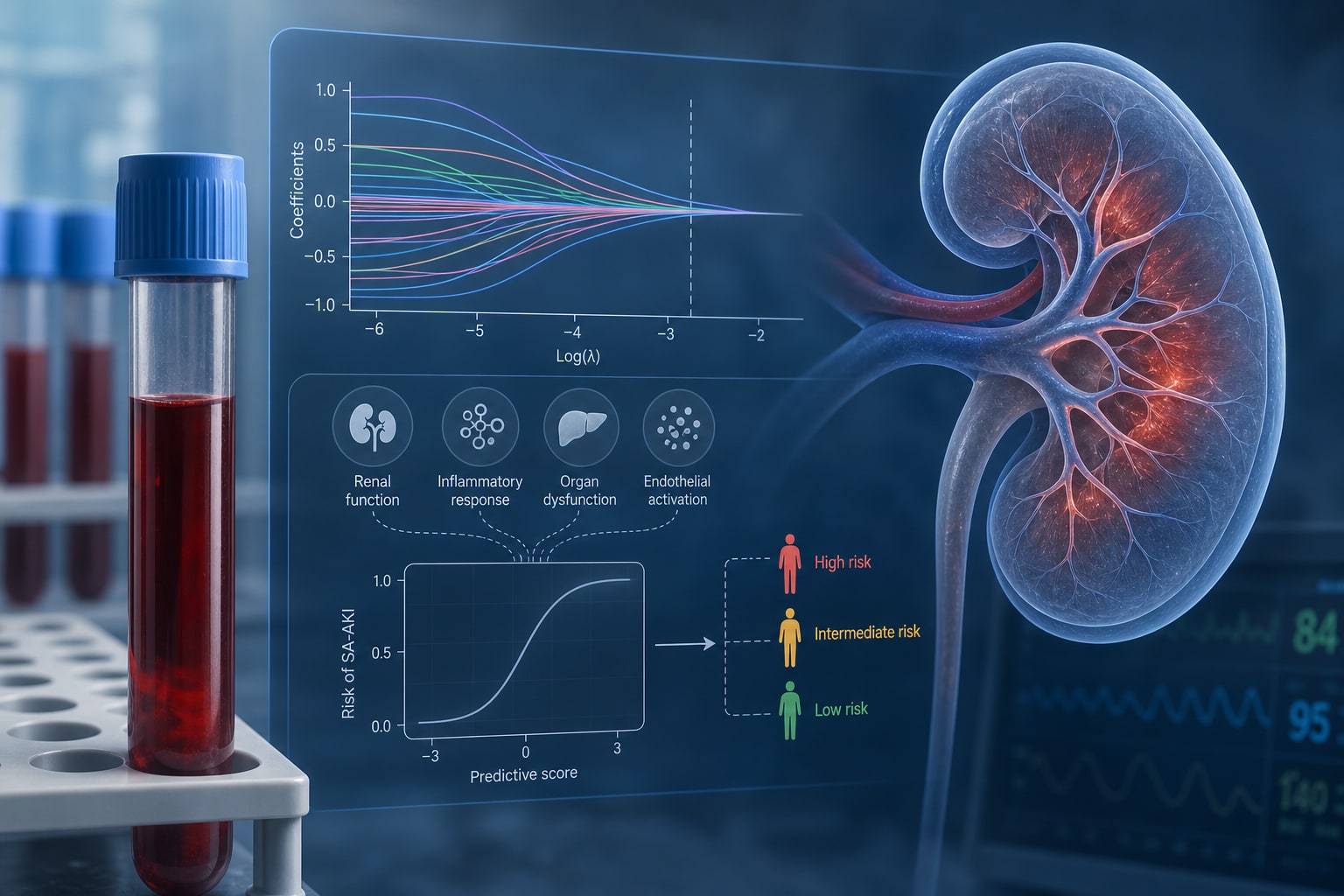
This study developed and validated a predictive model for sepsis-associated acute kidney injury (SA-AKI) using first serum laboratory indicators.
Background
Sepsis-associated acute kidney injury (SA-AKI) is a significant complication that increases mortality in critically ill patients. Early detection is crucial for timely interventions, yet traditional diagnostic methods often fail to identify kidney injury promptly.
Data Highlights
Indicator
Risk Factor
Myoglobin (MYO)
Yes
Alanine aminotransferase (ALT)
Yes
Phosphorus (PO4)
Yes
Sodium (Na)
Yes
Potassium (K)
Yes
Carbon dioxide combining power (CO2-CP)
Yes
Platelet (PLT)
Yes
Neutrophil (NEUT)
Yes
Key Findings
The model identified 8 independent risk factors for SA-AKI from first serum indicators.
Training cohort AUC was 0.839, and validation cohort AUC was 0.832.
Subgroup analyses showed stable performance across age and sex strata (all AUCs > 0.81).
A nomogram was developed for individualized risk estimation.
The model demonstrated significant clinical utility across a wide threshold probability range.
Clinical Implications
The predictive model can assist healthcare professionals in early risk stratification of sepsis patients for SA-AKI.
Conclusion
The study presents a validated predictive model for SA-AKI risk estimation using initial serum biomarkers, emphasizing the need for further external validation.
Federal prosecutors allege that a Florida physician and research staff fabricated clinical trial records that were submitted into database systems used to evaluate investigational drugs.