Establishment of prognostic nomogram in cervical cancer with hepatitis B virus infection: a retrospective study - Report - MDSpire

Establishment of prognostic nomogram in cervical cancer with hepatitis B virus infection: a retrospective study

  • By

  • Zhongyan Dou

  • Shuhui Yu

  • Jinping Zhang

  • Xingrao Wu

  • Kangming Li

  • Meiping Jiang

  • Chunfang Zhao

  • Lan Zhang

  • July 13, 2026

Share

Clinical Report: Development of a Prognostic Nomogram for Cervical Cancer Patients

Overview

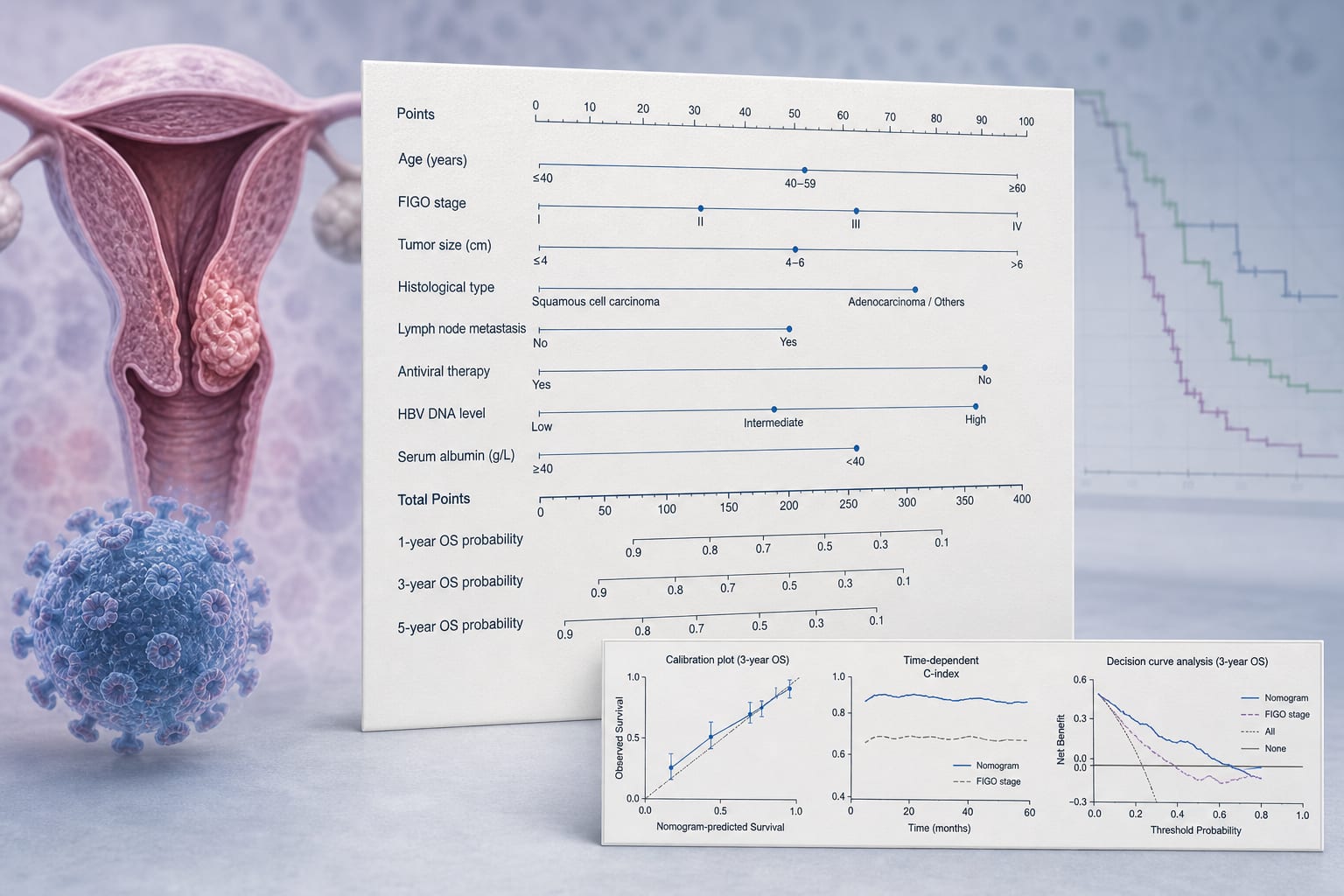
This study developed a prognostic nomogram for predicting overall survival in HBsAg-positive cervical cancer patients.

Background

Cervical cancer is a leading gynecologic malignancy globally, with significant incidence and mortality rates. Chronic hepatitis B virus (HBV) infection is a major public health concern and has been linked to poorer outcomes in cancer patients. Identifying prognostic factors for HBsAg-positive cervical cancer patients is essential for tailoring treatment strategies.

Data Highlights

FactorHarrell's C-indexFIGO C-index
Nomogram0.817 (95% CI, 0.762–0.873)0.700 (95% CI, 0.637–0.764)

Key Findings

  • Independent prognostic factors identified include tumor stage, baseline serum AST levels, antiviral therapy, lymph node status, and treatment modality.
  • The nomogram's C-index was higher than that of the FIGO staging system (P < 0.001).
  • Decision curve analysis showed performance of the nomogram compared to FIGO.
  • Calibration curves indicated consistency between predicted and observed survival probabilities.
  • High-risk group based on the nomogram had poorer overall survival compared to the low-risk group (P < 0.001).

Clinical Implications

The established nomogram provides a prognostic tool for HBsAg-positive cervical cancer patients compared to traditional FIGO staging.

Conclusion

The nomogram developed in this study offers a method for predicting overall survival in HBsAg-positive cervical cancer patients.

Related Resources & Content

  1. Author(s)/Org, Source, Year -- Title
  2. Author(s)/Org, Source, Year -- Title
  3. Author(s)/Org, Source, Year -- Title
  4. Author(s)/Org, Source, Year -- Title
  5. Author(s)/Org, Source, Year -- Title
  6. Author(s)/Org, Source, Year -- Title
  7. Author(s)/Org, Source, Year -- Title
  8. Author(s)/Org, Source, Year -- Title
  9. Author(s)/Org, Source, Year -- Title
  10. Author(s)/Org, Source, Year -- Title
  11. Author(s)/Org, Source, Year -- Title
  12. Author(s)/Org, Source, Year -- Title
  13. Cervical Cancer, Version 2.2026, NCCN Clinical Practice Guidelines In Oncology - PubMed
  14. Cost-Effectiveness of Pembrolizumab With Chemoradiotherapy for Locally Advanced Cervical Cancer
  15. Pembrolizumab or placebo with chemoradiotherapy followed by pembrolizumab or placebo for newly diagnosed, high-risk, locally advanced cervical cancer (ENGOT-cx11/GOG-3047/KEYNOTE-A18): overall survival results from a randomised, double-blind, placebo-controlled, phase 3 trial - ScienceDirect
  16. Pembrolizumab for Persistent, Recurrent, or Metastatic Cervical Cancer | New England Journal of Medicine
  17. Cervical cancer
  18. AASLD/IDSA Practice Guideline Update on Treatment of Chronic Hepatitis B
  19. EASL Clinical Practice Guidelines on the management of hepatitis B virus infection
  20. Comparative Risk of Hepatitis B Virus Reactivation in Patients Receiving Immune Checkpoint Inhibitors or Tyrosine Kinase Inhibitors for Liver Cancer
  21. Prognostic value of systemic immune-inflammation index in cervical cancer: a systematic review and meta-analysis - PubMed
  22. Prognostic value of platelet to lymphocyte ratio in patients with cervical cancer: an updated systematic review and meta-analysis - PubMed
  23. A meta-analysis of albumin, globulin, and albumin globulin ratios for predicting prognosis of cervical cancer - PubMed
  24. What is the impact of perineural invasion on the prognosis of cervical cancer: a systematic review and meta-analysis | BMC Cancer | Springer Nature Link
  25. Frontiers | Machine learning-based prediction of clinical outcomes in cervical cancer using routine hematological indices: development and web implementation

Original Source(s)

Related Content