Evaluating glycolysis-associated biomarkers for radiotherapy sensitivity in head and neck squamous cancer - Report - MDSpire

Evaluating glycolysis-associated biomarkers for radiotherapy sensitivity in head and neck squamous cancer

  • By

  • Bilan Xie

  • Hainan Yang

  • Chunyuan Lin

  • Jinzhi Lai

  • June 29, 2026

  • 0 min

Share

Clinical Report: Assessing Glycolysis-Related Biomarkers for Sensitivity to Radiotherapy in Head and Neck Squamous Cell Carcinoma

Overview

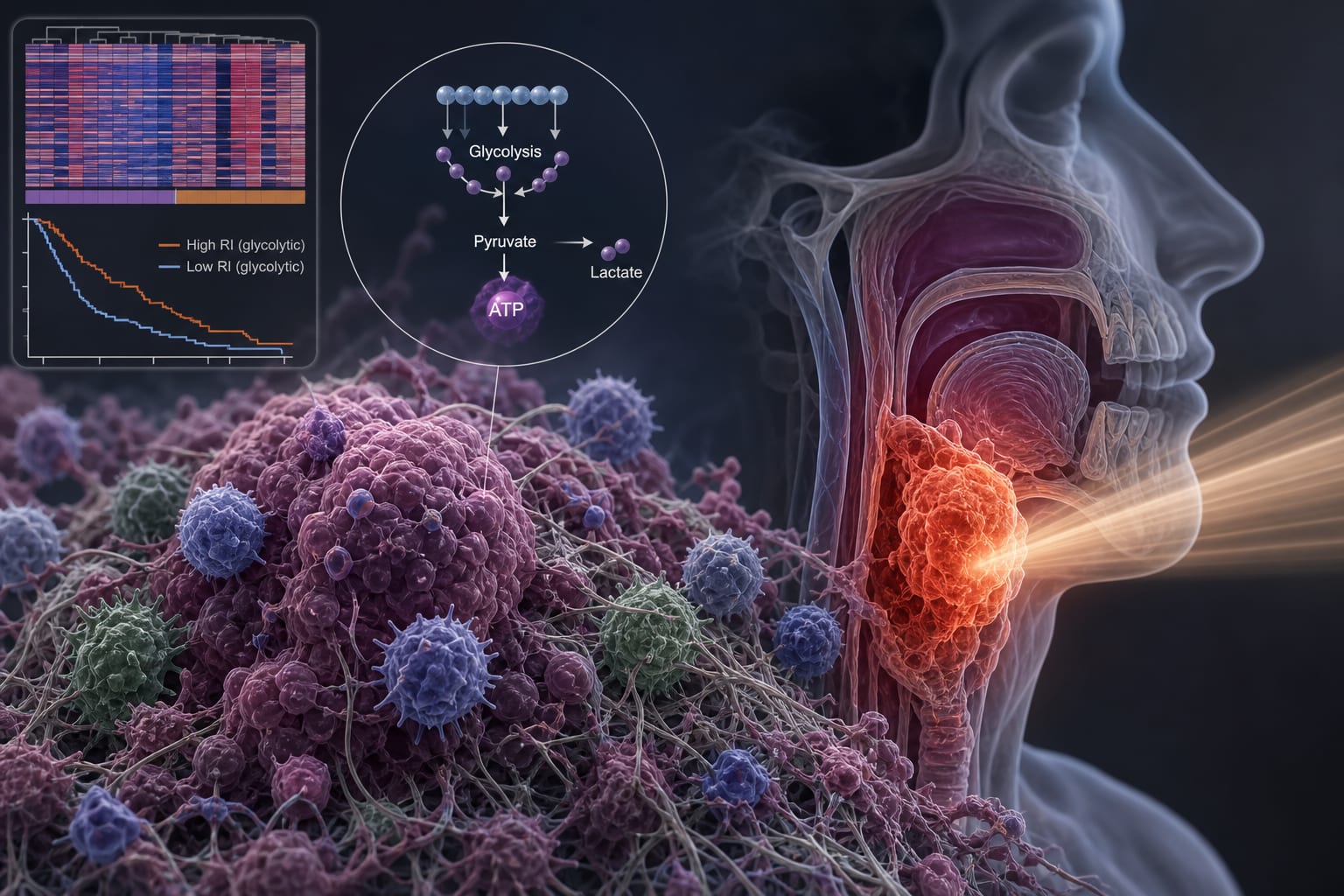
This study identifies a glycolysis-associated radiosensitivity index (RI) that correlates with radiotherapy outcomes in head and neck squamous cell carcinoma (HNSC).

Background

Head and neck squamous cell carcinoma (HNSC) poses significant treatment challenges due to variable responses to radiotherapy, with up to 30% of patients exhibiting radio-resistance.

Data Highlights

FindingDetails
Overall SurvivalLow glycolytic activity correlates with improved overall survival post-radiotherapy.
Radio-resistanceHigh glycolytic activity is associated with radio-resistance in HNSC.
Immune InfiltrationRS tumors show higher immune cell infiltration compared to RR tumors.
TIDE ScoresRS tumors exhibit lower TIDE scores.
In Vitro ValidationCAL-27IR cells show elevated glycolytic activity and upregulation of RI-related genes.

Key Findings

  • Low glycolytic activity is linked to improved overall survival in HNSC patients after radiotherapy.
  • High glycolytic activity correlates with radio-resistance in HNSC.
  • Patients stratified into RS and RR groups based on glycolysis-related gene expression.
  • RS tumors have significantly higher immune cell infiltration and lower TIDE scores.

Clinical Implications

Understanding glycolytic activity can aid in stratifying patients for treatment approaches.

Conclusion

The findings highlight the role of glycolytic activity in determining radiotherapy sensitivity in HNSC.

Related Resources & Content

  1. European Radiology, 2023 -- Predictive Value of Serial Multiparametric MRI and FDG-PET/CT Imaging Changes During Radiation Therapy for Treatment Outcomes in Head and Neck Cancer Patients
  2. Frontiers in Oncology -- Dual-energy and perfusion CT for predicting response to chemo-radiotherapy in head and neck cancer: an exploratory study
  3. Journal of Gastroenterology -- Alterations in Enzyme Protein Synthesis Related to Glucose Metabolism in Hepatocellular Carcinoma
  4. NCCN Guidelines® Insights: Head and Neck Cancers, Version 2.2025 - PubMed
  5. Clinical Benefit and Safety of Reduced Elective Dose in Definitive Radiotherapy for Head and Neck Squamous Cell Carcinoma: The UPGRADE-RT Multicenter Randomized Controlled Trial | Journal of Clinical Oncology
  6. Journal of Neuro-Oncology — Metabolism of Amino Acids in Gliomas: In Vivo MR Spectroscopy Identifies Alanine as a Potential Indicator of Poor Prognosis in Patients with Glioma
  7. NCCN Guidelines® Insights: Head and Neck Cancers, Version 2.2025 - PubMed
  8. Clinical Benefit and Safety of Reduced Elective Dose in Definitive Radiotherapy for Head and Neck Squamous Cell Carcinoma: The UPGRADE-RT Multicenter Randomized Controlled Trial | Journal of Clinical Oncology
  9. Diagnostic, Prognostic, and Predictive Molecular Biomarkers in Head and Neck Squamous Cell Carcinoma: A Comprehensive Review

Original Source(s)

Related Content