The Role of Artificial Intelligence in Enhancing Diagnosis, Treatment, and Results in Neurovascular Surgery
-
By
-
Liping Li
-
Zhonghua Zhang
-
Lin Zong
-
June 18, 2026
Clinical Report: The Role of Artificial Intelligence in Neurovascular Surgery
Overview
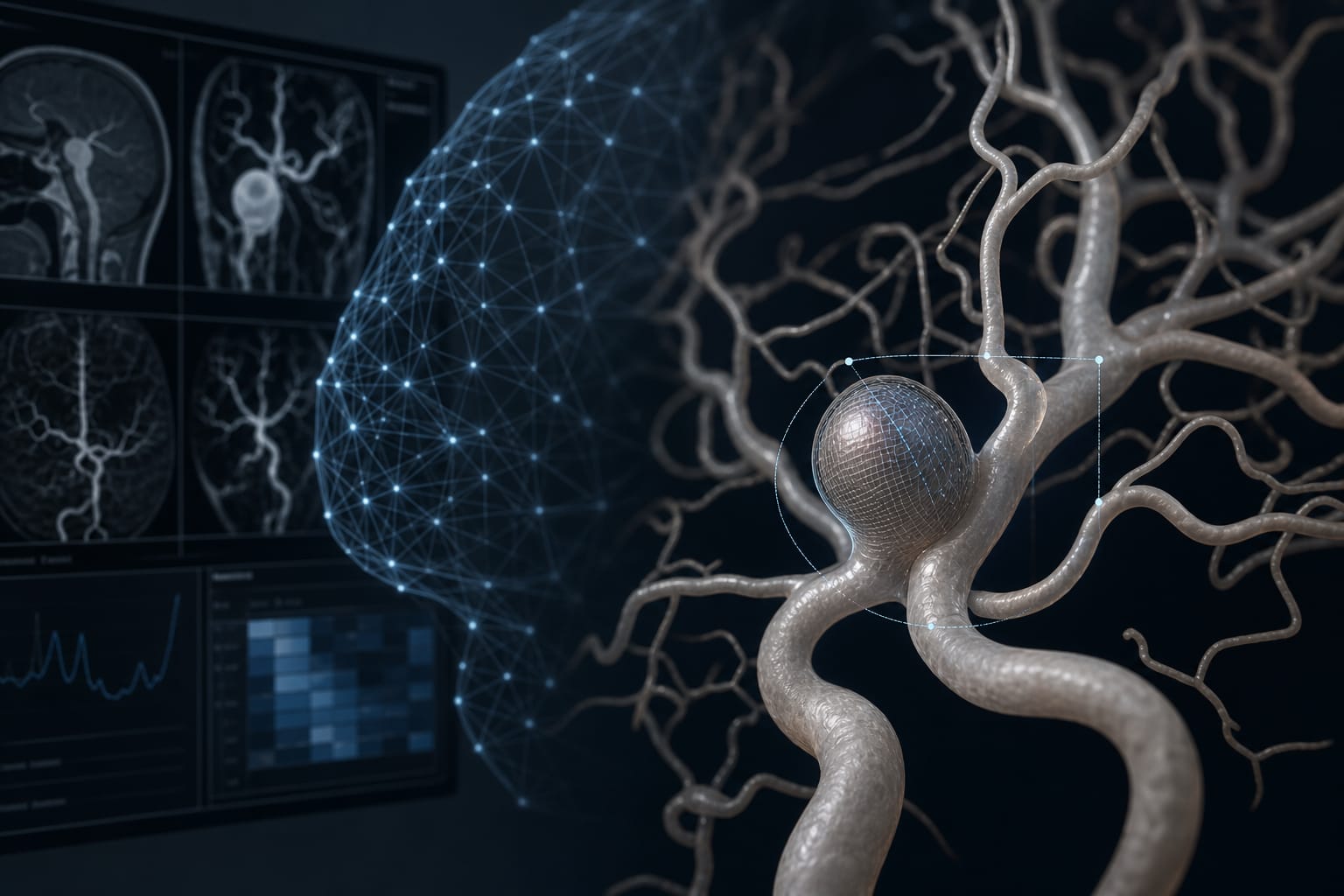
Artificial intelligence (AI) is enhancing neurovascular surgery by improving diagnostic accuracy, risk prediction, and treatment planning. This review highlights the applications of AI across the continuum of cerebrovascular care.
Background
Cerebrovascular diseases are a leading cause of morbidity and mortality, necessitating timely and accurate diagnosis and intervention. The complexity of neurovascular pathologies and variability in clinical presentation challenge traditional diagnostic methods. AI offers innovative solutions to analyze multimodal data.
Data Highlights
No specific numerical data provided in the source material.
Key Findings
- AI algorithms improve diagnostic accuracy for detecting large vessel occlusions and characterizing aneurysm morphology.
- Machine learning models can predict aneurysm rupture risk based on morphological and hemodynamic features.
- AI is utilized for risk stratification, predicting functional recovery after stroke and post-intervention complications.
- Robotic-assisted microsurgery and intraoperative guidance systems are enhanced by AI, showing potential improvements in procedural safety and efficacy.
- Challenges include algorithmic bias, limited generalizability, and regulatory barriers to AI implementation in clinical practice.
Clinical Implications
Successful integration of AI into clinical workflows is essential for maximizing its benefits in patient care.
Conclusion
AI has the potential to significantly enhance the diagnosis and treatment of neurovascular conditions, although challenges remain in its clinical application. Continued evaluation and adaptation are necessary to fully realize its benefits in precision medicine.
Related Resources & Content
- conexiant, AI for Stroke: What the Data Show, 2023 -- AI for Stroke: What the Data Show
- npj Digital Medicine, Computer vision applications in vascular surgery: a systematic review and critical appraisal, 2024 -- Computer vision applications in vascular surgery: a systematic review and critical appraisal
- Journal of Neuro-Oncology, Innovations in Artificial Intelligence for Neurosurgical Oncology: A Comprehensive Review, 2024 -- Innovations in Artificial Intelligence for Neurosurgical Oncology: A Comprehensive Review
- Hub - Professional Heart Daily | American Heart Association, 2026 Guideline for the Early Management of Patients With Acute Ischemic Stroke -- 2026 Guideline for the Early Management of Patients With Acute Ischemic Stroke
- Translational Stroke Research, Automated Emergent Large Vessel Occlusion Detection Using Viz.ai Software and Its Impact on Stroke Workflow Metrics and Patient Outcomes in Stroke Centers: A Systematic Review and Meta-analysis, 2025 -- Automated Emergent Large Vessel Occlusion Detection Using Viz.ai Software
- conexiant — What AI Can (and Can’t) Do in Surgery Training
- Hub - Professional Heart Daily | American Heart Association
- Automated Emergent Large Vessel Occlusion Detection Using Viz.ai Software and Its Impact on Stroke Workflow Metrics and Patient Outcomes in Stroke Centers: A Systematic Review and Meta-analysis | Translational Stroke Research | Springer Nature Link
- European Stroke Organisation (ESO) and European Association of Neurosurgical Societies (EANS) guideline on stroke due to spontaneous intracerebral haemorrhage - PubMed
Based on findings from:
Artificial intelligence in neurovascular surgery: advancing diagnosis, treatment, and outcomes
Liping Li, Zhonghua Zhang, Lin Zong. Frontiers In Surgery, 2026.
https://www.frontiersin.org/journals/surgery/articles/10.3389/fsurg.2026.1841708/full
This content is an AI-generated, fully rewritten summary based on a published scholarly article. It does not reproduce the original text and is not a substitute for the original publication. Readers are encouraged to consult the source for full context, data, and methodology.