Interpretable machine learning for presurgical differentiation of Hürthle cell carcinoma and adenoma: a SHAP-augmented approach - Report - MDSpire

Interpretable Machine Learning Techniques for Preoperative Distinction Between Hürthle Cell Carcinoma and Adenoma: A SHAP-Enhanced Methodology

  • By

  • Junyu Cao

  • Jing Li

  • Chuancheng Zhou

  • Jie Zhou

  • Kunxian Yang

  • July 20, 2026

Share

Clinical Report: Interpretable Machine Learning Techniques for Preoperative Distinction

Overview

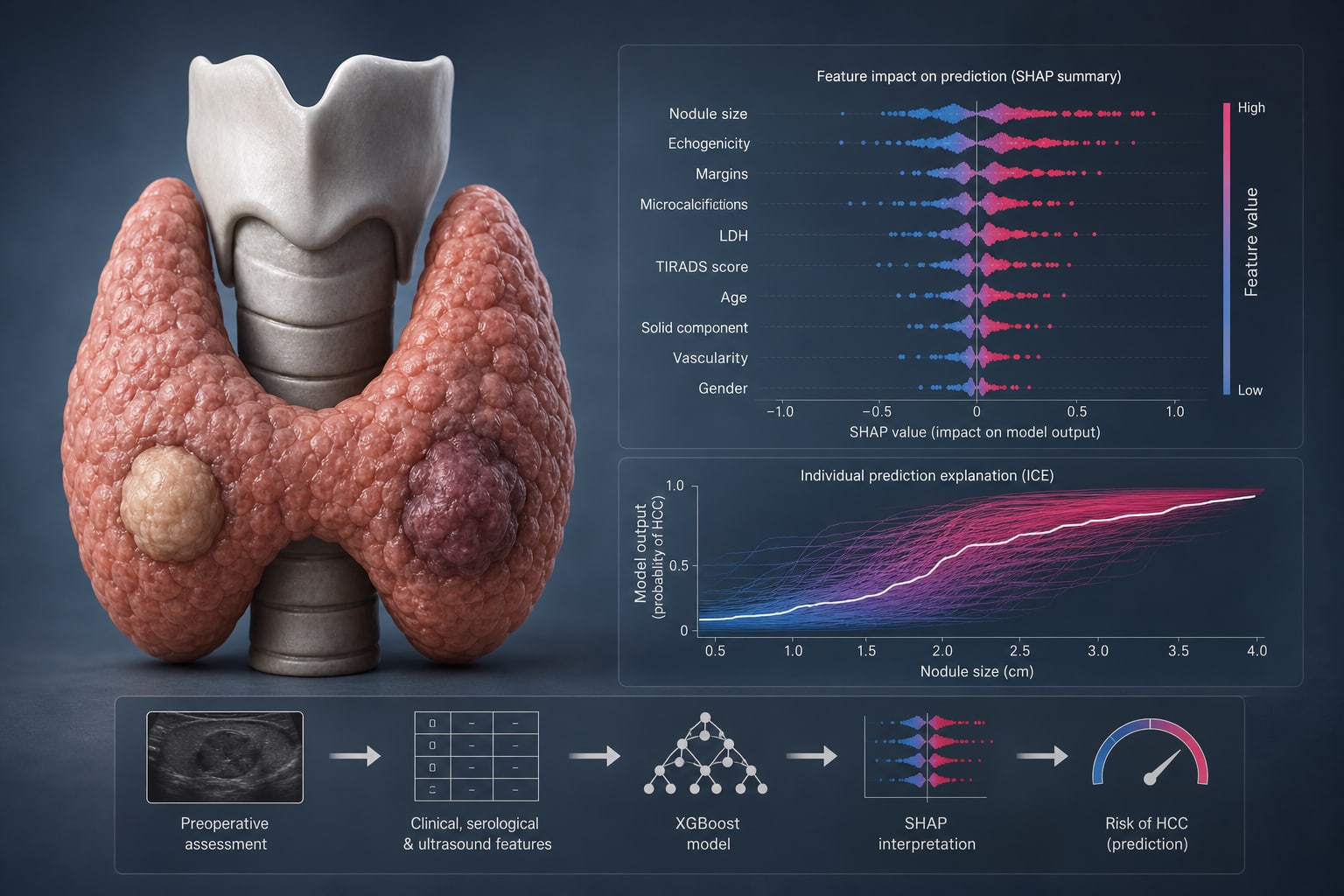
This study presents a machine learning framework that enhances the preoperative differentiation between Hürthle cell carcinoma and adenoma. The XGBoost model demonstrated superior diagnostic performance compared to traditional logistic regression, with significant implications for clinical decision-making.

Background

Differentiating between benign Hürthle cell adenoma and malignant Hürthle cell carcinoma is a significant clinical challenge, often leading to unnecessary surgeries. Traditional diagnostic methods, including fine-needle aspiration biopsy, have limitations in accurately assessing these neoplasms. The development of advanced machine learning techniques may improve diagnostic accuracy and reduce the burden of unnecessary surgical interventions.

Data Highlights

ModelAUC
XGBoost0.911
Logistic Regression0.746

Key Findings

  • The XGBoost model outperformed logistic regression in distinguishing Hürthle cell carcinoma from adenoma.
  • SHAP analysis identified key predictors of malignancy, including vascularity grade and serum thyroglobulin levels.
  • The study included a cohort of 554 patients, with 280 diagnosed with HCA and 274 with HCC.
  • Decision curve analysis indicated a higher clinical net benefit for the XGBoost model.
  • Patient-specific ICE trajectories provided insights into misclassified cases.

Clinical Implications

The SHAP-augmented XGBoost framework offers a transparent and accurate method for presurgical risk stratification of Hürthle cell neoplasms. This approach may help clinicians make more informed decisions and potentially reduce unnecessary surgical procedures.

Conclusion

The study demonstrates the potential of machine learning techniques to enhance the preoperative diagnostic process for Hürthle cell neoplasms, with implications for improved patient outcomes.

Related Resources & Content

  1. Update from the 2022 World Health Organization Classification of Thyroid Tumors: A Standardized Diagnostic Approach - PMC
  2. Effectiveness of Molecular Testing Techniques for Diagnosis of Indeterminate Thyroid Nodules: A Randomized Clinical Trial | Endocrine Surgery | JAMA Oncology | JAMA Network
  3. NCCN Guidelines® Insights: Thyroid Carcinoma, Version 1.2025 - PubMed
  4. Frontiers in Surgery — Perioperative machine learning models with SHAP interpretation for predicting adverse outcomes in breast cancer surgery
  5. Frontiers in Oncology — A CT-based multi-scale fusion model with SHAP interpretation for preoperative differentiation between lung adenocarcinoma in situ/minimally invasive adenocarcinoma and invasive adenocarcinoma: a multicenter study
  6. Surgical Endoscopy — Hierarchical Classification of Ampullary Tumors Using AI: A Deep Learning Method with White-Light and Narrow-Band Imaging Techniques
  7. Acta Neurochirurgica — Machine learning-based models for preoperative prediction of pituitary adenoma consistency: a systematic review and meta-analysis
  8. Update from the 2022 World Health Organization Classification of Thyroid Tumors: A Standardized Diagnostic Approach - PMC
  9. https://ptacts.uspto.gov/ptacts/public-informations/petitions/1555744/download-documents?artifactId=ckm6TbzJ5Pus8Ec7rBF8f25Y_iln2ZA4zj1QHSgI8fPwdHz-LQQ48BA
  10. Table 7. [The Bethesda System for Reporting Thyroid Cytopathology: Recommended Diagnostic Categories]. - Endotext - NCBI Bookshelf
  11. Effectiveness of Molecular Testing Techniques for Diagnosis of Indeterminate Thyroid Nodules: A Randomized Clinical Trial | Endocrine Surgery | JAMA Oncology | JAMA Network
  12. NCCN Guidelines® Insights: Thyroid Carcinoma, Version 1.2025 - PubMed

Original Source(s)

Related Content