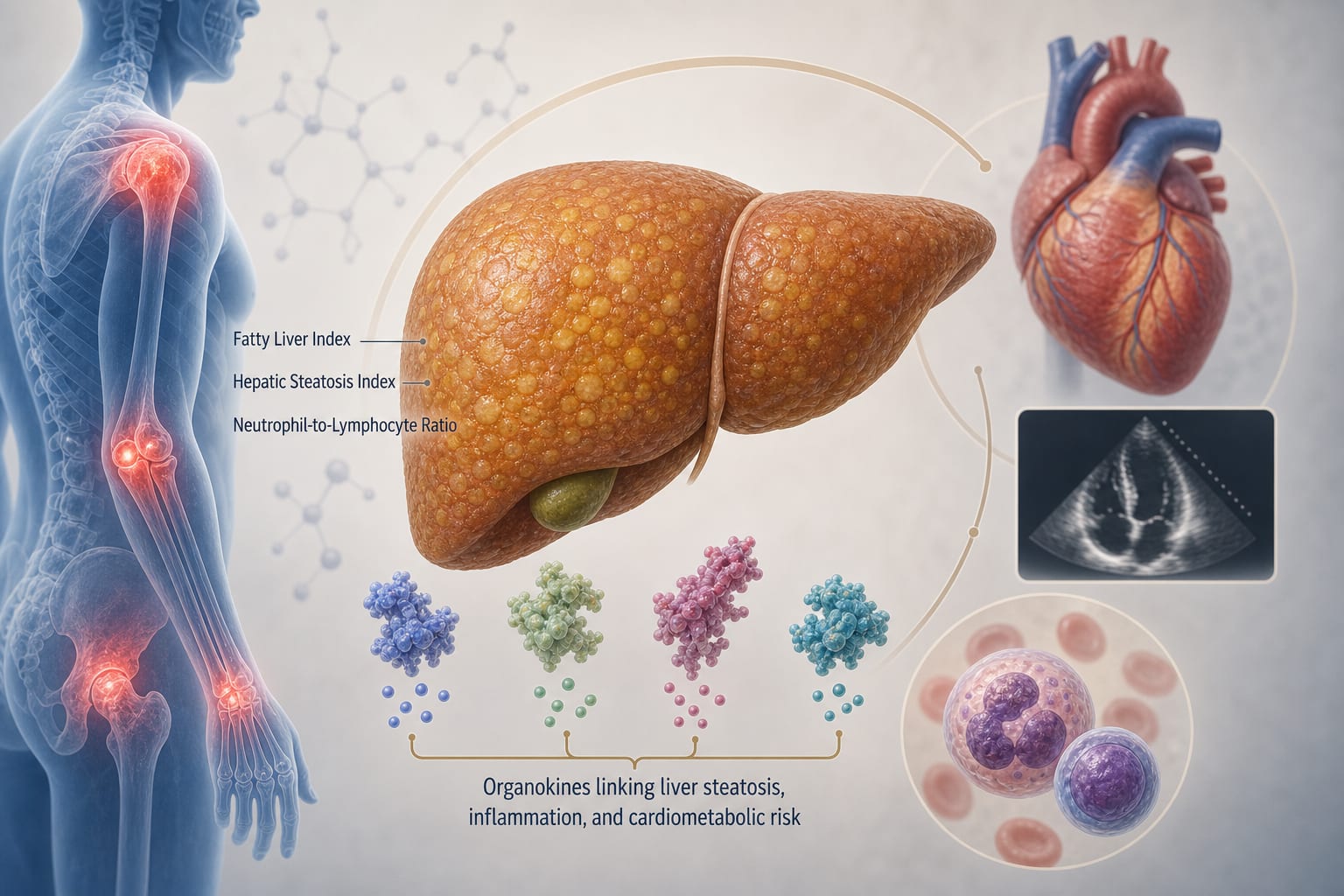
Association of Liver Steatosis, Specific Organokines, and Cardiovascular Risk Factors in Patients with Rheumatoid Arthritis
Overview
This study investigates the prevalence of metabolic dysfunction-associated steatotic liver disease (MASLD) in rheumatoid arthritis (RA) patients and evaluates the diagnostic performance of liver fat indices and organokines. Findings indicate that MASLD is present in approximately one-third of RA patients, with specific indices showing associations with cardiovascular risk factors.
Background
Metabolic dysfunction-associated steatotic liver disease (MASLD) is frequently observed in patients with rheumatoid arthritis (RA), often remaining undiagnosed due to its asymptomatic nature. Understanding the relationship between liver steatosis and cardiovascular risk in RA patients is important.
Data Highlights
Parameter
Value
Prevalence of MASLD
~33%
FLI AUC
0.81
HSI AUC
0.82
FLI Sensitivity
93%
FLI Specificity
58%
FABP4 Sensitivity
67%
FABP4 Specificity
89%
NLR OR for MASLD
2.53
Key Findings
Approximately one-third of RA patients were found to have MASLD.
The fatty liver index (FLI) and fatty acid binding protein 4 (FABP4) showed the best diagnostic discrimination for MASLD.
FLI was positively associated with cardiovascular risk scores and left ventricular diastolic dysfunction parameters.
The neutrophil-to-lymphocyte ratio (NLR) was significantly associated with an increased risk of MASLD.
FLI and HSI demonstrated moderate-to-good discrimination for ultrasound-defined MASLD.
Further investigation into FABP4 and fibroblast growth factor 21 (FGF21) as adjunctive biomarkers for MASLD is warranted.
Clinical Implications
The study highlights the importance of using non-invasive liver fat indices for early detection of MASLD in RA patients. Clinicians should consider the associations between liver steatosis and cardiovascular risk factors when managing RA patients to improve overall patient outcomes.
Conclusion
The study presents findings on the diagnostic utility of liver fat indices and their relationship with cardiovascular risk in RA patients.