Prediction models for sepsis-associated acute kidney injury: a systematic review and meta-analysis - Report - MDSpire
Coming Soon: Introducing MDSpire News. Learn more
Conexiant’s news site is now MDSpire News. Learn more

Systematic Review and Meta-Analysis of Predictive Models for Acute Kidney Injury Linked to Sepsis

  • By

  • Muze Huang

  • Shiyuan Wu

  • Zi-Han Shen

  • Sarena Jiayao Zhang

  • Yaw-syan Fu

  • Jingyi Wu

  • September 14, 2026

Share

Clinical Report: Systematic Review and Meta-Analysis of Predictive Models for Acute Kidney Injury Linked to Sepsis

Overview

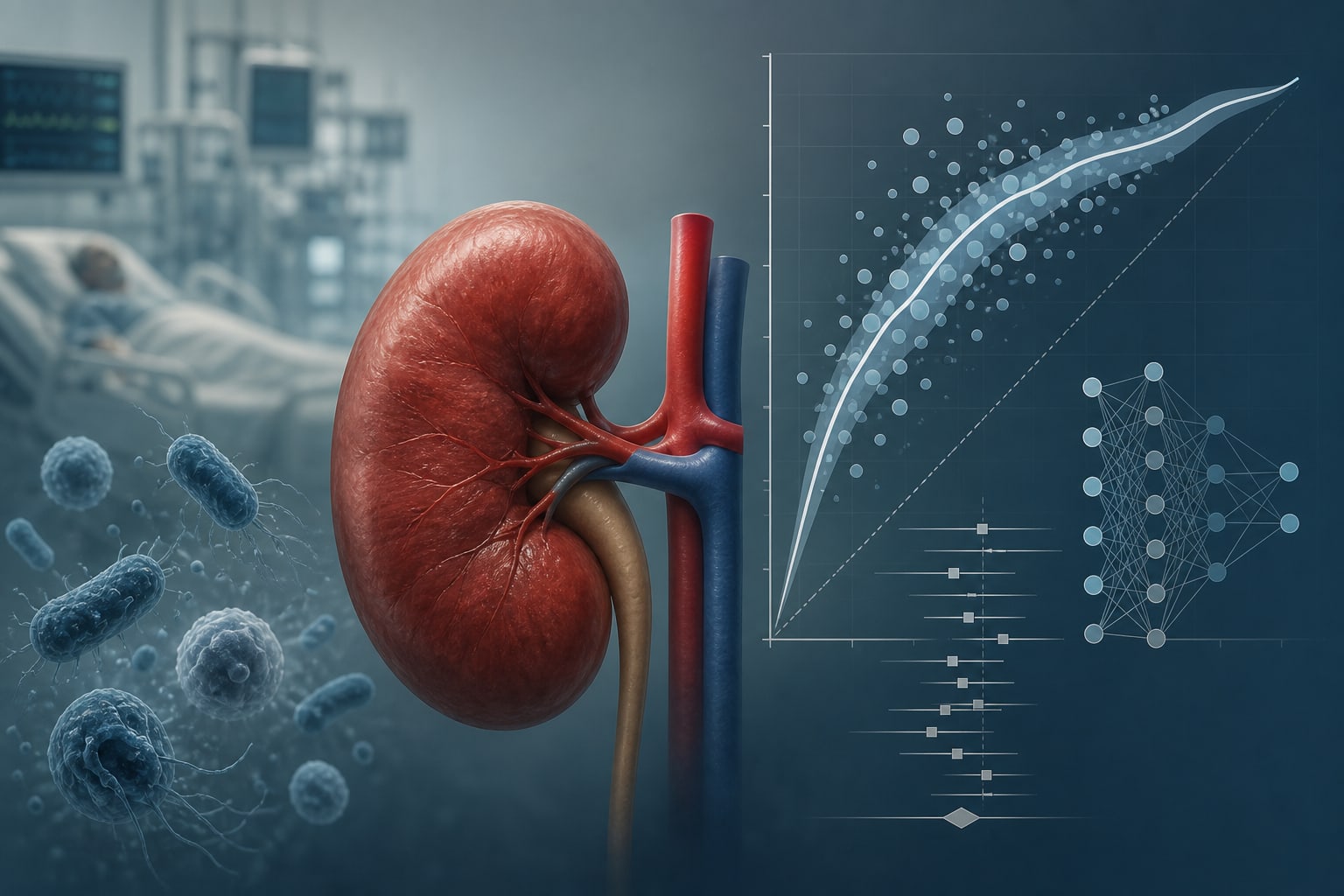
This systematic review and meta-analysis evaluates the performance of predictive models for sepsis-associated acute kidney injury (SA-AKI). The pooled C-statistic was 0.817, although significant heterogeneity exists among studies.

Background

Sepsis is a major cause of mortality in intensive care units, with acute kidney injury occurring in 40% to 50% of sepsis patients. Identifying patients at high risk for SA-AKI is critical for timely intervention. The development of reliable predictive models is essential to enhance early detection and management of this condition.

Data Highlights

MetricPooled Estimate95% CI
C-statistic0.8170.781–0.847
Heterogeneity (I²)92.8%-
Models in Asia C-statistic0.845-
Models in North America C-statistic0.777-
Low risk of bias C-statistic0.847-
High risk of bias C-statistic0.762-

Key Findings

  • The pooled C-statistic for SA-AKI prediction models was 0.817.
  • Substantial heterogeneity was observed among studies (I² = 92.8%).
  • Models developed in Asian regions showed a higher pooled C-statistic compared to those from North America (0.845 vs. 0.777).
  • Studies with a low risk of bias demonstrated better predictive performance than those with a high risk of bias (0.847 vs. 0.762).
  • No significant publication bias was detected (P = 0.1891).

Clinical Implications

Clinicians should consider the variability in model performance based on regional and bias-related factors.

Conclusion

The study highlights the moderate-to-good performance of current SA-AKI prediction models, emphasizing the need for further validation.
Related Resources & Content

  1. Author(s)/Org, Source, Year -- Title
  2. Author(s)/Org, Source, Year -- Title
  3. Author(s)/Org, Source, Year -- Title
  4. Author(s)/Org, Source, Year -- Title
  5. Surviving Sepsis Campaign: International Guidelines for Management of Sepsis and Septic Shock 2026 | SCCM
  6. KDIGO 2026 AKI/AKD Guideline Public Review Draft
  7. Sepsis-associated acute kidney injury: consensus report of the 28th Acute Disease Quality Initiative workgroup
  8. Prediction Models for Sepsis-Associated Acute Kidney Injury: A Systematic Review and Meta-Analysis
  9. Systematic Review and Meta-Analysis of Machine Learning Models for Acute Kidney Injury Risk Classification - PubMed
  10. Prediction of severe sepsis-associated acute kidney injury incorporating immune-inflammatory profiles: development and validation of a machine learning model in a multicenter prospective cohort study
  11. Surviving Sepsis Campaign Guidelines
  12. KDIGO 2026 AKI/AKD Guideline Public Review Draft
  13. Sepsis-associated acute kidney injury consensus report
  14. Frontiers | Prediction Models for Sepsis-Associated Acute Kidney Injury: A Systematic Review and Meta-Analysis
  15. Systematic Review and Meta-Analysis of Machine Learning Models for Acute Kidney Injury Risk Classification - PubMed
  16. Prediction of severe sepsis-associated acute kidney injury incorporating immune-inflammatory profiles: development and validation of a machine learning model in a multicenter prospective cohort study

Original Source(s)

Related Content