Clinical Report: Activity Monitoring With an Insertable Cardiac Monitor
Overview
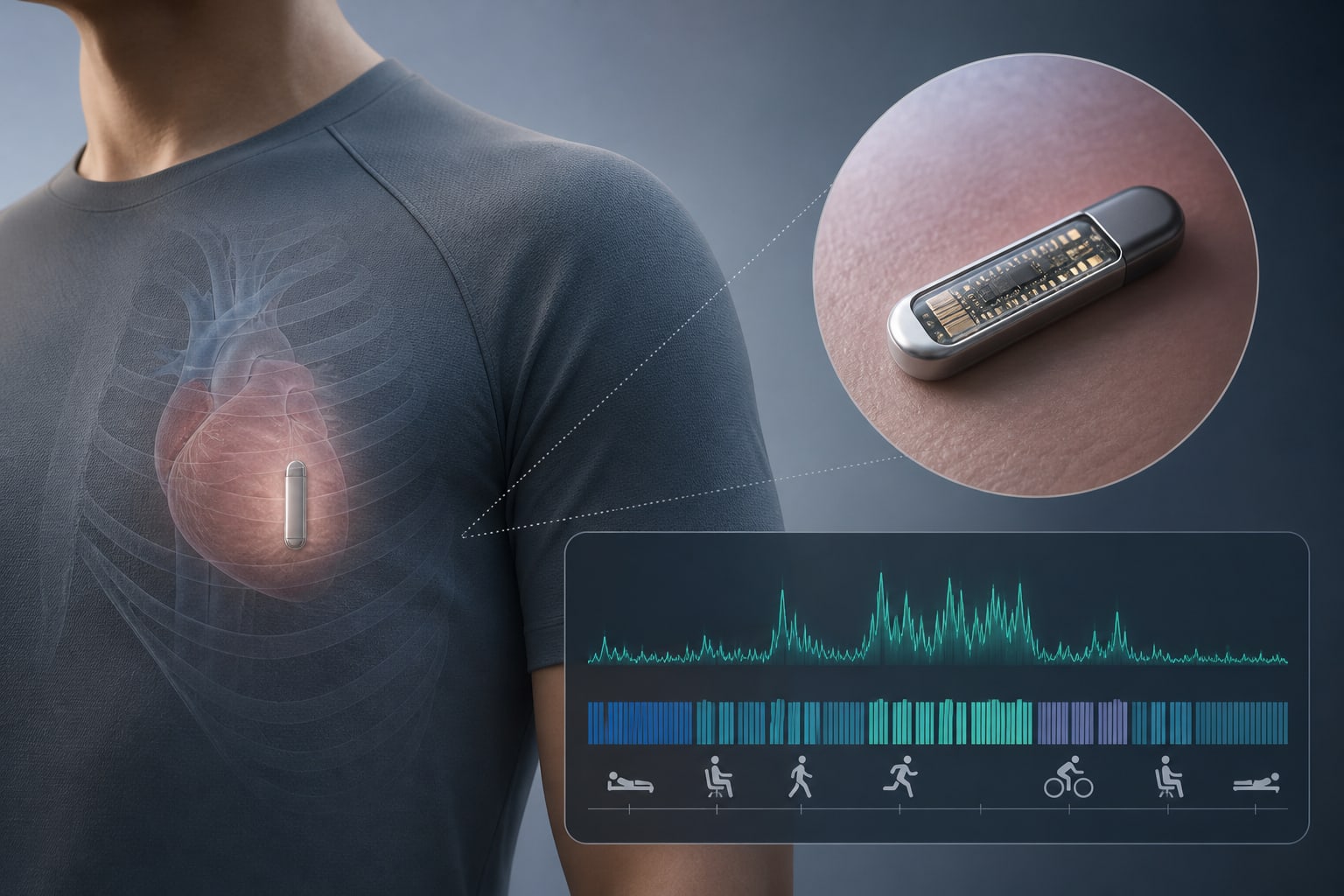
This subanalysis of LUX-Dx TRENDS evaluates accelerometer-derived activity signals and algorithm-based activity classification in ambulatory patients with heart failure. Signals increase with treadmill walking speed, and activity classification shows high agreement with a prespecified reference standard under controlled testing conditions.
Background
Pacemakers and implantable cardioverter-defibrillators commonly use accelerometers to monitor activity and inform rate-adaptive pacing. Insertable cardiac monitors (ICMs) are smaller, creating technical challenges when incorporating additional sensors. Accelerometer technology in ICMs could extend continuous activity monitoring to patients without an indication for a pacemaker or defibrillator. This subanalysis evaluates an embedded accelerometer and activity-classification algorithm in an investigational LUX-Dx ICM.
Data Highlights
Study element | Details reported |
|---|
Study | LUX-Dx TRENDS (NCT04790344), a multicenter, single-arm study; this report evaluates its exercise substudy. |
Population | The substudy includes 104 adults at 26 US sites with New York Heart Association class II or III heart failure across the spectrum of left ventricular ejection fraction. Device data are available for 56 participants in dataset 1 and 45 in dataset 2. |
Activity assessments | Participants maintain 4–5 stationary postures for approximately 5 minutes each and complete treadmill stages lasting approximately 3 minutes each. Speed increases from 0.7 to 3.2 mph in 0.5-mph increments; grade can subsequently increase in 2% increments to 12%. |
Signal analysis | Linear mixed-effects models with random intercepts and slopes evaluate the association between treadmill speed and stage-averaged accelerometer signals in milligravities (mG). |
Classification analysis | Dataset 2 is evaluated using Cohen’s kappa. The primary reference standard defines walking at ≥1.2 mph as active and stationary postures as inactive. The prespecified performance goal is κ > 0.8. Confidence intervals use 1000 subject-level bootstrap replicates. |
Results available in supplied material | Accelerometer signals increase by an estimated 33.7 mG per 1-mph increase in treadmill walking speed in dataset 1 and 32.3 mG in dataset 2 (both P < .0001). In dataset 2, activity-classification agreement is κ = 0.971 (95% CI, 0.947–0.985), exceeding the prespecified goal of κ > 0.8. Sensitivity is 0.974, specificity is 0.994, positive predictive value is 0.991, and negative predictive value is 0.982. |
Key Findings
Subcutaneous accelerometer signals show a strong positive association with treadmill walking speed in both datasets.
Algorithm-based activity classification in dataset 2 exceeds the prespecified agreement goal of κ > 0.8.
The primary analysis excludes the 0.7-mph treadmill stage because intermittent walking may introduce classification ambiguity.
The performance goal remains met when sensitivity analyses classify walking at 0.7 mph as either active or inactive.
Three enrolled participants do not contribute to either analysis dataset because device data are unavailable.
Clinical Implications
The findings demonstrate the feasibility of measuring activity using an accelerometer embedded in a miniaturized subcutaneous ICM. This technology may expand opportunities for objective activity monitoring in ambulatory patients. Further research should evaluate its real-world utility for detection, risk stratification, and patient management.
Limitations
Performance is assessed during controlled treadmill exercise and stationary postures; other activities, including biking and swimming, are not studied. Gait differences, treadmill calibration, operator compliance, reference-label inaccuracies, and external vibration may affect results. Effects of electromagnetic interference, temperature variation, and respiratory rate changes are not assessed. Stationary measurements may not reflect prolonged rest during sleep. Selection may exclude frailer or gait-limited patients, substantial attrition occurs at higher speeds, and algorithm performance is not evaluated within patient subgroups.
Conclusion
Subcutaneous accelerometer signals increase with treadmill walking speed, and the ICM algorithm accurately classifies activity against the prespecified reference standard under controlled conditions. The results support further investigation of ICM-based activity monitoring in ambulatory patients.
Related Resources & Content
Kadhiresan VA, Pastore J, Auricchio A, et al. A novel method—the activity log index—for monitoring physical activity of patients with heart failure. Am J Cardiol. 2002;89:1435–1437.
Richards M, Olshansky B, Sharma AD, et al. Addition of minute ventilation to rate-response pacing improves heart rate score more than accelerometer alone. Heart Rhythm. 2018;15:1730–1735.
Stansfield B, Hajarnis M, Sudarshan R. Characteristics of very slow stepping in healthy adults and validity of the activPAL3 activity monitor in detecting these steps. Med Eng Phys. 2015;37:42–47.
Frodi DM, Kolk MZH, Langford J, et al. Long-term adherence to a wearable for continuous behavioural activity measuring in the SafeHeart implantable cardioverter defibrillator population. Eur Heart J Digit Health. 2024;5:622–632.
Kolk MZH, Frodi DM, Andersen TO, et al. Accelerometer-assessed physical behavior and the association with clinical outcomes in implantable cardioverter-defibrillator recipients: a systematic review. Cardiovasc Digit Health J. 2022;3:46–55.
Singh B, Chastin S, Miatke A, et al. Real-world accuracy of wearable activity trackers for detecting medical conditions: systematic review and meta-analysis. JMIR Mhealth Uhealth. 2024;12:e56972.