Risk factors associated with postoperative lymphocele in patients with gynecological malignant tumors: a systematic review and meta-analysis - Report - MDSpire

Risk factors associated with postoperative lymphocele in patients with gynecological malignant tumors: a systematic review and meta-analysis

  • By

  • Ting-yu Zhao

  • Wen Jiang

  • Jia-min Liu

  • Zhi-yi Liu

  • Ping Xie

  • June 10, 2026

  • 0 min

Share

Clinical Report: Identifying Risk Factors for Postoperative Lymphocele

Overview

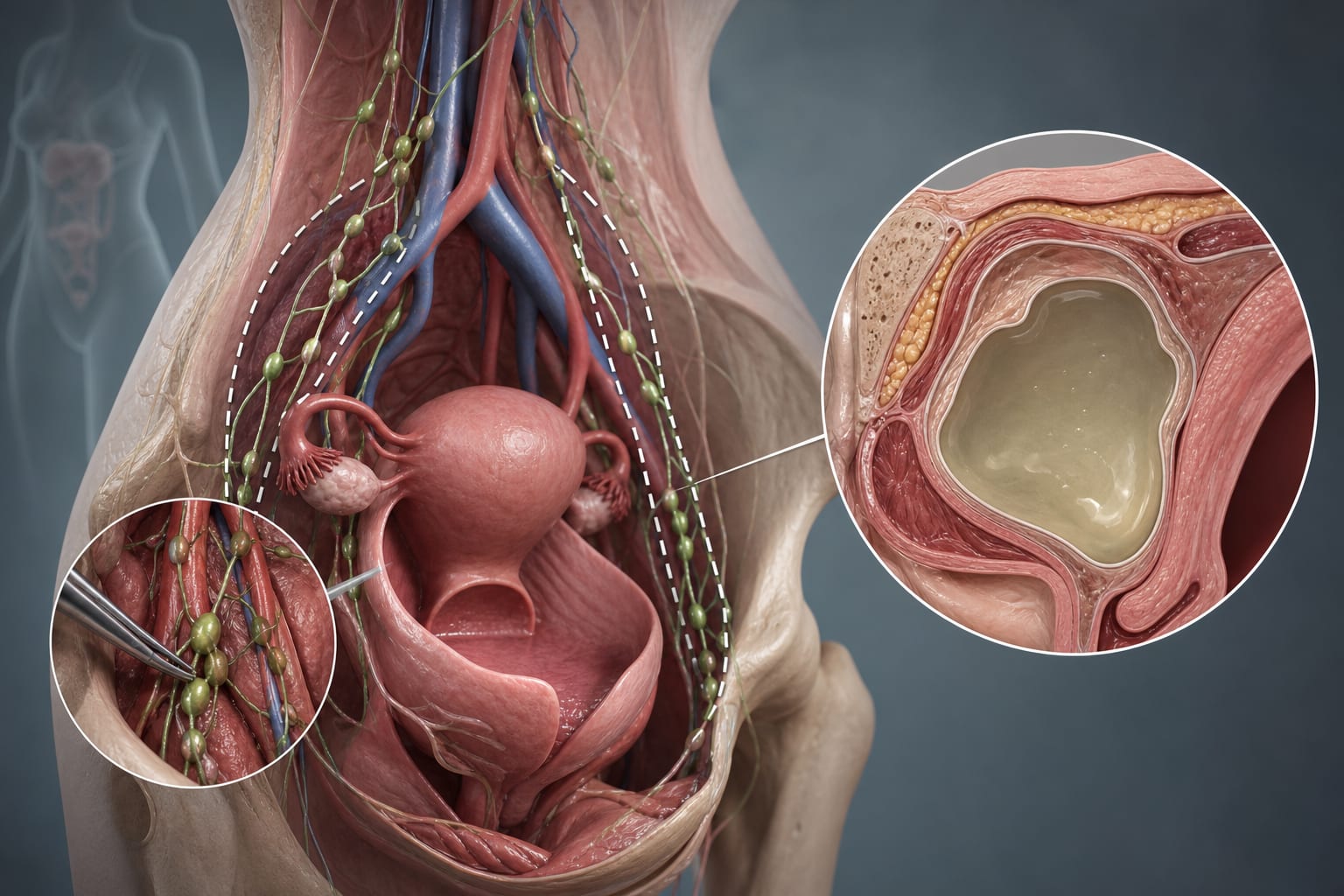
This systematic review and meta-analysis identifies significant risk factors for postoperative lymphocele in patients with gynecological malignancies, with a pooled incidence of 30.18%. Key factors include age, BMI, diabetes, and specific surgical procedures.

Background

Postoperative lymphocele is a common complication following lymph node dissection in gynecological surgeries, leading to significant morbidity and potential delays in adjuvant therapy. Understanding the risk factors associated with lymphocele formation is crucial for improving patient outcomes and guiding clinical management strategies.

Data Highlights

Risk FactorOdds Ratio (OR)95% Confidence Interval (CI)
Age >50 years1.211.02–1.42
BMI ≥24 kg/m²1.451.10–1.93
Diabetes mellitus1.301.11–1.52
Laparotomy2.762.12–3.58
Resection of >20 lymph nodes2.752.16–3.51

Key Findings

  • Pooled incidence of postoperative lymphocele is 30.18%.
  • Age >50 years is associated with an increased risk (OR = 1.21).
  • BMI ≥24 kg/m² significantly raises the risk (OR = 1.45).
  • Diabetes mellitus increases the odds of lymphocele formation (OR = 1.30).
  • Laparotomy is linked to a higher risk (OR = 2.76).
  • Resection of more than 20 lymph nodes also increases risk (OR = 2.75).

Clinical Implications

Clinicians should consider these identified risk factors when planning surgical interventions for patients with gynecological malignancies. Tailoring surgical approaches and postoperative management based on these factors may help mitigate the risk of lymphocele formation.

Conclusion

The findings highlight the importance of integrating various preoperative and surgical factors to stratify the risk of postoperative lymphocele in patients with gynecological malignancies. Further prospective studies are needed to validate these findings and refine prevention strategies.

Related Resources & Content

  1. Frontiers, 2026 -- Identifying Risk Factors for Postoperative Lymphocele in Patients with Gynecological Malignancies: A Systematic Review and Meta-Analysis
  2. 2025 ESGO–ESTRO–ESP Guidelines for Endometrial Cancer
  3. NEJM, 2025 -- Sentinel-Lymph-Node Biopsy Alone or with Lymphadenectomy in Cervical Cancer
  4. Updates in Surgery — A Comprehensive Review of Preoperative Imaging Factors Linked to Low Anterior Resection Syndrome (LARS) Development
  5. Surgical Endoscopy — Identifying Risk Factors for Low Anterior Resection Syndrome (LARS) in Patients Undergoing Laparoscopic Rectal Cancer Surgery
  6. Identifying Risk Factors for Postoperative Complications in Patients Receiving Cytoreductive Surgery with Hyperthermic Intraperitoneal Chemotherapy: A Systematic Review and Meta-Analysis
  7. Impact of Postoperative Complications on Five-Year Survival Rates After Laparoscopic Resection for Colorectal Cancer: A Retrospective Analysis
  8. https://guidelines.esgo.org/media/2025/09/ESGO-ESTRO-ESP-Guidelines-for-EC_-LO-July-2025.pdf
  9. Sentinel-Lymph-Node Biopsy Alone or with Lymphadenectomy in Cervical Cancer | New England Journal of Medicine
  10. Frontiers | Risk factors associated with postoperative lymphocele in patients with gynecological malignant tumors: a systematic review and meta-analysis

Original Source(s)

Related Content