The Potential of Ambient AI Innovations in Healthcare Education: Benefits and Safeguards
-
By
-
Shirin Shafazand
-
Umar Bowers
-
Sudha Jayaraman
-
September 8, 2026
Clinical Report: The Potential of Ambient AI Innovations in Healthcare Education
Overview
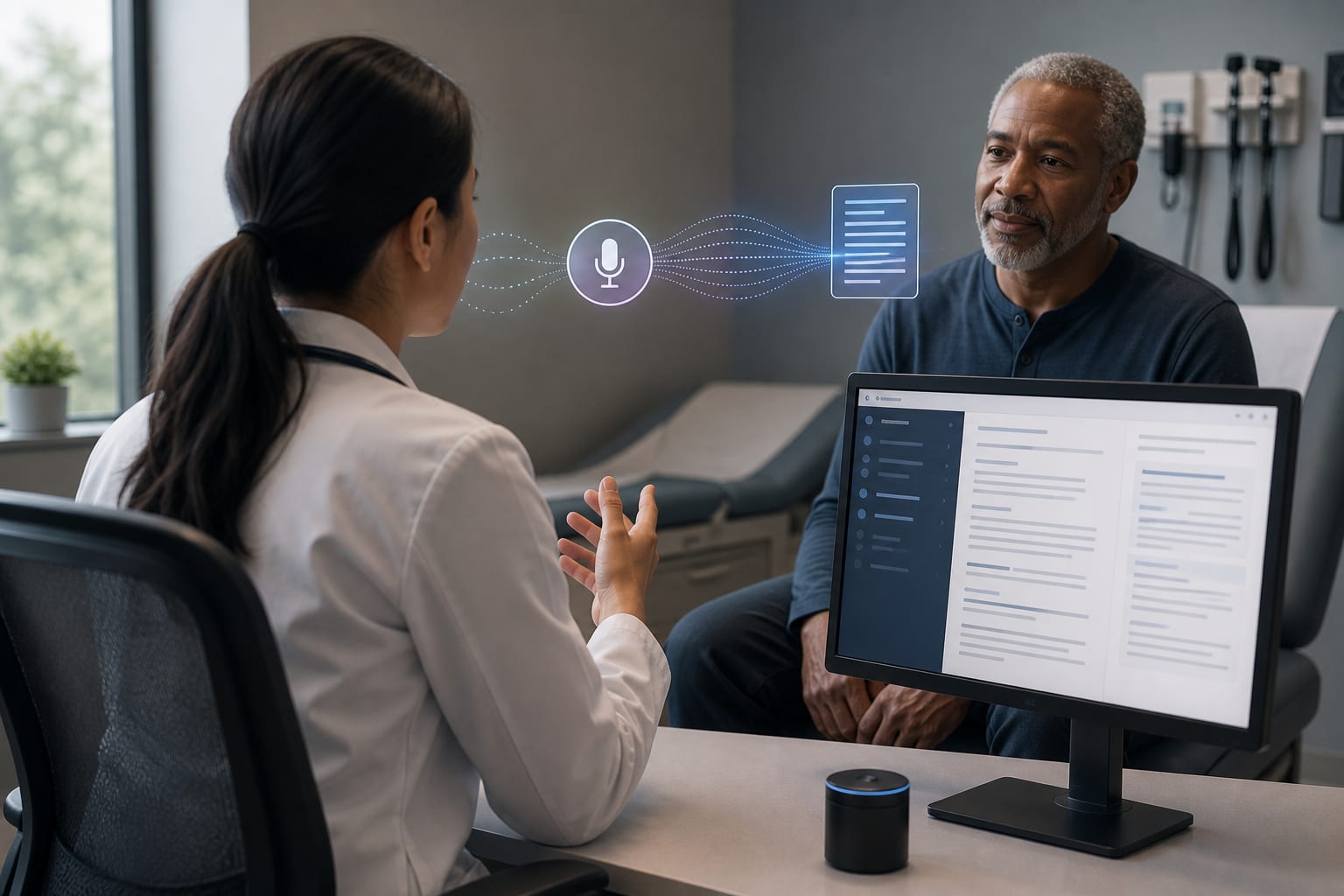
Ambient AI technologies have the potential to alleviate documentation burdens in healthcare, enhancing provider satisfaction and patient engagement. However, the implications for medical education require careful consideration.
Background
The integration of ambient AI in healthcare is poised to transform clinical workflows, similar to the transition from paper to electronic health records. This shift may significantly impact medical education, as trainees will likely encounter these technologies during their training.
Data Highlights
No numerical data or trial results were provided in the source material.
Key Findings
- Ambient AI can reduce administrative burdens, potentially decreasing provider burnout.
- Initial evaluations suggest ambient AI may enhance provider job satisfaction and patient engagement.
- Concerns exist regarding the accuracy and quality of ambient AI documentation.
- There is a lack of research on how ambient AI affects the acquisition of clinical documentation and reasoning skills in medical education.
- Medical educators must monitor the introduction of ambient AI.
Clinical Implications
The deployment of ambient AI in clinical settings should be approached with caution.
Conclusion
The impact of ambient AI on medical education and skill acquisition warrants further investigation.
Related Resources & Content
- Sarraf B, Ghasempour A, Front Public Health, 2025 -- Impact of artificial intelligence on electronic health record-related burnouts among healthcare professionals: systematic review
- Shah SJ, Crowell T, JAMA Netw Open, 2025 -- Physician perspectives on ambient AI scribes
- Zolnoori M, Vergez S, JAMIA Open, 2024 -- Decoding disparities: evaluating automatic speech recognition system performance
- Ng JJW, Wang E, BMC Med Inform Decis Mak, 2025 -- Evaluating the performance of artificial intelligence-based speech recognition for clinical documentation
- Afshar M, Resnik F, NEJM AI, 2025 -- A novel playbook for pragmatic trial operations to monitor and evaluate ambient artificial intelligence in clinical practice
- JMIR Medical Informatics — A Framework for Understanding the Integration of Ambient AI: Insights from Academic and Industry Perspectives
- Frontiers in Medicine — Integrating AI into undergraduate medical education: an exploration of learner-centered approaches through AI
- JMIR Medical Informatics — Selecting, Scaling, and Measuring the Value of Ambient AI in a Nonacademic Health System: Multiphase Pilot Study
- Frontiers in Medicine — Preparing Tomorrow's Physicians for AI-Driven Healthcare: Insights from a Study on Medical Students', Interns', and Residents' Knowledge, Attitudes, and Educational Needs
- A Framework for Understanding the Integration of Ambient AI
- Integrating AI into undergraduate medical education
- Selecting, Scaling, and Measuring the Value of Ambient AI in a Nonacademic Health System
- Preparing Tomorrow's Physicians for AI-Driven Healthcare
- A Regulation To Promote Responsible AI In Health Care
- Ambient AI Scribes in Clinical Practice: A Randomized Trial - PubMed
- An Artificial Intelligence Code of Conduct for Health and Medicine: Essential Guidance for Aligned Action | The National Academies Press
Based on findings from:
The Promise of Ambient AI Technology in Medical Education: Opportunities and Guardrails
Shirin Shafazand, Umar Bowers, Sudha Jayaraman. Jmir Medical Informatics, 2026.
https://medinform.jmir.org/2026/1/e88725
This content is an AI-generated, fully rewritten summary based on a published scholarly article. It does not reproduce the original text and is not a substitute for the original publication. Readers are encouraged to consult the source for full context, data, and methodology.