Clinical Report: EDI Performance Varies Across Patient Care Settings
Overview
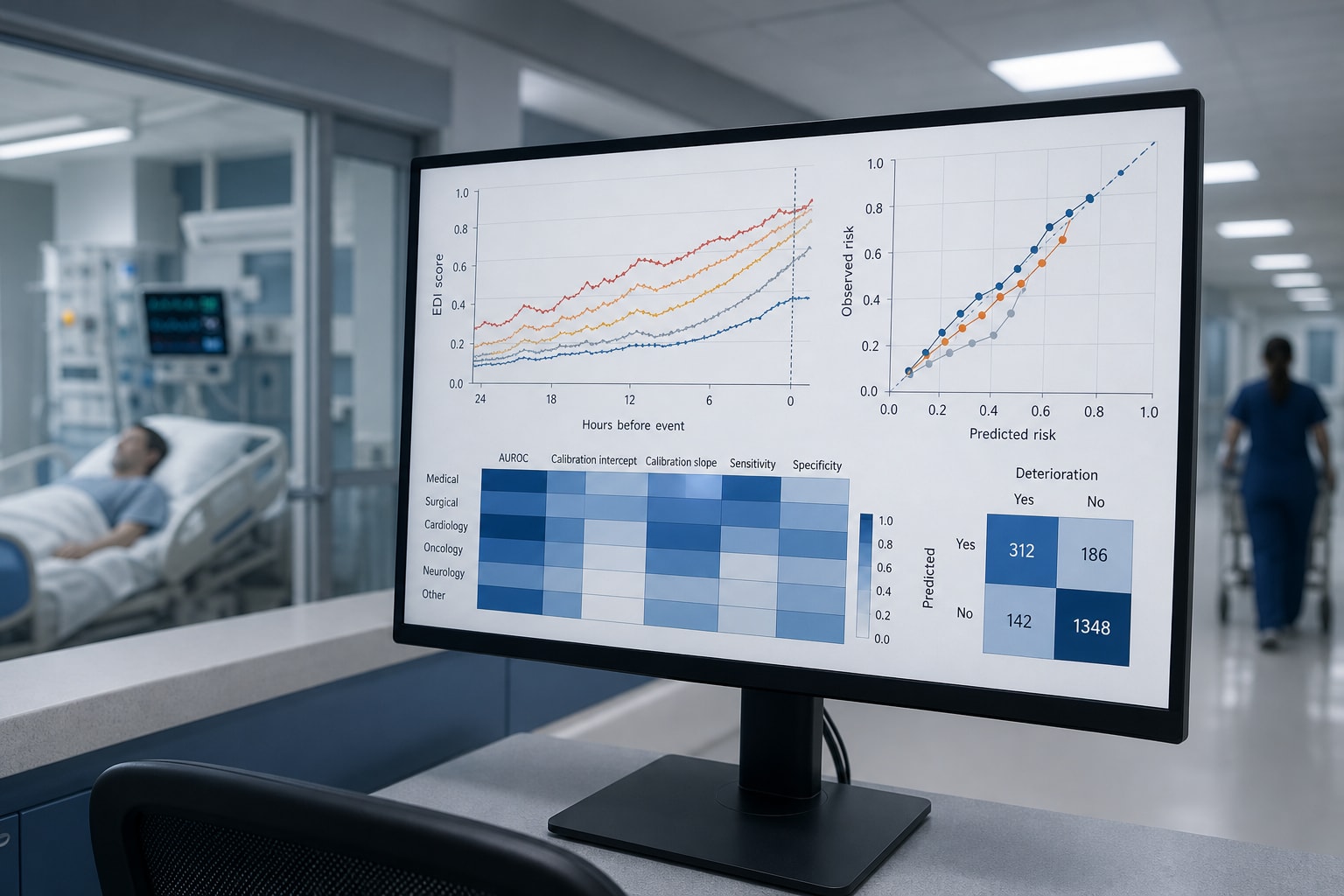
In a retrospective study of 77,478 adult inpatient encounters at one Northern California academic hospital, the Epic Deterioration Index (EDI) had an overall AUROC of 0.763 (95% CI 0.759–0.768) for the study’s deterioration outcomes. Discrimination varied by clinical service, with the highest AUROC in haematology/oncology/bone marrow transplant and the lowest in cardiology and neurosciences, supporting evaluation of performance across clinically meaningful subgroups.
Background
The EDI is a proprietary model used in US hospitals to predict clinical deterioration, and prior evaluations have reported hospital-wide discrimination while leaving uncertainty about performance across disease-focused subgroups. Broadly applied models may not capture differences in deterioration patterns, care environments, and workflows. The study assessed EDI performance by clinical service line and hospital location using outcomes including ICU transfer, rapid response team activation, initiation of comfort care, or death. Its authors state that understanding subgroup variation is important to safe, effective, and precise deployment in inpatient settings.
Data Highlights
Measure
Finding
Study design and setting
Retrospective cross-sectional study; adult inpatients at a Northern California academic hospital, 2021–2024
EDI values generated every 15 minutes; primary evaluation used a 12-hour prediction window, with sensitivity analyses at 2, 4, 8, and 24 hours
Key Findings
The study evaluated 77,478 encounters and 10,579 deterioration events.
Overall EDI discrimination was AUROC 0.763 (95% CI 0.759–0.768).
Performance differed across clinical services; the highest reported AUROC was 0.815 in haematology/oncology/bone marrow transplant.
The lowest reported service-line AUROCs were 0.670 in cardiology and 0.677 in neurosciences.
Comparable variation was observed across hospital locations.
The supplied related-article context lists oncology-focused prediction and response-system abstracts, but provides no results from those abstracts that can be compared quantitatively with this inpatient study.
Clinical Implications
The study authors state that safe, effective, and precise inpatient deployment depends on understanding how model performance varies among clinically meaningful patient subgroups. The reported service-line and location differences indicate that hospital-wide performance estimates alone may not describe performance in every care setting.
Conclusion
In this single-hospital evaluation, EDI discrimination varied substantially across clinical services and locations. The authors identify subgroup-specific performance assessment as important to deployment of inpatient predictive models.
Related Resources & Content
Study authors not provided, source not provided, year not provided -- Performance of a Commercial Clinical Deterioration Prediction Model Varies Across Patient Care Settings