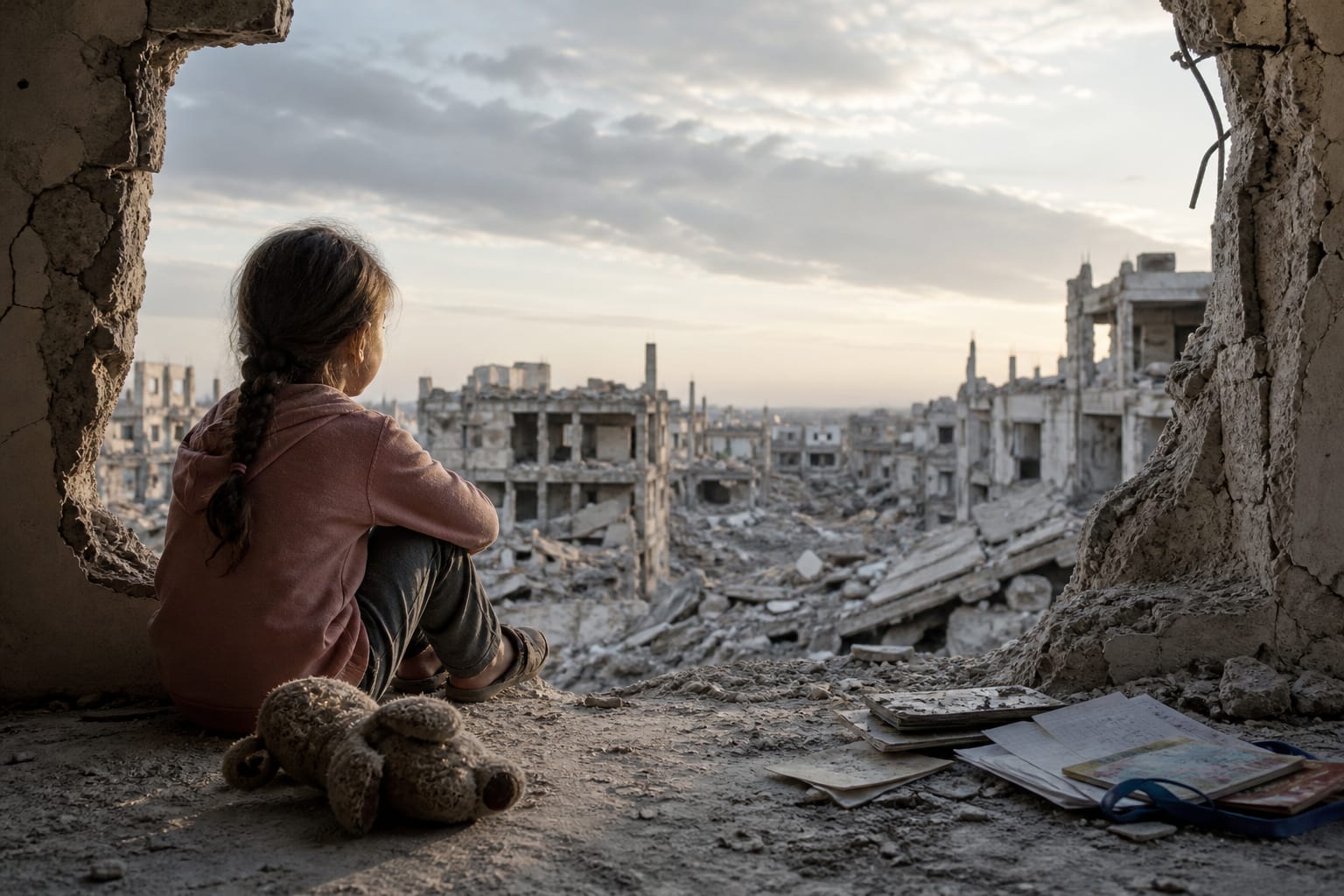
The Impact of War on Children’s Wellbeing and Development
-
By
-
Erwin Jiayuan Khoo
-
Barbara Rubio
-
Jeffrey Goldhagen
-
October 8, 2026
Clinical Report: The Impact of War on Children’s Wellbeing and Development
Overview
The article frames armed conflict as a political determinant of children’s health and development, with consequences for survival, education, healthcare, and recovery from trauma. It describes damage to civilian infrastructure and attacks on healthcare, and situates these harms within international legal obligations and the structural forces that sustain conflict.
Background
The article focuses on armed conflict because it engages binding duties under the UN Convention on the Rights of the Child, including protections related to survival and development, violence, health, education, and recovery. It describes war as an upstream political determinant that disrupts the conditions needed for children to survive, develop, learn, and recover. The related article on multiple crises reports that more than 473 million children live in conflict-affected areas, while the rehabilitation article describes intertwined physical and psychological harms amid disrupted healthcare. The source also identifies climate pressures, competition over extractable resources, external involvement, and the global arms trade as factors associated with the persistence and conduct of conflict.
Data Highlights
| Measure | Reported finding | Source context |
|---|---|---|
| Children in conflict-affected areas | More than 473 million | Related article: The Impact of Multiple Crises on Child Development and Children with Disabilities |
| School attacks in Gaza | 590 or more attacks; 88% of facilities damaged or destroyed | Main article context |
| Violent incidents involving healthcare | 655 incidents in 16 countries over two and a half years | ICRC Health Care in Danger study, as cited in the main article |
| Children living in conflict-affected areas | One in six | Related article: Children affected by armed conflict: rehabilitation as a global health responsibility |
Key Findings
- The article cites UNCRC Articles 6, 19, 24, 28, and 39 as establishing obligations concerning children’s survival and development, protection from violence, health, education, and recovery from trauma during conflict.
- In Gaza, the article reports at least 590 school attacks and damage to or destruction of 88% of educational facilities; it also reports repeated strikes on healthcare facilities.
- The article describes International Humanitarian Law principles of distinction, proportionality, humanity, and military necessity, and cites Additional Protocol I Article 58 on moving civilians and civilian objects away from military objectives wherever feasible.
- The ICRC study cited in the article recorded 655 violent incidents involving healthcare in 16 countries over two and a half years, including armed incursions, attacks on ambulances, and killing or abduction of healthcare personnel; the study considered the count an underestimate because insecurity impedes documentation.
- The related rehabilitation article reports that one in six children resides in a conflict-affected area and describes physical and psychological trauma occurring alongside disrupted and inadequate healthcare.
- The related multiple-crises article reports that more than 473 million children currently live in conflict-affected areas and identifies conflict alongside climate change, migration, pandemics, and economic inequalities as pressures on children.
Clinical Implications
The source describes conflict-related damage to healthcare infrastructure and loss of health workers as barriers to both care and recovery, while the related rehabilitation article identifies a need for professional, evidence-informed pediatric rehabilitation in crisis settings. The supplied web research context describes trauma-informed, developmentally appropriate care, integrated mental health and psychosocial support, pediatric blast-injury resuscitation guidance, and catch-up immunization as relevant clinical guidance; these recommendations are attributed to the named organizations and guidance documents in the references.
Conclusion
The article presents children’s harms in armed conflict as consequences of both direct violence and the disruption of protective systems, including education and healthcare. It links these effects to children’s rights and to legal obligations that remain applicable during conflict.
Related Resources & Content
- BMJ Paediatrics Open, 2026 -- The Impact of Multiple Crises on Child Development and Children with Disabilities
- BMJ Paediatrics Open, 2026 -- Children affected by armed conflict: rehabilitation as a global health responsibility
- International Committee of the Red Cross -- Health Care in Danger study, as cited in the article
- American Academy of Pediatrics, 2026 -- The Effects of Armed Conflict on Children and Adolescents: Policy Statement
- World Health Organization, 2026 -- Disarmament, demobilization and reintegration and mental health and psychosocial support: operational guidance
- National Institute for Health and Care Excellence -- Recommendations: Post-traumatic stress disorder, NG116
- Explosive Weapons Trauma Care Collective, 2026 -- Clinical Practice Guideline: Resuscitation of Pediatric Blast Injury Patient
- World Health Organization, 2025 -- Immunization in practice: a practical guide for health staff
- International Journal of Infectious Diseases — Infectious Complications of War-Related Injuries in Children: Experience from the Gaza Conflict
- BMJ Paediatrics Open — Communicating with families during armed conflict: when healthcare systems fracture but phones remain
- The Effects of Armed Conflict on Children and Adolescents: Policy Statement
- Disarmament, demobilization and reintegration and mental health and psychosocial support: operational guidance
- Recommendations | Post-traumatic stress disorder | NICE
- Explosive Weapons Trauma Care Collective Clinical Practice Guideline: Resuscitation of Pediatric Blast Injury Patient
- Immunization in practice: a practical guide for health staff
- Psychosocial and mental health interventions for children and adolescents in conflict: A systematic mapping review - University of Twente Research Information
- Evaluating digital mental health interventions for Middle East and North Africa children and adolescents affected by armed conflict: A systematic review - ScienceDirect
- Effectiveness of psychological interventions for mental health problems among war refugees: A systematic review and meta-analysis - ScienceDirect
- School-based psychosocial interventions for refugee and conflict-affected adolescents in Middle Eastern countries: a systematic review and meta-analysis.
- Effectiveness of a universal film intervention in reducing violence against children and increasing positive parenting among migrant and displaced caregivers from Myanmar: a community-based cluster randomised trial - The Lancet Regional Health – Southeast Asia
Based on findings from:
War and the destruction of wellbeing in children
Erwin Jiayuan Khoo, Barbara Rubio, Jeffrey Goldhagen. Bmj Paediatrics Open, 2026.
https://bmjpaedsopen.bmj.com/content/10/1/e005215
This content is an AI-generated, fully rewritten summary based on a published scholarly article. It does not reproduce the original text and is not a substitute for the original publication. Readers are encouraged to consult the source for full context, data, and methodology.