Spatial genetic mapping links shared inflammatory bowel disease liability to adult immune–epithelial lesion contexts - Report - MDSpire

Spatial genetic mapping links shared inflammatory bowel disease liability to adult immune–epithelial lesion contexts

  • By

  • Guangyi Tao

  • Hanzhe Du

  • Jun Zhao

  • Zhonghe Zeng

  • Junwu Cui

  • Longming Lei

  • July 8, 2026

  • 0 min

Share

Clinical Report: Genetic Spatial Mapping Reveals Connections in IBD

Overview

This study identifies strong genetic correlations among inflammatory bowel disease (IBD) subtypes and highlights the spatial contexts of genetic susceptibility in adult immune-epithelial lesions. Key findings include the prioritization of immune-inflammatory candidates and significant enrichment of genetic signals in specific tissue regions.

Background

Inflammatory bowel disease (IBD), comprising Crohn’s disease (CD) and ulcerative colitis (UC), presents significant clinical heterogeneity and therapeutic challenges. Understanding the genetic underpinnings and spatial expression of IBD susceptibility is crucial for developing targeted therapies and improving patient outcomes. This research integrates genetic data with spatial mapping to elucidate the tissue-specific contexts of IBD.

Data Highlights

CorrelationrgP-value
Overall IBD vs CD0.94581.79 × 10−8
Overall IBD vs UC1.09073.48 × 10−6
CD vs UC0.95350.0133

Key Findings

  • Strong positive genetic correlations were found among overall IBD, CD, and UC.
  • Immune-inflammatory candidates prioritized include IL23R, JAK2, STAT3, CCL2, NOD2, and HLA-region genes.
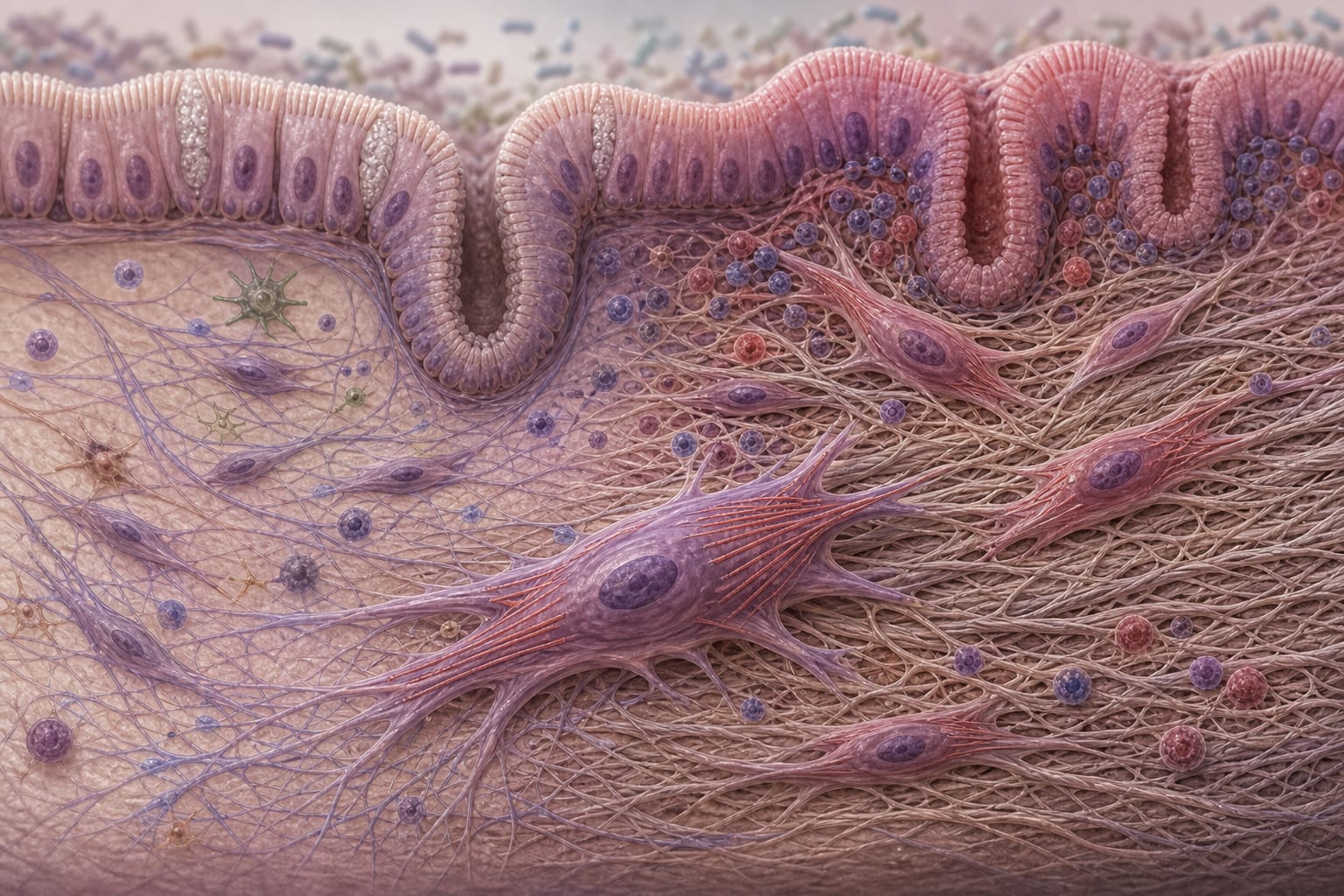
  • Significant enrichment of overall IBD signals was observed in immune regions of SCP2959 CD and idiopathic UC inflamed tissue.
  • RT-qPCR demonstrated that JAK2 knockdown reduced cytokine-induced CCL2 and CXCL8 expression.
  • Exploratory developmental mapping revealed nominal signals in various tissue regions, including gastrointestinal and neural areas.

Clinical Implications

Understanding the spatial relationships of genetic susceptibility in IBD may aid in identifying potential targets for intervention in IBD management.

Conclusion

This research provides insights into the genetic and spatial dimensions of IBD susceptibility, linking them to adult immune-epithelial inflammatory lesions.

Related Resources & Content

  1. Journal of Crohn's and Colitis, 2023 -- Spatial transcriptomics and immunophenotyping uncover chronic inflammation-induced immune adaptations favoring dysplasia development in patients at risk of colitis-associated cancer
  2. Frontiers in Immunology, 2023 -- Editorial: Genetics, microbiomes, and environmental factors in autoimmunity: from bench to bedside
  3. Journal of Gastroenterology, 2013 -- The Interplay of Diet, Microbiota, and Genetic Factors in Inflammatory Bowel Disease Development
  4. Journal of Crohn's and Colitis, 2023 -- Spatial transcriptomics reveals unique inflammatory signatures across all anatomic locations in postoperative Crohn’s disease
  5. Pharmacological management of moderate-to-severe Crohn’s disease – American Gastroenterological Association, 2023
  6. Efficacy and safety of intravenous induction and subcutaneous maintenance therapy with guselkumab for patients with Crohn's disease (GALAXI-2 and GALAXI-3): 48-week results from two phase 3, randomised, placebo and active comparator-controlled, double-blind, triple-dummy trials - ScienceDirect, 2023
  7. Cell-type-resolved genetic variation shapes inflammatory bowel disease risk | Nature, 2023
  8. Pharmacological management of moderate-to-severe Crohn’s disease – American Gastroenterological Association
  9. Efficacy and safety of intravenous induction and subcutaneous maintenance therapy with guselkumab for patients with Crohn's disease (GALAXI-2 and GALAXI-3): 48-week results from two phase 3, randomised, placebo and active comparator-controlled, double-blind, triple-dummy trials - ScienceDirect
  10. Cell-type-resolved genetic variation shapes inflammatory bowel disease risk | Nature

Original Source(s)

Related Content