Hemorrhage-coagulation immune phenotype is associated with CD163/HO-1-enriched heme-processing macrophage remodeling and predicts recurrence in colorectal cancer: a real-world retrospective cohort study - Report - MDSpire
Advertisement
Hemorrhage-coagulation immune phenotype is associated with CD163/HO-1-enriched heme-processing macrophage remodeling and predicts recurrence in colorectal cancer: a real-world retrospective cohort study
Clinical Report: Association of Hemorrhage-Coagulation Immune Phenotype in CRC
Overview
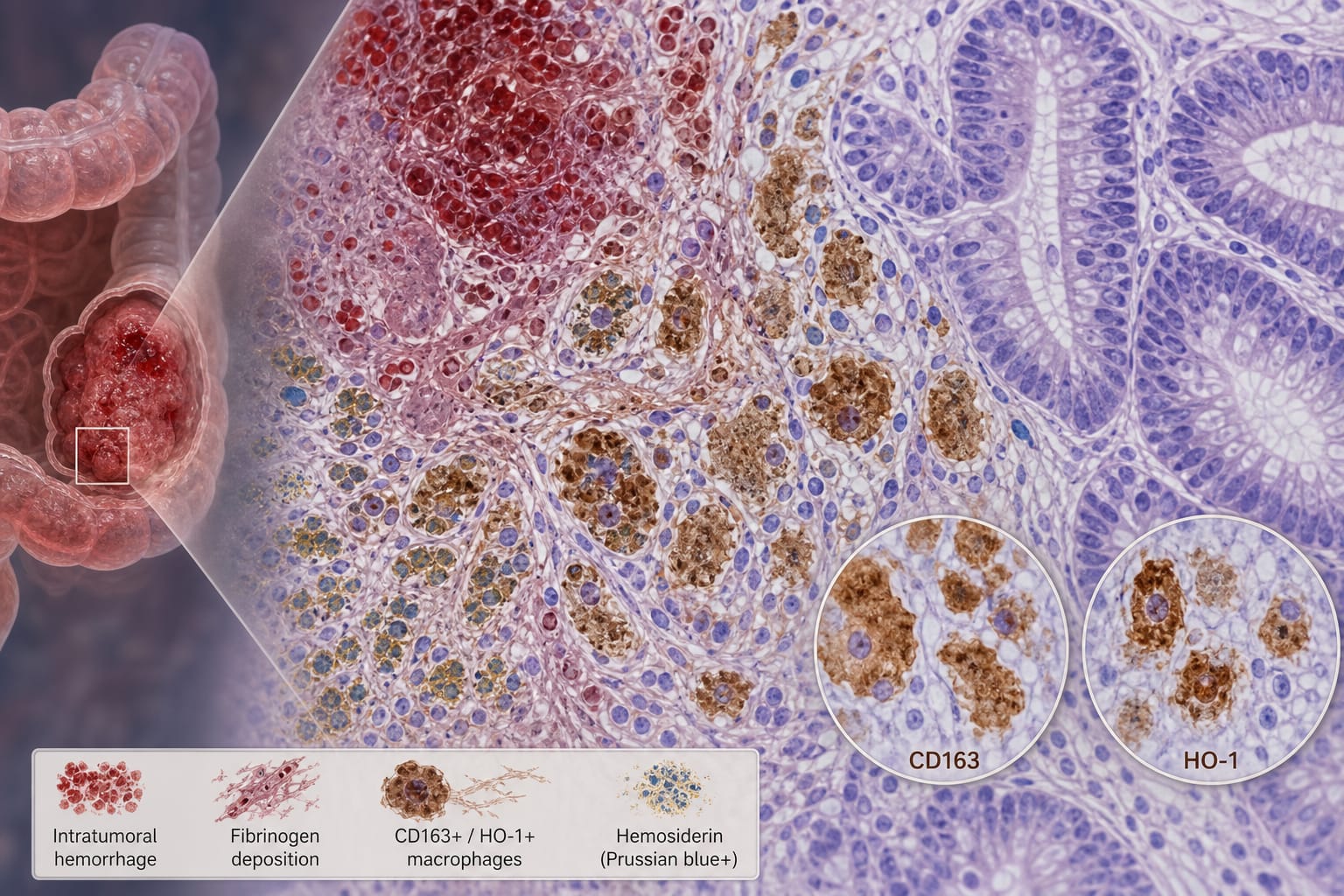
This study identifies a hemorrhage-coagulation immune phenotype (HCIP) in colorectal cancer that correlates with CD163/HO-1-enriched macrophage remodeling and recurrence-free survival (RFS).
Background
Colorectal cancer is a leading cause of cancer-related mortality, and recurrence after surgery poses significant challenges in patient management. Understanding the immune microenvironment, particularly the roles of macrophages and coagulation, is crucial for improving prognostic assessments and therapeutic strategies.
Data Highlights
Characteristic
HCIP-Poor Tumors
HCIP-Other Tumors
AJCC Stage
Advanced
Less Advanced
Tumor Size
Larger
Smaller
Ulceration
More Frequent
Less Frequent
Necrosis
More Frequent
Less Frequent
CD8+ T-cell Density
Lower
Higher
CD163+ Macrophage Density
Higher
Lower
Key Findings
HCIP-poor tumors are associated with advanced AJCC stage and larger tumor size.
These tumors exhibit lower CD8+ T-cell density and higher CD163+ macrophage density.
HCIP-poor status correlates with worse recurrence-free survival (adjusted HR 1.91).
Fibrinogen is identified as the most stable marker associated with RFS.
Inclusion of HCIP and its components provides modest incremental prognostic value beyond clinical variables.
Clinical Implications
The identification of HCIP may assist clinicians in stratifying colorectal cancer patients based on recurrence risk.
Conclusion
The study establishes HCIP as a relevant immune phenotype in colorectal cancer, linking local hemorrhagic pathology and systemic coagulation with recurrence risk.