Development and validation of a multimodal predictive model based on clinical, biochemical, and quantitative dual-energy CT parameters: for predicting the benignity and malignancy of thyroid nodules - Report - MDSpire
Advertisement
Development and validation of a multimodal predictive model based on clinical, biochemical, and quantitative dual-energy CT parameters: for predicting the benignity and malignancy of thyroid nodules
Clinical Report: Predictive Model for Distinguishing Thyroid Nodules
Overview
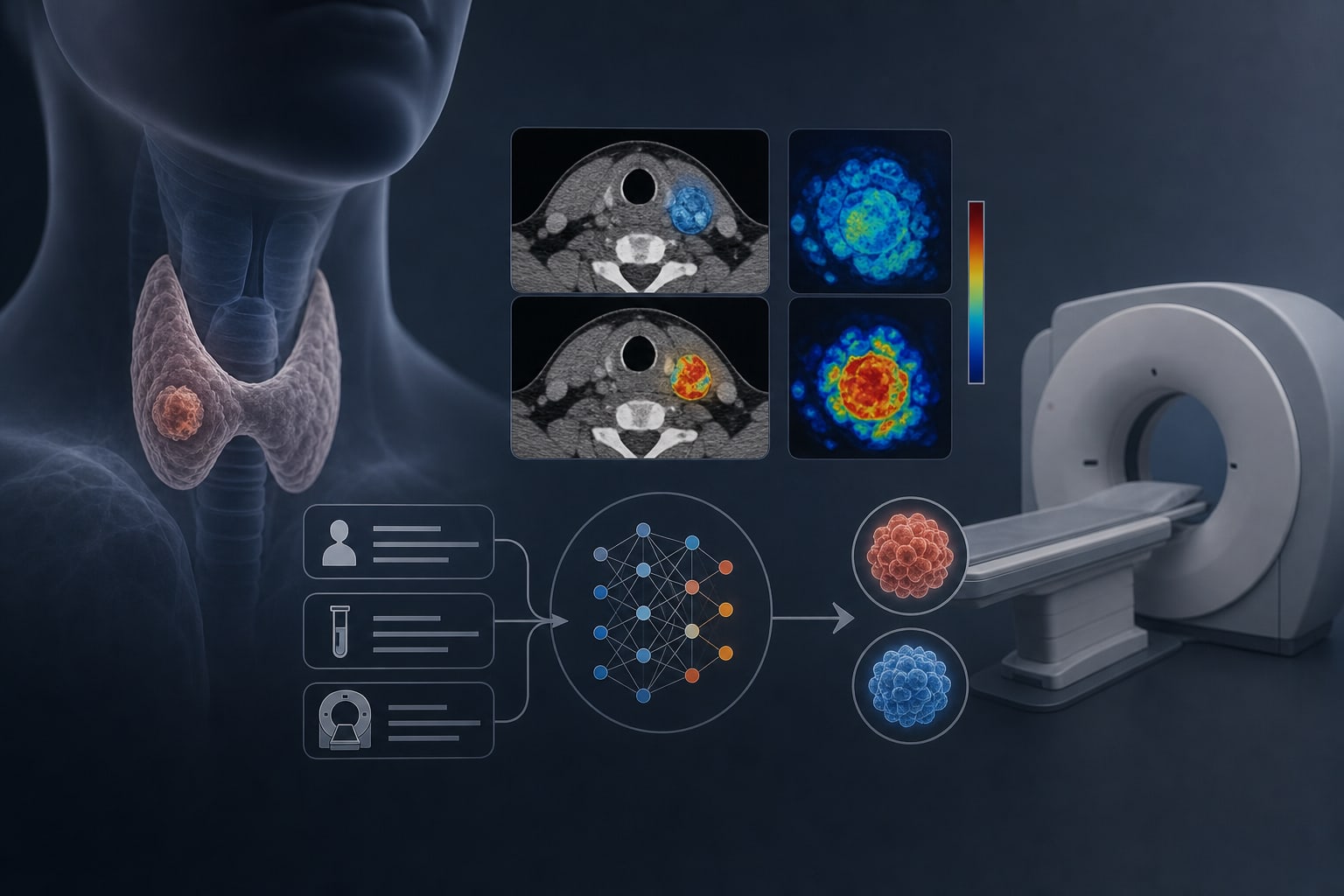
This study developed a predictive model combining clinical, biochemical, and DECT parameters to differentiate between benign and malignant thyroid nodules.
Background
Thyroid cancer is the most prevalent endocrine malignancy, with a rising incidence, particularly among women. Accurate differentiation between benign and malignant thyroid nodules is crucial, as current methods like fine-needle aspiration biopsy often yield indeterminate results. Advanced imaging techniques, including dual-energy CT, provide valuable quantitative data that can enhance preoperative assessments.
Data Highlights
Predictor
Odds Ratio (OR)
p-value
Age
0.93
<0.001
TSH
1.65
0.037
Thyroid Nodule Volume (TV)
0.91
0.017
AUC (Training Cohort)
0.866
N/A
AUC (Validation Cohort)
0.852
N/A
Key Findings
The predictive model integrates clinical, biochemical, and DECT parameters.
Age, TSH, and thyroid nodule volume were identified as independent predictors of malignancy.
The model achieved an AUC of 0.866 in the training cohort and 0.852 in the validation cohort.
Goodness-of-fit tests indicated an acceptable model fit.
Calibration curves showed good agreement between predicted and observed outcomes.
Clinical Implications
The developed predictive model may assist clinicians in accurately stratifying the risk of malignancy in thyroid nodules, potentially reducing unnecessary surgical interventions. This tool offers a non-invasive approach to enhance patient management.
Conclusion
The study successfully created a multimodal predictive model for thyroid nodules.