Environmental and family correlates of daily TV-watching time in children with autism spectrum disorder and typically developing children - Report - MDSpire

Environmental and family correlates of daily TV-watching time in children with autism spectrum disorder and typically developing children

  • By

  • Preeta Rajandran

  • Sophia Ang

  • Woonyoung Song

  • Jaehoon Lee

  • Shin Ying Chu

  • Onn Wah Lee

  • Pui Juan Woi

  • Ling-Yi Lin

  • Chien-Ju Chang

  • June 22, 2026

  • 0 min

Share

Clinical Report: Influence of Environmental and Familial Factors on TV Viewing in ASD

Overview

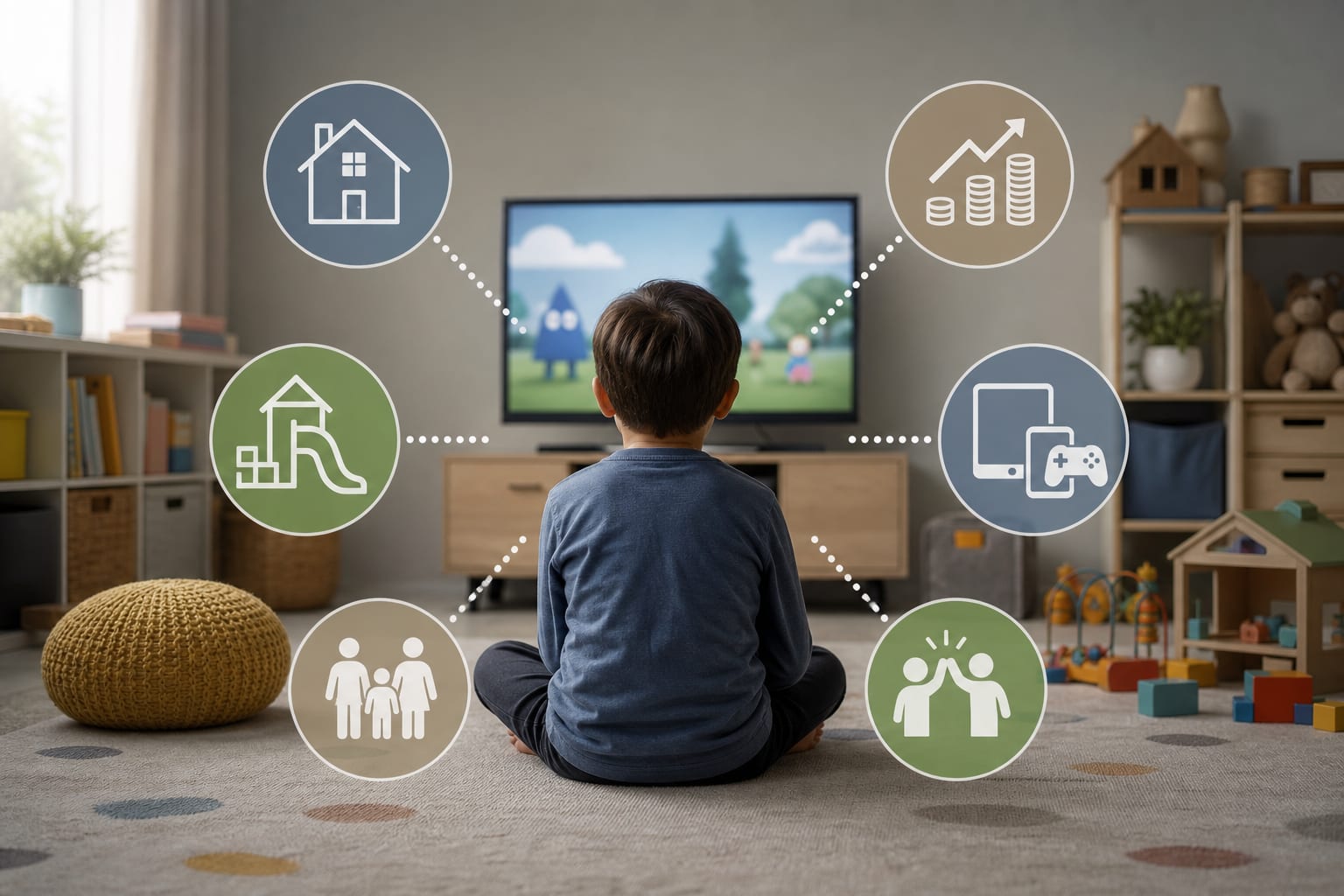
This study examines the impact of environmental and familial factors on daily television viewing time in children with autism spectrum disorder (ASD) compared to typically developing (TD) peers. Key findings indicate that family interaction during holidays and the availability of indoor play spaces are associated with TV watching habits.

Background

Understanding the factors that influence screen time in children, particularly those with ASD, is crucial given the potential adverse effects of excessive television viewing on cognitive and social-emotional development. The World Health Organization recommends limiting screen exposure for young children.

Data Highlights

GroupDaily TV Watching Time (Mean ± SD)
ASD1.88 ± 1.57 h
TD2.03 ± 1.26 h

Key Findings

  • Children with ASD watched slightly less TV daily than TD children.
  • Non-television electronic device usage time significantly predicts longer TV watching time (p < .001).
  • Indoor space availability is associated with lower TV watching time (p = .012).
  • Higher family interaction during holidays correlates with reduced TV watching time in children with ASD.
  • Lower socioeconomic status is linked to increased TV watching time.

Clinical Implications

Clinicians and caregivers should consider the role of family engagement and environmental factors in managing screen time for children with ASD.

Conclusion

The findings indicate the importance of family involvement and environmental conditions in shaping television viewing behaviors among children with ASD.

Related Resources & Content

  1. Frontiers in Pediatrics, 2026 -- Environmental and family correlates of daily TV-watching time in children with autism spectrum disorder and typically developing children
  2. Guidelines on physical activity, sedentary behaviour and sleep for children under 5 years of age, WHO
  3. Frontiers in Psychiatry — Developmental outcomes of young children with an autism diagnosis and its associated clinical correlates
  4. Frontiers in Psychiatry — Factors influencing the sensory profile in patients with autism spectrum disorder from 16 months to 14 years: results of an observational study
  5. npj Digital Medicine — Quantitative Evaluation of Atypical Facial Expression Patterns in Children with Autism Spectrum Disorder Through Naturalistic Interaction Dynamics
  6. Frontiers in Psychiatry — Narrative and visual attention in autism spectrum disorder: a cross-cultural perspective
  7. Guidelines on physical activity, sedentary behaviour and sleep for children under 5 years of age
  8. A Systematic Review of the Association Between Screen-Based Media Device Use and Sleep Outcomes in Autistic Children and Adolescents | Review Journal of Autism and Developmental Disorders | Springer Nature Link
  9. Frontiers | Environmental and family correlates of daily TV-watching time in children with autism spectrum disorder and typically developing children

Original Source(s)

Related Content