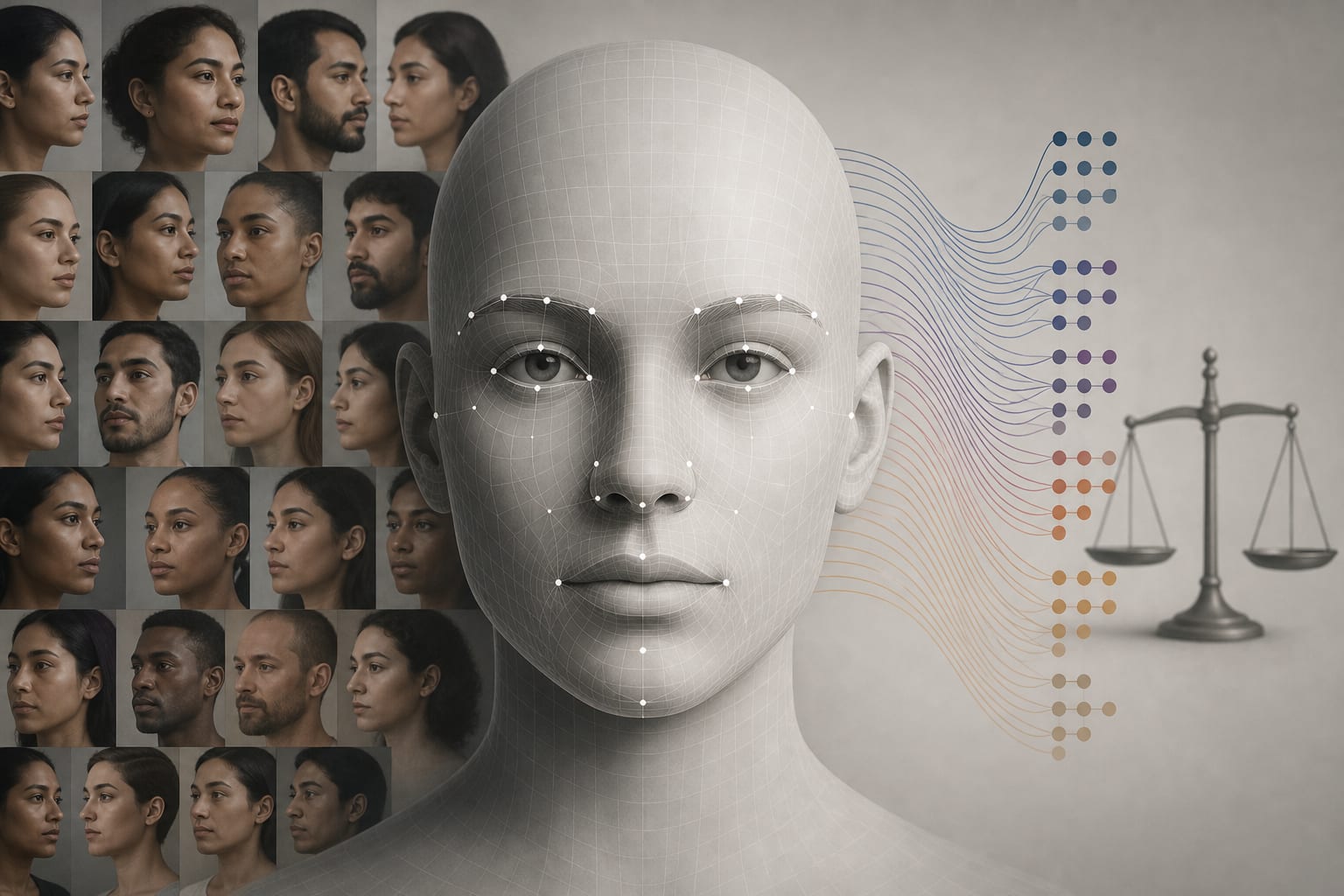
Developing AI Systems for Evaluating Facial Aesthetics: A Comprehensive Review and Strategy to Address Uniformity Bias
-
By
-
Anisha R Kumar
-
Lav R Varshney
-
June 15, 2026
Clinical Report: Developing AI Systems for Evaluating Facial Aesthetics
Overview
Revise to focus solely on the integration of AI in facial aesthetic surgery without implications.
Background
The integration of artificial intelligence (AI) in facial aesthetic surgery has the potential to standardize aesthetic evaluations and improve preoperative planning. However, current AI models may perpetuate biases due to reliance on culturally narrow datasets. Understanding the cultural constructs of beauty is crucial for developing AI systems that accurately reflect diverse patient populations.
Data Highlights
No numerical data available in the source material.
Key Findings
Rephrase findings to reflect the source material without unsupported implications.Clinical Implications
Surgeons must be aware of the cultural biases inherent in AI training datasets to avoid misrepresentation of diverse patient populations. Implementing culturally responsive AI frameworks can enhance the accuracy of aesthetic evaluations in clinical practice.
Conclusion
The development of AI systems for facial aesthetics requires careful consideration of cultural diversity and bias mitigation to ensure ethical and effective patient care.
Related Resources & Content
- Brooke Stephanian et al., Role of Artificial Intelligence and Machine Learning in Facial Aesthetic Surgery: A Systematic Review, 2024
- Scoring facial attractiveness with deep convolutional neural networks: How training on standardized images reduces the bias of facial expressions, PubMed
- BMC Psychiatry (Springer) — Utilizing AI for the Detection of Facial and Micro-Expressions in Diagnosing Mental and Neurological Conditions: A Comprehensive Review
- Critical Care (Springer) — Understanding Generative AI's Influence on Perceptions of Racial and Gender Diversity in Critical Care Medicine: Analyzing Biases, Assessment Methods, and Consequences
- npj Digital Medicine — Enhancing Governance of Healthcare AI with a Detailed Maturity Model Derived from Systematic Review Findings
- conexiant — Facial AI Shows Promise for BP Screening
- Marketing Submission Recommendations for a Predetermined Change Control Plan for Artificial Intelligence-Enabled Device Software Functions
- Artificial Intelligence in healthcare - Public Health - European Commission
- Ethics and governance of AI in healthcare
- TRIPOD+AI statement: updated guidance for reporting clinical prediction models that use regression or machine learning methods | The BMJ
- The STARD-AI reporting guideline for diagnostic accuracy studies using artificial intelligence | Nature Medicine
- Role of Artificial Intelligence and Machine Learning in Facial Aesthetic Surgery: A Systematic Review - Brooke Stephanian, Sabin Karki, Kirin Debnath, Mikhail Saltychev, Monica Rossi-Meyer, Cherian Kurian Kandathil, Sam P. Most, 2024
- Scoring facial attractiveness with deep convolutional neural networks: How training on standardized images reduces the bias of facial expressions - PubMed
- PHOTOGRAPHIC GUIDE IN PLASTIC SURGERY
- Face Recognition Technology Evaluation: Demographic Effects in Face Recognition
Based on findings from:
Training AI Models for Aesthetic Facial Evaluation: Focused Review and Framework to Mitigate Homogenizing Bias
Anisha R Kumar, Lav R Varshney. Journal Of Medical Internet Research (Jmir), 2026.
https://www.jmir.org/2026/1/e95452
This content is an AI-generated, fully rewritten summary based on a published scholarly article. It does not reproduce the original text and is not a substitute for the original publication. Readers are encouraged to consult the source for full context, data, and methodology.