Astaxanthin as a potential therapeutic agent in polycystic ovary syndrome: a review of its antioxidant, anti-inflammatory, and metabolic mechanisms - Report - MDSpire

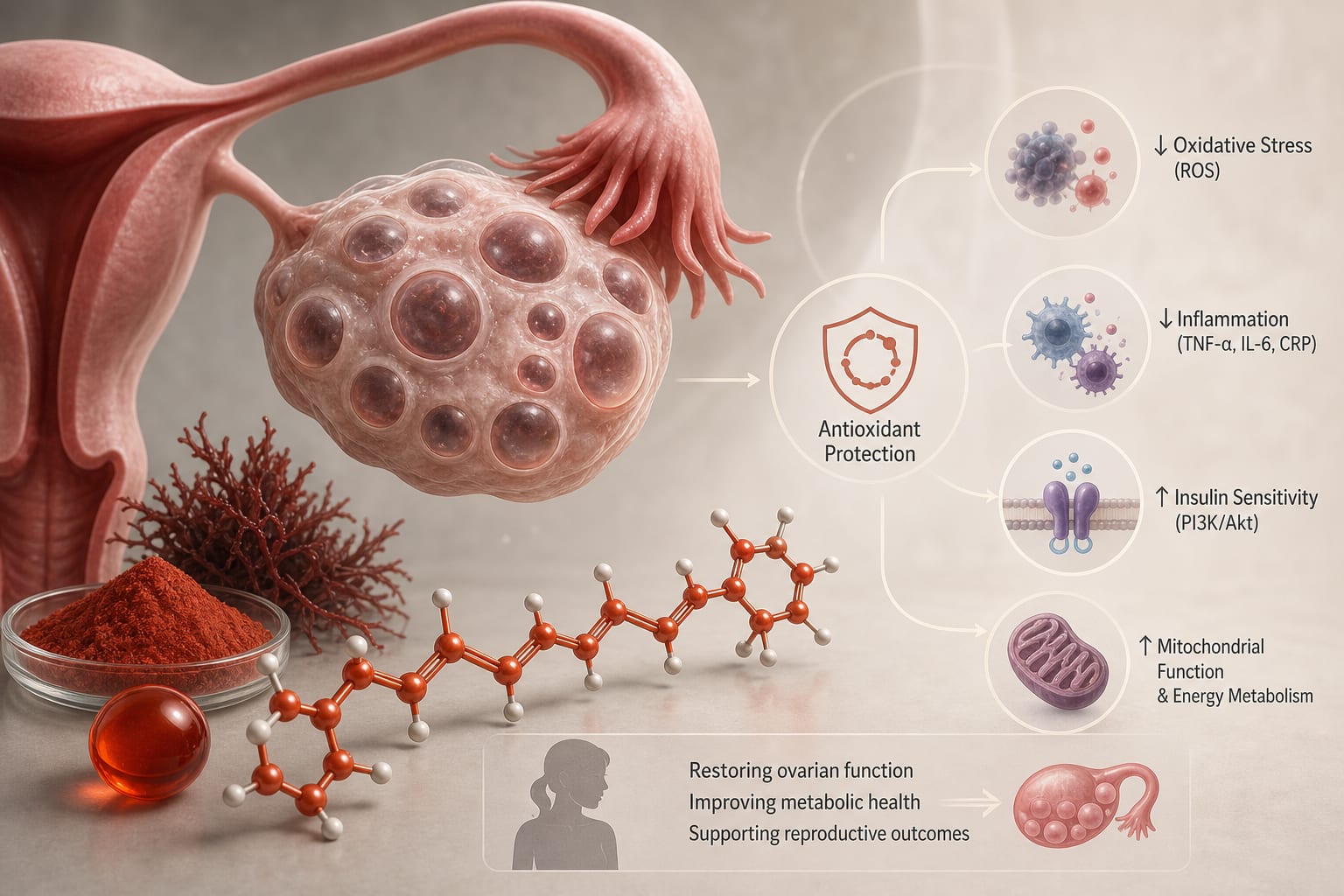
Astaxanthin as a potential therapeutic agent in polycystic ovary syndrome: a review of its antioxidant, anti-inflammatory, and metabolic mechanisms

  • By

  • Jialai Wang

  • Ying Yang

  • Ziwei Wang

  • Chengdong Liu

  • Yanhua Han

  • Xiaoke Wu

  • Hui Chang

  • July 13, 2026

Share

Clinical Report: Astaxanthin's Role as a Potential Treatment for PCOS

Overview

Astaxanthin, a natural carotenoid, has antioxidant and anti-inflammatory properties. This report reviews its potential mechanisms and therapeutic prospects in improving PCOS symptoms.

Background

Polycystic ovary syndrome (PCOS) is a prevalent endocrine disorder affecting women of reproductive age, leading to reproductive and metabolic complications. Current management strategies include lifestyle changes and pharmacotherapy, which have limitations in efficacy and safety. There is interest in natural compounds like astaxanthin as potential adjunct therapies.

Data Highlights

No specific numerical data is available in the source material.

Key Findings

  • Astaxanthin exhibits significant antioxidant and anti-inflammatory activities.
  • It enhances insulin sensitivity and activates the Nrf2 antioxidant pathway.
  • Astaxanthin inhibits the NF-κB inflammatory signaling pathway.
  • It modulates cellular apoptosis.
  • Current pharmacological treatments for PCOS have various limitations.

Clinical Implications

Further research is needed to establish the efficacy and safety of astaxanthin in clinical practice.

Conclusion

Further investigation is warranted to clarify the role of astaxanthin in treatment protocols for PCOS.

Related Resources & Content

  1. Frontiers in Reproductive Health, 2026 -- Integrating evidence-based lifestyle and adjunct therapies for long-term management of polycystic ovary syndrome: mechanistic insights and clinical implications
  2. Frontiers in Endocrinology, 2026 -- Comparative analysis of glucagon-like peptide-1 receptor agonists, metformin, and inositol in improving anthropometric and metabolic outcomes in women with polycystic ovary syndrome: a network meta-analysis
  3. The Journal of Clinical Endocrinology & Metabolism -- Cytokine Profiling Across Diverse Populations Indicates Immune Dysregulation Rather Than Chronic Inflammation in Polycystic Ovary Syndrome
  4. Recommendations from the 2023 International Evidence-based Guideline for the Assessment and Management of Polycystic Ovary Syndrome - PMC
  5. Frontiers in Reproductive Health — Yoga as a complementary intervention for polycystic ovary Syndrome management: a systematic review
  6. Efficacy of dietary supplements as an adjunctive therapy for polycystic ovary syndrome: an umbrella meta-analysis - PMC
  7. Recommendations from the 2023 International Evidence-based Guideline for the Assessment and Management of Polycystic Ovary Syndrome - PMC
  8. https://www.nature.com/articles/s41598-026-36449-7_reference.pdf

Original Source(s)

Related Content