Automated Assessment of Lewis Scores in Small-Bowel Crohn Disease With Capsule Endoscopy: A Retrospective Cohort Study
-
By
-
Yingying Meng
-
Min Gao
-
Jie Wu
-
Ying Huang
-
October 13, 2026
Clinical Report: Automated Lewis Score Assessment in Small-Bowel Crohn Disease
Overview
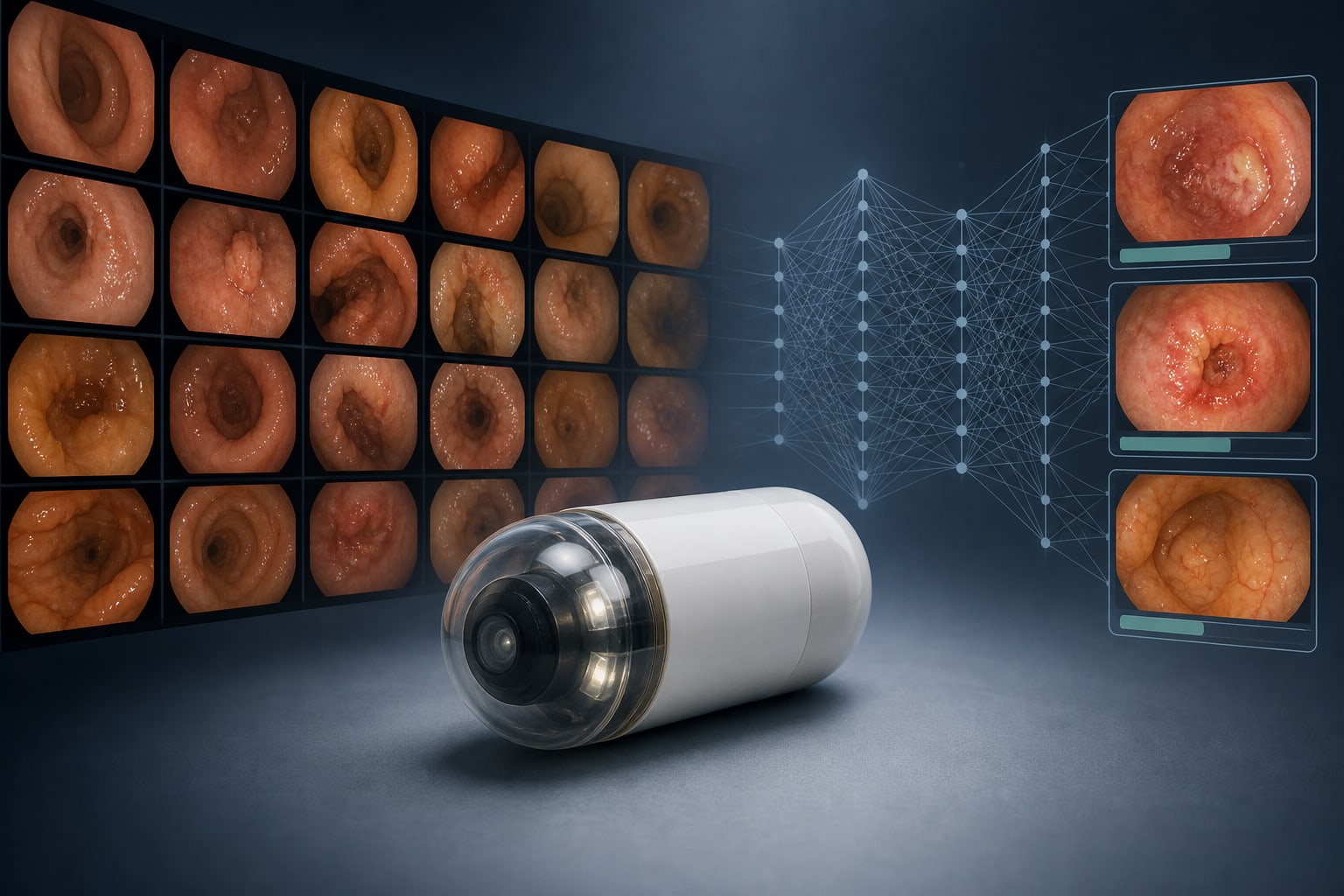
The article describes Eval-Model, a multitask deep-learning framework developed to automate Lewis score (LS) estimation from small-bowel capsule endoscopy (SBCE) in Crohn disease. The model combines lesion identification and localization, stenosis categorization, and sequence-level temporal regression using long short-term memory; the supplied article excerpt does not report cohort size or performance results.
Background
Crohn disease can affect any part of the digestive tract, and the small intestine is involved in approximately 70% of cases; in nearly 30%, lesions are confined to the small intestine. SBCE visualizes small-bowel lesions and their extent, but examinations generate many frames and interpretation can be time-consuming and affected by image quality and reader variability. The Lewis score quantifies small-bowel inflammatory activity using villous edema, ulceration, and stenosis. The article presents automated LS estimation as a response to the workload and variability associated with manual scoring.
Data Highlights
The supplied article excerpt provides no cohort size, numerical performance estimates, or study outcome data. It describes Eval-Model as a multitask framework incorporating lesion identification and localization, stenosis categorization, and LSTM-based temporal regression.
Key Findings
- The small intestine is affected in approximately 70% of Crohn disease cases, and lesions are restricted to this region in nearly 30%.
- SBCE can visualize Crohn disease lesions throughout the small intestine, but each examination typically contains tens of thousands of frames.
- The Lewis score assesses inflammatory activity using villous edema, ulceration, and stenosis; manual calculation requires detailed review and is described as vulnerable to interobserver variability.
- Eval-Model was developed and preliminarily validated to automate LS estimation during SBCE examinations for small-bowel Crohn disease.
- The framework combines lesion identification and localization, stenosis categorization, and sequence-level temporal regression using LSTM.
- The related 2025 ECCO–ESGAR–ESP–IBUS guidance described in the supplied context recommends capsule endoscopy for suspected Crohn disease when colonoscopy and imaging are negative, with attention to retention risk and patency assessment when stenosis is suspected.
Clinical Implications
The article positions automated LS estimation as a potential means of reducing the workload of SBCE interpretation and improving scoring consistency, but the supplied excerpt does not provide quantitative evidence of either effect. Capsule endoscopy use should be considered in the context of the cited guidance on excluding obstruction and assessing patency when stenosis is suspected.
Conclusion
Eval-Model integrates lesion detection, stenosis categorization, and temporal sequence analysis to automate Lewis score estimation from SBCE. The available excerpt does not provide numerical results with which to assess its performance.
Related Resources & Content
- Gralnek IM, et al., Alimentary Pharmacology & Therapeutics, 2008 -- Development of a capsule endoscopy scoring index for small bowel mucosal inflammatory change
- ECCO–ESGAR–ESP–IBUS, 2025 -- Guidelines on Diagnostics and Monitoring of Patients with Inflammatory Bowel Disease: Part 1
- ESGE, 2022 -- Small-bowel capsule endoscopy and device-assisted enteroscopy: ESGE Guideline—Update 2022
- Journal of Gastroenterology, 2018 -- Nationwide Case-Control Study on the Role of Capsule Endoscopy in Diagnosing Crohn’s Disease
- Journal of Crohn's and Colitis, 2024 -- Evaluation of Endoscopic Activity and Lesion Classification Using Panenteric Capsule Endoscopy in Crohn’s Disease Patients
- Journal of Gastroenterology, 2023 -- Prospective Multicenter Study on the Safety and Effectiveness of Capsule Endoscopy for Crohn’s Disease in Japan (SPREAD-J Study)
- Journal of Gastroenterology — Evaluating the Diagnostic Precision and Threshold Levels of Serum Leucine-Rich Alpha-2 Glycoprotein in Assessing Small Bowel Activity in Crohn’s Disease
- ECCO–ESGAR–ESP–IBUS Guidelines on Diagnostics and Monitoring of Patients with Inflammatory Bowel Disease: Part 1
- The Lewis score or the capsule endoscopy Crohn’s disease activity index: which one is better for the assessment of small bowel inflammation in established Crohn’s disease?
- Evaluation of Endoscopic Activity and Lesion Classification Using Panenteric Capsule Endoscopy in Crohn’s Disease Patients
- Prospective Multicenter Study on the Safety and Effectiveness of Capsule Endoscopy for Crohn’s Disease in Japan (SPREAD-J Study)
- network meta-analysis of capsule endoscopy versus imaging modalities for diagnosing small bowel Crohn’s disease | Journal of Crohn's and Colitis | Oxford Academic
Based on findings from:
Automated Lewis Score Estimation for Small Bowel Crohn Disease Using Capsule Endoscopy: Retrospective Cohort Study
Yingying Meng, Min Gao, Jie Wu, Ying Huang. Jmir Medical Informatics, 2026.
https://medinform.jmir.org/2026/1/e92416
This content is an AI-generated, fully rewritten summary based on a published scholarly article. It does not reproduce the original text and is not a substitute for the original publication. Readers are encouraged to consult the source for full context, data, and methodology.