Clinical Report: Exploring the Role of Extracellular Vesicles in Neonatal Health
Overview
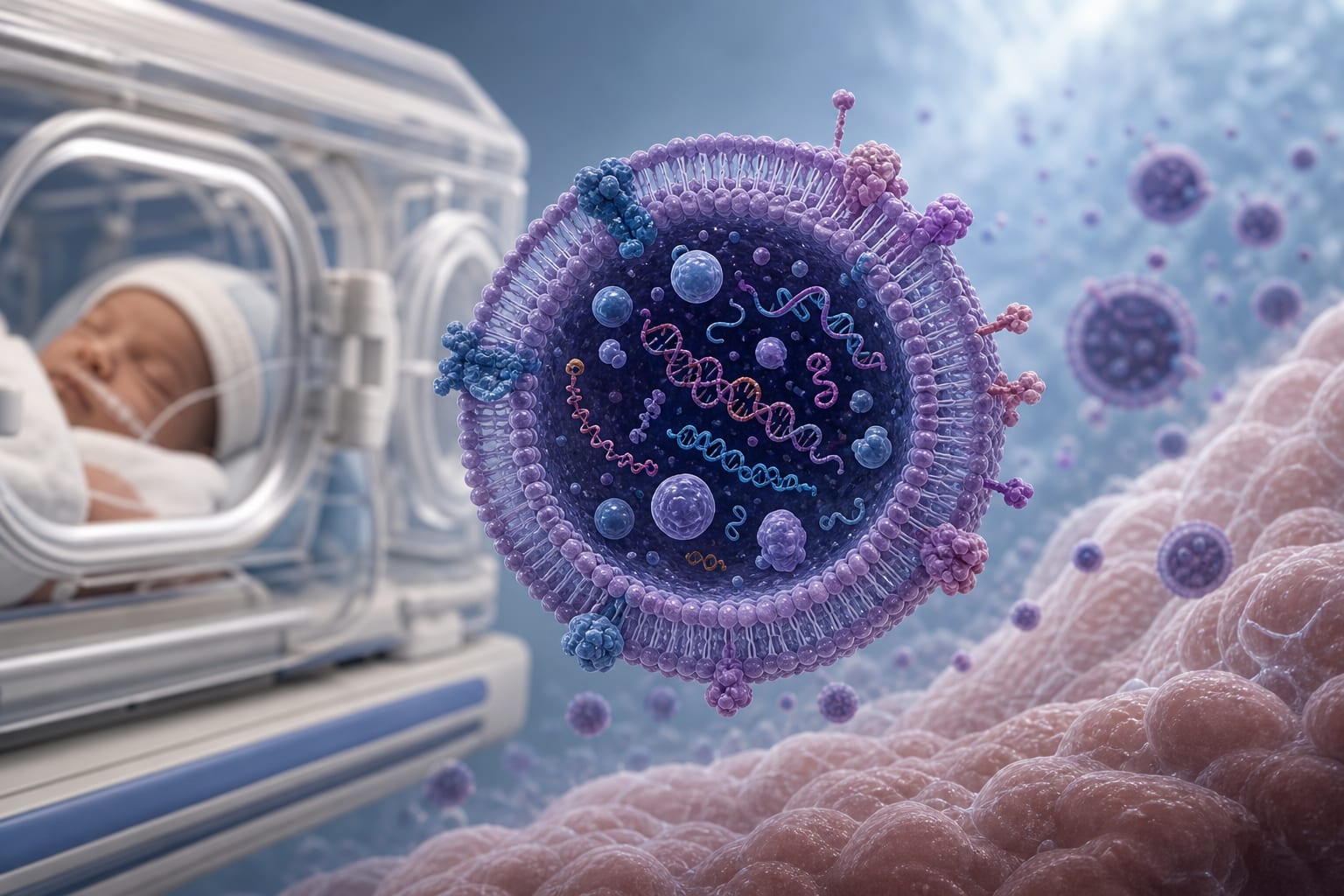
This review systematically synthesizes evidence on extracellular vesicles (EVs) derived from neonatal biological fluids, highlighting their involvement in neonatal health and disease.
Background
Extracellular vesicles (EVs) are membrane-bound particles that play critical roles in intercellular communication and various biological processes. Their presence in biological fluids from neonates is documented.
Data Highlights
No specific numerical data or trial results were provided in the source material.
Key Findings
EVs are consistently present and biologically active across diverse neonatal conditions.
They are isolated from multiple biological matrices, primarily umbilical cord and peripheral blood.
Sampling of EVs is mainly performed at birth or during early postnatal life.
Current evidence on EVs in neonates is derived from predominantly observational studies with small-to-moderate sample sizes.
Standardized studies are needed to clarify the biological functions and clinical utility of EVs.
Clinical Implications
The presence of EVs in neonatal biological fluids indicates their role in diagnostics and as biomarkers for various conditions.
Conclusion
Extracellular vesicles are involved in neonatal health and disease, but further investigation is needed to validate their clinical applications.
by Alexandra Lianou, Andreas G. Tsantes, Sotirios P. Fortis, Effie G. Papageorgiou, Anastasios G. Kriebardis, Panagiotis G. Zoumpoulakis, Zoi Iliodromiti, Theodora Boutsikou, Evangelos Terpos, Maria Gavriatopoulou, Nicoletta Iacovidou, Rozeta Sokou