External validation of a machine learning-based web application for personalized testing of objective functioning using the five-repetition sit-to-stand test - Report - MDSpire
Clinical Report: Validation of a Machine Learning-Driven Web Tool for Customized Assessment
Overview
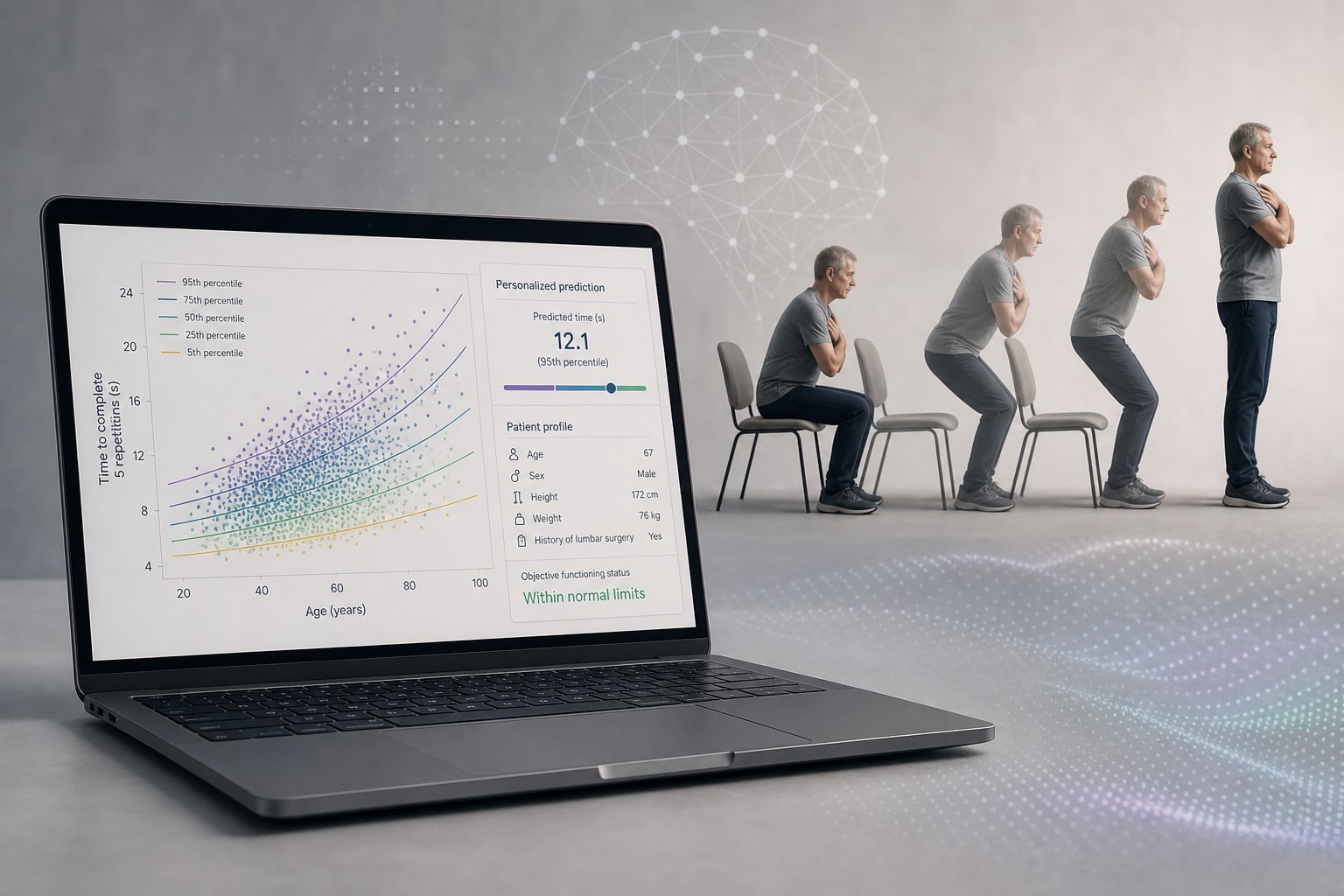
This study validates a machine learning-based web application designed to assess objective functioning via the five-repetition sit-to-stand (5R-STS) test. The model incorporates demographic variables to improve classification accuracy of objective functional impairment in a healthy cohort.
Background
Standardized outcome metrics are crucial in neurosurgical practice for assessing clinical status and treatment effects. The five-repetition sit-to-stand (5R-STS) test is a widely used diagnostic tool, but its reliance on a single upper limit of normal can lead to misclassification of patients. This study addresses the need for a more personalized approach to improve the accuracy of functional assessments.
Data Highlights
No numerical data provided in the source material.
Key Findings
The machine learning model improves classification accuracy of objective functional impairment (OFI) by incorporating demographic variables.
External validation was conducted on a cohort of healthy individuals from multiple countries.
The study emphasizes the importance of external validation for predictive models in clinical settings.
Standardized testing protocols were followed for the 5R-STS test to ensure consistency.
The model's generalizability across diverse demographics and testing conditions remains to be established.
Clinical Implications
The findings suggest that integrating demographic factors into functional assessments may enhance the accuracy of identifying objective functional impairment. This approach could lead to more tailored evaluations in clinical practice.
Conclusion
The validation of the machine learning-driven web tool requires further research to confirm its applicability across varied patient populations.
by Kenneth Arockia, Massimo Bottini, Anita M. Klukowska, Victor Gabriel El-Hajj, Maria Gharios, Ali Buwaider, Carlo Serra, Luca Regli, Marc L. Schröder, Victor E. Staartjes