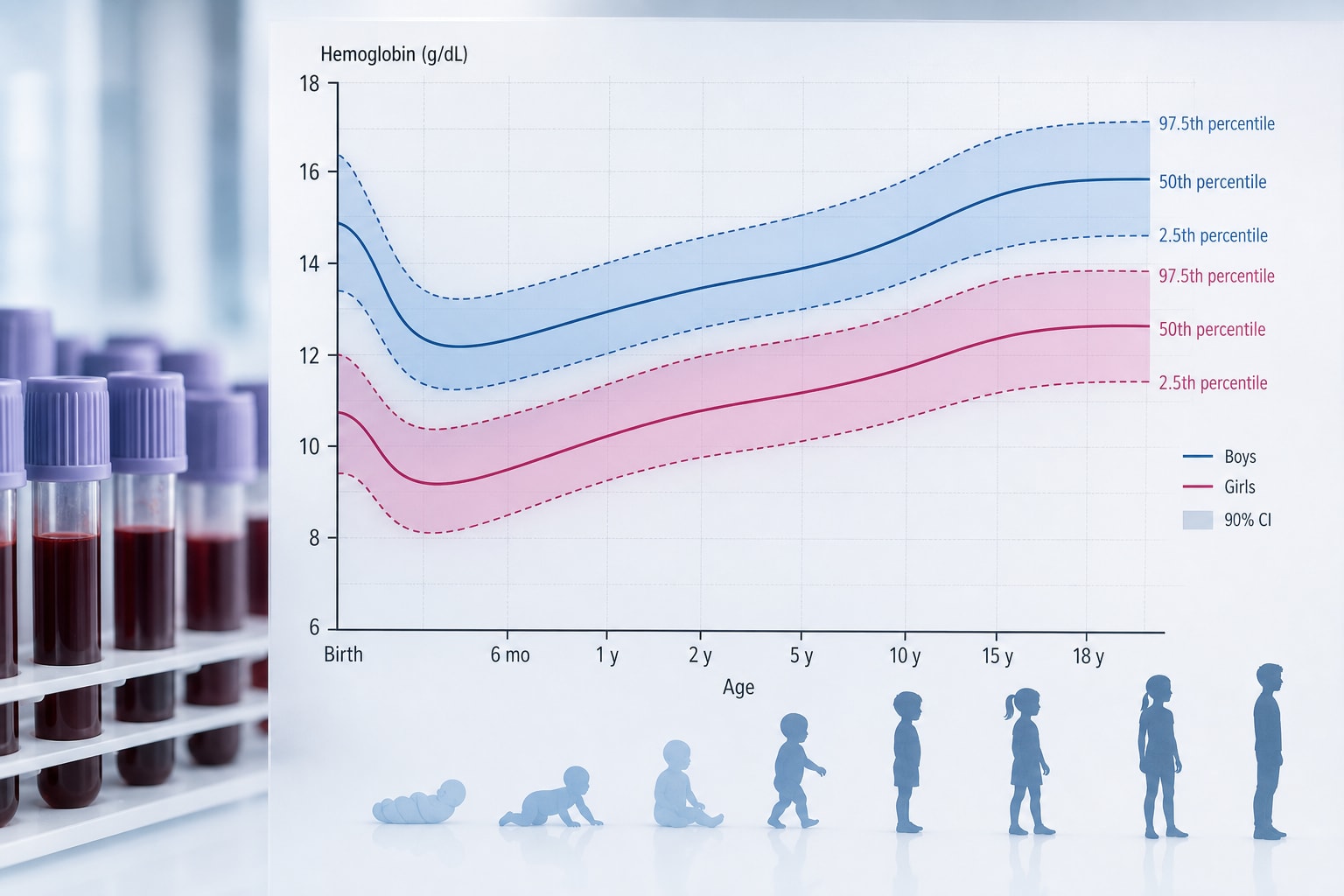
Clinical Report: Reference Intervals and Ideal Curves for Pediatric Hemoglobin Levels
Overview
This study establishes sex-specific reference curves (RCs) and optimal curves (OCs) for pediatric hemoglobin levels, addressing limitations in current World Health Organization (WHO) thresholds.
Background
Hemoglobin levels are crucial for diagnosing and managing various conditions in children. Established reference intervals (RIs) often fail to capture age-related variability, particularly in pediatric populations where growth significantly influences hemoglobin levels. This study aims to enhance the interpretation of hemoglobin levels by creating more precise reference curves.
Data Highlights
No numerical data or trial data provided in the source material.
Key Findings
Reference curves (RCs) treat age as a continuous variable, improving the granularity of hemoglobin level assessments.
Current WHO hemoglobin thresholds are fixed and may not adequately reflect age-related variability in hemoglobin levels.
Optimal curves (OCs) were constructed based on prespecified optimality criteria from previous research.
The study utilized quantile regression to model hemoglobin levels, eliminating the need for age partitioning.
Data were collected from a diverse cohort of healthy children in Toronto, Ontario, Canada.
Clinical Implications
The development of sex-specific RCs and OCs for hemoglobin levels can aid in the interpretation of anemia diagnosis and management in pediatric patients.
Conclusion
This study provides a framework for interpreting pediatric hemoglobin levels through the use of continuous age modeling.
by Vid Bijelić, Franco Momoli, Mira Liebman, Beth K. Potter, Cornelia M. Borkhoff, Catherine S. Birken, Jonathon L. Maguire, Patricia C. Parkin, Jemila S. Hamid
A literature review published in Future Cardiology suggests that providers should look beyond chronological age to various modifiable physiologic factors when planning a superior cavopulmonary connection (SCPC) procedure.
Court-documented maltreatment was associated with small differences in GrimAge and DunedinPACE in sixth decade of life, but neither difference was statistically significant.