Risk stratification model based on estimated dose of radiation to immune cells and radiotherapy-related nadir lymphocyte count for predicting the efficacy of consolidation immunotherapy in stage III non-small cell lung cancer - Report - MDSpire
Advertisement
Risk stratification model based on estimated dose of radiation to immune cells and radiotherapy-related nadir lymphocyte count for predicting the efficacy of consolidation immunotherapy in stage III non-small cell lung cancer
Clinical Report: Prognostic Model for Immunotherapy Outcomes in NSCLC
Overview
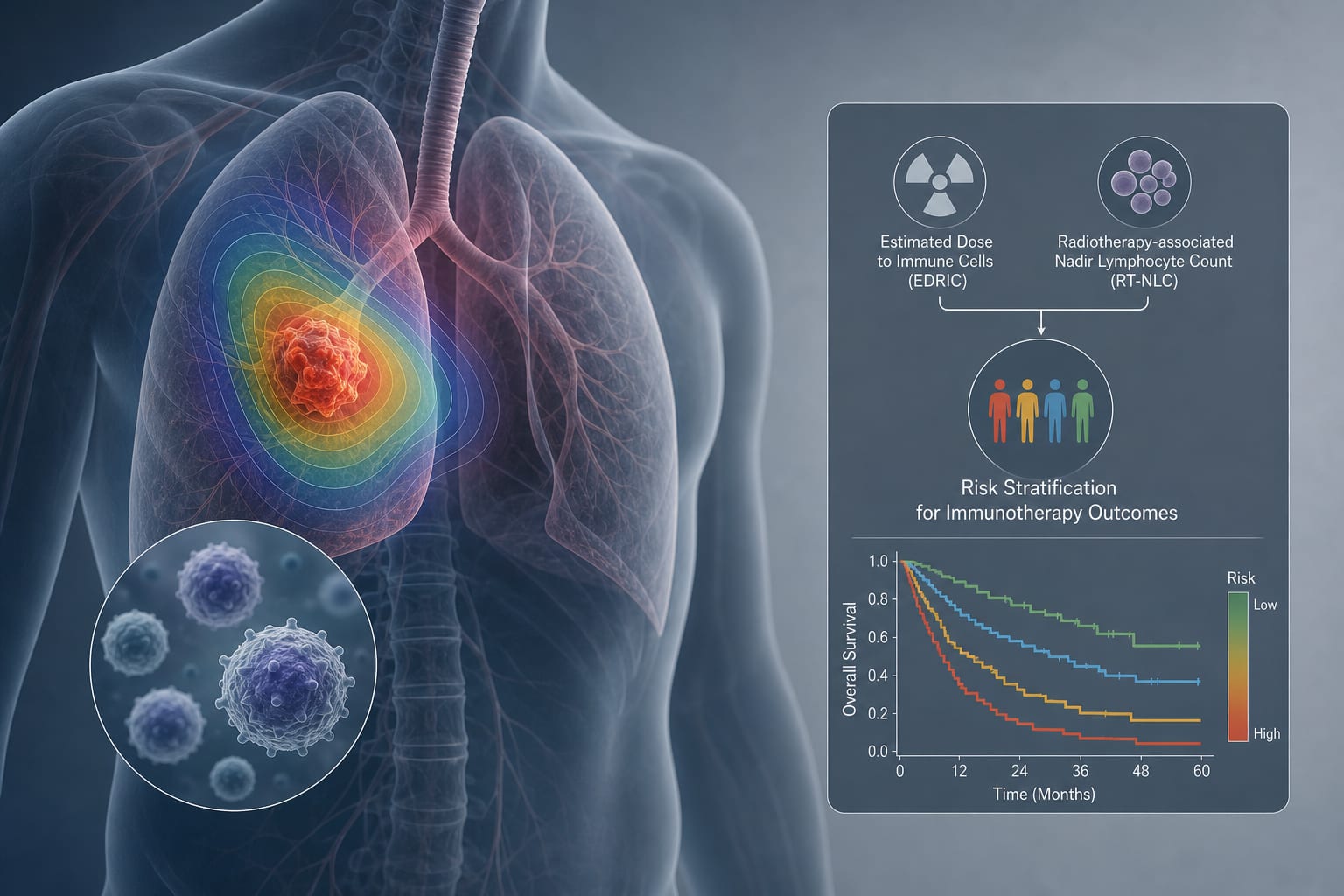
This study evaluates the prognostic value of estimated radiation dose to immune cells (EDRIC) and nadir lymphocyte count (RT-NLC) in patients with unresectable stage III non-small cell lung cancer (NSCLC).
Background
Lung cancer remains the leading cause of cancer-related mortality globally, with a significant proportion of cases diagnosed at an advanced stage. For unresectable stage III NSCLC, definitive chemoradiotherapy has been the standard treatment, yet survival rates remain low. Recent advancements in immunotherapy have shown promise, but understanding the impact of radiotherapy on immune function is crucial for optimizing treatment outcomes.
Data Highlights
Parameter
Median Value
P-Value
Overall Survival (OS)
49.7 vs. 38.1 months
0.015
Progression-Free Survival (PFS)
29.7 vs. 17.3 months
0.006
Locoregional Relapse-Free Survival (LRFS)
32.4 vs. 19.8 months
0.004
Distant Metastasis-Free Survival (DMFS)
44.8 vs. 24.0 months
0.001
Key Findings
EDRIC inversely correlated with RT-NLC (r = –0.38, P < 0.001).
Lower EDRIC was associated with significantly improved median OS (49.7 vs. 38.1 months, P = 0.015).
High RT-NLC group showed prolonged median DMFS (44.8 vs. 26.8 months, P = 0.012).
High-risk patients (EDRIC ≥ 6.75 Gy and RT-NLC < 0.54×10^9/L) had inferior survival but benefited from consolidation immunotherapy.
Low EDRIC independently predicted improved OS (HR = 0.51) and PFS (HR = 0.56).
Clinical Implications
The integration of EDRIC and RT-NLC as prognostic biomarkers can aid in identifying high-risk patients.
Conclusion
EDRIC and RT-NLC are valuable prognostic indicators in unresectable stage III NSCLC.