Beyond hypoxic–ischemic encephalopathy: genetic insights and precision diagnosis in neonatal encephalopathies - Report - MDSpire

Beyond hypoxic–ischemic encephalopathy: genetic insights and precision diagnosis in neonatal encephalopathies

  • By

  • Carla Cimino

  • Vincenzo Sortino

  • Annamaria Sapuppo

  • Marco Andrea Nicola Saporito

  • Federica Scarlata

  • Raffaele Falsaperla

  • June 15, 2026

  • 0 min

Share

Clinical Report: Expanding Understanding of Neonatal Encephalopathies

Overview

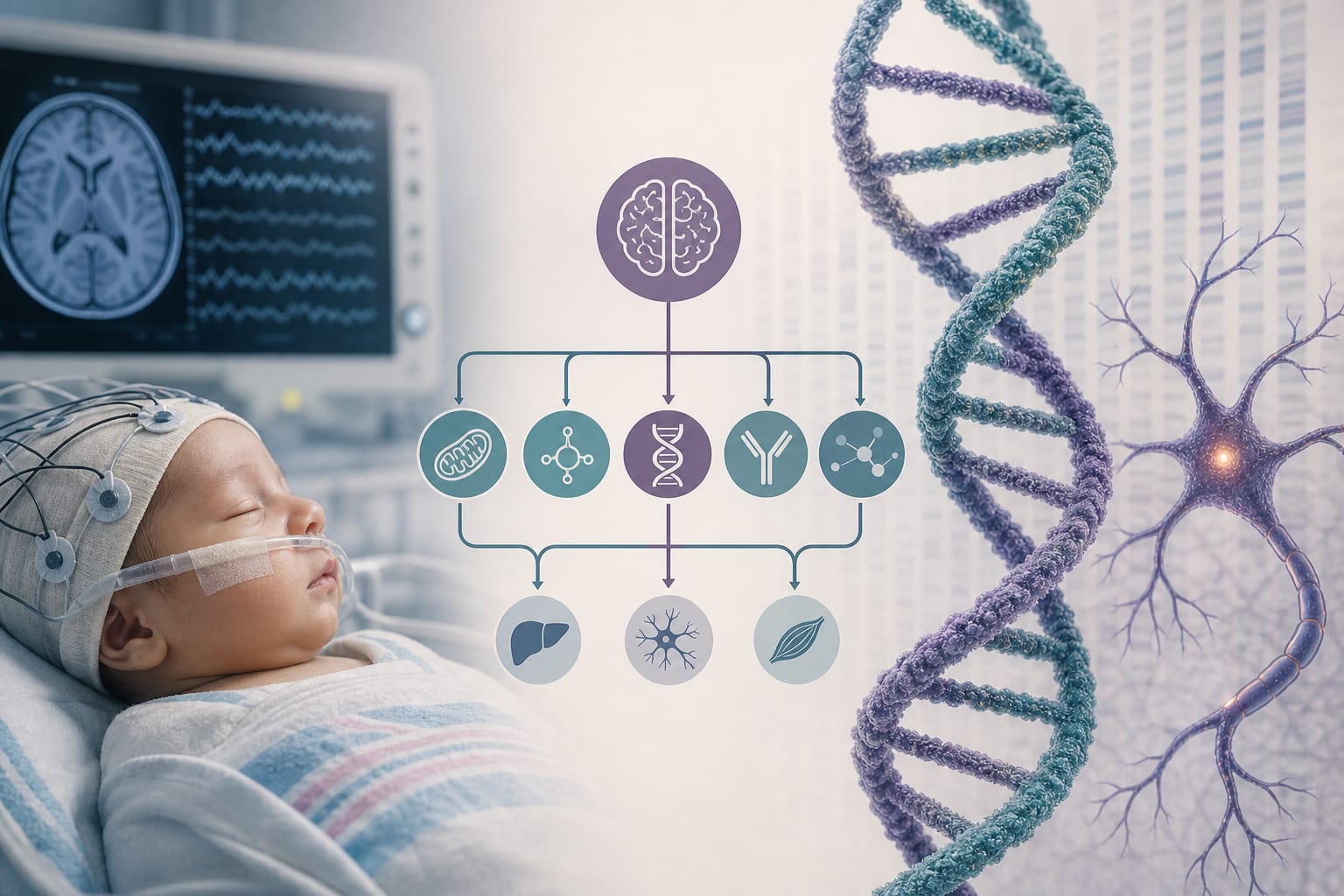
This report reviews the diverse etiologies of neonatal encephalopathies, emphasizing the importance of recognizing genetic factors beyond hypoxic-ischemic encephalopathy (HIE). A structured diagnostic algorithm is introduced to aid in the differential diagnosis and management of affected newborns.

Background

Neonatal encephalopathy (NE) is a complex neurological syndrome that can arise from various causes, including genetic, metabolic, and immune-mediated factors. Historically, HIE has been the primary focus, but many cases present with alternative etiologies that complicate diagnosis and treatment. Understanding these diverse causes is critical for timely intervention and appropriate family counseling.

Data Highlights

No numerical data or trial data provided in the source material.

Key Findings

  • Neonatal encephalopathies encompass a range of disorders, not solely HIE.
  • Genetic factors may significantly contribute to NE, affecting neuronal development and function.
  • Next-generation sequencing (NGS) is now a first-line diagnostic tool for identifying genetic causes of NE.
  • Early identification of genetic variants can lead to targeted therapies and improved outcomes.
  • A structured diagnostic algorithm is proposed to assist clinicians in differentiating between HIE and other causes of NE.

Clinical Implications

Clinicians should adopt a comprehensive diagnostic approach that includes genetic testing for neonates presenting with encephalopathy. Early recognition of genetic conditions can facilitate timely interventions and enhance family support.

Conclusion

The evolving understanding of neonatal encephalopathies necessitates a shift in clinical practice towards recognizing genetic factors, which can significantly influence management and outcomes.

Related Resources & Content

  1. Author(s)/Org, Source, Year -- Title
  2. Author(s)/Org, Source, Year -- Title
  3. Author(s)/Org, Source, Year -- Title
  4. Author(s)/Org, Source, Year -- Title
  5. Author(s)/Org, Source, Year -- Title
  6. Author(s)/Org, Source, Year -- Title
  7. The Next Generation of Newborn Screening
  8. Association of the neonatal sequential organ failure assessment score with neurological outcomes in infants diagnosed with hypoxic-ischemic encephalopathy
  9. Predicting neurodevelopmental outcomes in neonatal hyperbilirubinemia: a multidimensional nomogram integrating biomarkers and neurobehavioral scores
  10. Neuroprognostication in neonatal encephalopathy due to presumed hypoxic-ischemic encephalopathy | Pediatric Research
  11. AAP report provides update on therapeutic hypothermia for neonates with HIE | AAP News | American Academy of Pediatrics
  12. The American Clinical Neurophysiology Society Guideline on Indications for Continuous Electroencephalography Monitoring in Neonates - PubMed
  13. Automated EEG Background Analysis and 2-Year Outcomes in Neonatal Hypoxic-Ischemic Encephalopathy - PMC
  14. Hypoxic-Ischemic Encephalopathy and Beyond: A Pictorial Review of Neuroimaging Findings in Neonatal Encephalopathy - PMC
  15. Expert Consensus Approach to Developing Inpatient Common Data Elements for Neonatal Encephalopathy Research | Neurology
  16. Standardized Criteria for Genomic Testing in the NICU | Pediatrics | American Academy of Pediatrics
  17. Neonatal Encephalopathy | Neurology Genetics
  18. Rapid Whole-Genome Sequencing in Critically Ill Infants and Children with Suspected, Undiagnosed Genetic Diseases: Evolution to a First-Tier Clinical Laboratory Test in the Era of Precision Medicine - PMC
  19. Frontiers | Rapid whole genome sequencing in newborn screening for metabolic diseases
  20. MPSE identifies newborns for whole genome sequencing within 48 h of NICU admission - PubMed
  21. Genetic and epigenetic contributors and mimickers of phenotypic hypoxic-ischemic encephalopathy (HIE) - ScienceDirect

Original Source(s)

Related Content