Clinical Report: Ultrasound Characteristics of Cutaneous Hidrocystoma
Overview
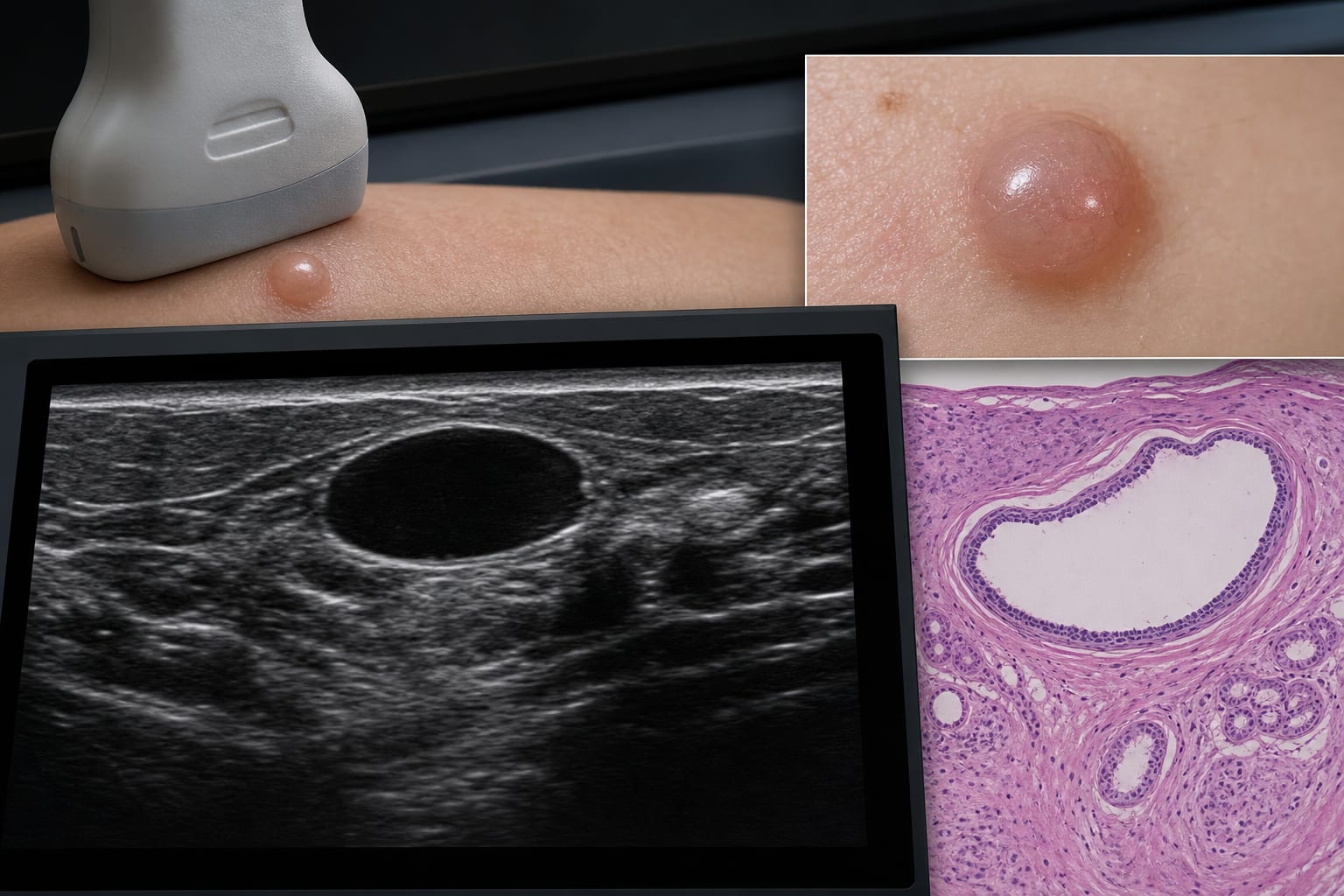
This study describes the ultrasound features of cutaneous hidrocystoma and correlates these findings with histopathology. High-frequency ultrasound (HFUS) provides information for lesion characterization, although definitive preoperative diagnosis remains challenging due to overlapping features with other lesions.
Background
Cutaneous hidrocystoma is a benign cystic lesion of sweat gland origin that poses diagnostic challenges due to its nonspecific clinical presentation. Accurate preoperative diagnosis is crucial for effective surgical planning, and while clinical examination and dermoscopy are standard, HFUS may provide additional information for lesion characterization. This study aims to systematically evaluate HFUS features in hidrocystoma and their correlation with histopathologic findings.
Data Highlights
Characteristic
Findings
Number of lesions
11
Location
Head and neck region (8 lesions)
Size
Most < 1.5 cm (10/11, 90.9%)
Echogenicity
Heterogeneous (36.4%), Anechoic (27.3%), Hypoechoic (18.2%), Hypoechoic with projections (18.2%)
Vascularity
Detected in 2 lesions (18.2%)
Key Findings
Eleven patients with pathologically confirmed hidrocystoma were analyzed.
Lesions predominantly located in the head and neck region.
Most lesions measured less than 1.5 cm in diameter.
Sonographic appearances included heterogeneous echogenicity and anechoic features.
Preoperative ultrasound interpretations did not identify any lesions as hidrocystoma.
Clinical Implications
HFUS may assist in localizing cutaneous hidrocystoma and narrowing the differential diagnosis, but the overlap in ultrasound features with other lesions may limit its utility for definitive preoperative diagnosis.
Conclusion
HFUS provides insights into the characteristics of cutaneous hidrocystoma, aiding in surgical planning despite challenges in achieving a definitive preoperative diagnosis.