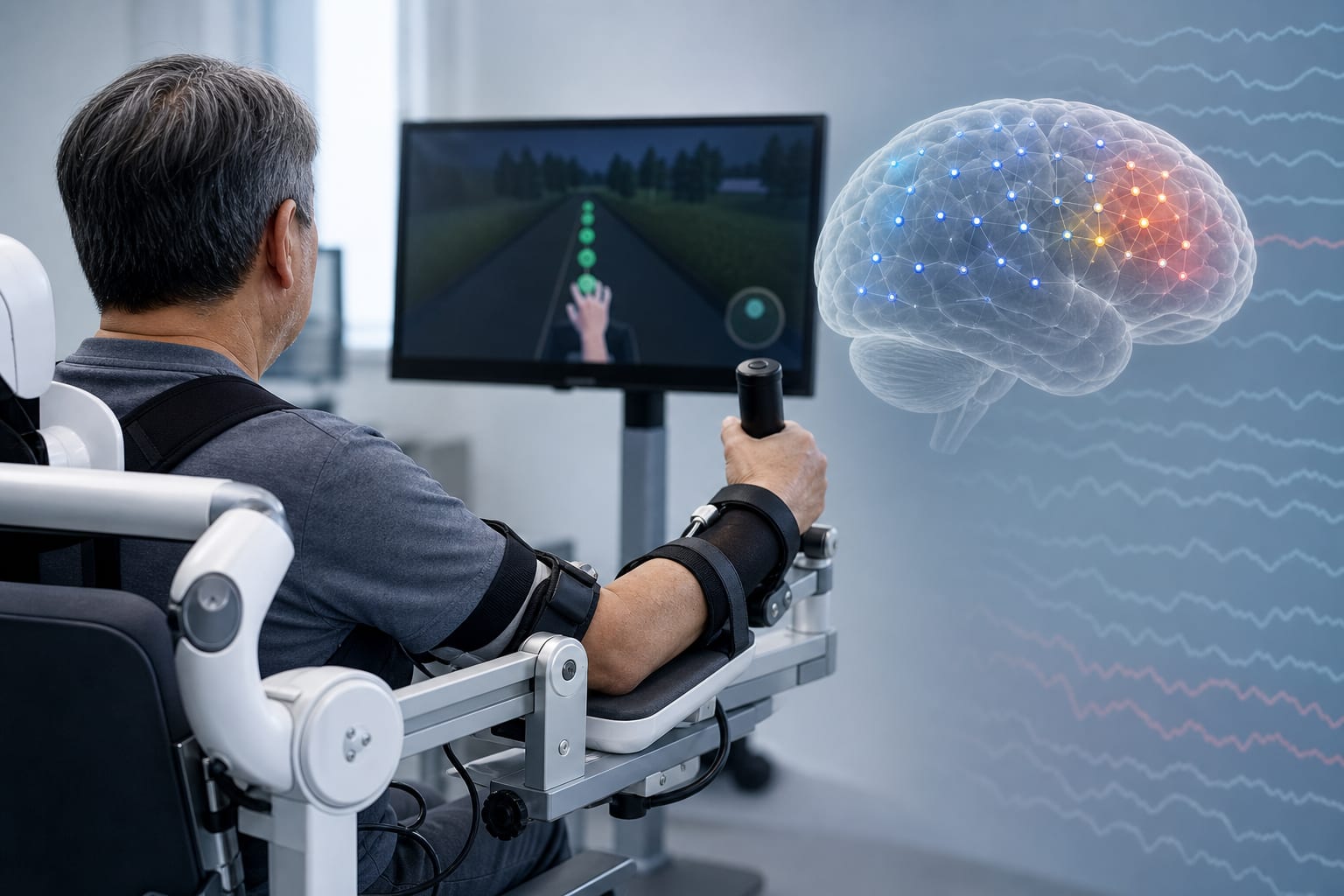
Clinical efficacy and cortical network modulation of a multimodal sensory feedback upper-limb rehabilitation robot for post-stroke upper-limb recovery: a randomized controlled trial - Report - MDSpire
Coming Soon: Introducing MDSpire News. Learn more
Conexiant’s news site is now MDSpire News. Learn more

Effectiveness and Cortical Network Alterations of a Multimodal Sensory Feedback Robot for Upper-Limb Rehabilitation in Post-Stroke Patients: A Randomized Controlled Study

  • By

  • Li-Hui Zhao

  • Jun-Peng Zhang

  • Jia-Jia Wu

  • Yu Cao

  • Zhan-Yue Lu

  • Xu-Yun Hua

  • Xia Bi

  • Jian-Guang Xu

  • September 4, 2026

Share

Clinical Report: Effectiveness and Cortical Network Alterations of a Multimodal Sensory Feedback Robot for Upper-Limb Rehabilitation in Post-Stroke Patients

Overview

This study evaluates the impact of multimodal sensory-feedback robot-assisted training on upper-limb recovery in post-stroke patients. Results indicate significant improvements in motor function and alterations in cortical connectivity following the intervention.

Background

Upper-limb motor impairment is a prevalent issue following stroke, affecting daily activities and quality of life. Conventional rehabilitation often faces limitations such as therapist availability and patient fatigue. Robot-assisted training, particularly with multimodal sensory feedback, may enhance rehabilitation outcomes by promoting engagement and sensorimotor integration.

Data Highlights

GroupFMA-UE Score Changep-value
Experimental (Robot-assisted)Significant improvement< 0.05
Control (Conventional)Smaller, non-significant improvementp > 0.05

Key Findings

  • Multimodal sensory-feedback robot-assisted training led to significant improvements in Fugl-Meyer Assessment scores compared to conventional rehabilitation.
  • Resting-state fNIRS showed increased fronto-motor connectivity in the experimental group post-intervention.
  • Task-related fNIRS indicated channel-specific activation changes during motor tasks between groups.
  • No significant baseline differences in zFC were observed between groups prior to intervention.
  • Cortical activation remained preserved in the experimental group while decreasing in the control group post-intervention.

Clinical Implications

The findings suggest that incorporating multimodal sensory-feedback robot-assisted training may enhance motor recovery in post-stroke patients. Clinicians should consider this approach to improve rehabilitation outcomes alongside conventional methods.

Conclusion

The study demonstrates that multimodal sensory-feedback robot-assisted training can improve upper-limb recovery and induce measurable neurophysiological changes in post-stroke patients.

Related Resources & Content

  1. Author(s)/Org, Source, Year -- Title
  2. DIGITAL HEALTH, Unilateral and bilateral digital mirror visual feedback with different movement types modulate mu oscillations in individuals with stroke
  3. Frontiers in Neurology, Effects of Non-Invasive Neural Stimulation Modalities on Upper Limb Function in Subacute Stroke: A Systematic Review and Meta-Analysis
  4. Frontiers in Neurology, Differential cortical responses of robot-assisted active and mirror therapy task conditions in stroke patients and healthy controls: a comparative fNIRS study
  5. European Stroke Organisation (ESO) guideline on motor rehabilitation
  6. Effects of Robot-Assisted Therapy for Upper Limb Rehabilitation After Stroke: An Umbrella Review of Systematic Reviews
  7. Frontiers in Neurology — Effects of blood flow restriction combined with robot-assisted training on upper limb motor function after stroke: a randomized controlled trial protocol
  8. European Stroke Organisation (ESO) guideline on motor rehabilitation
  9. Effects of Robot-Assisted Therapy for Upper Limb Rehabilitation After Stroke: An Umbrella Review of Systematic Reviews.
  10. Frontiers | Clinical Efficacy and Cortical Network Modulation of a Multimodal Sensory Feedback Upper-Limb Rehabilitation Robot for Post-Stroke Upper-Limb Recovery: A Randomized Controlled Trial

Original Source(s)

Related Content