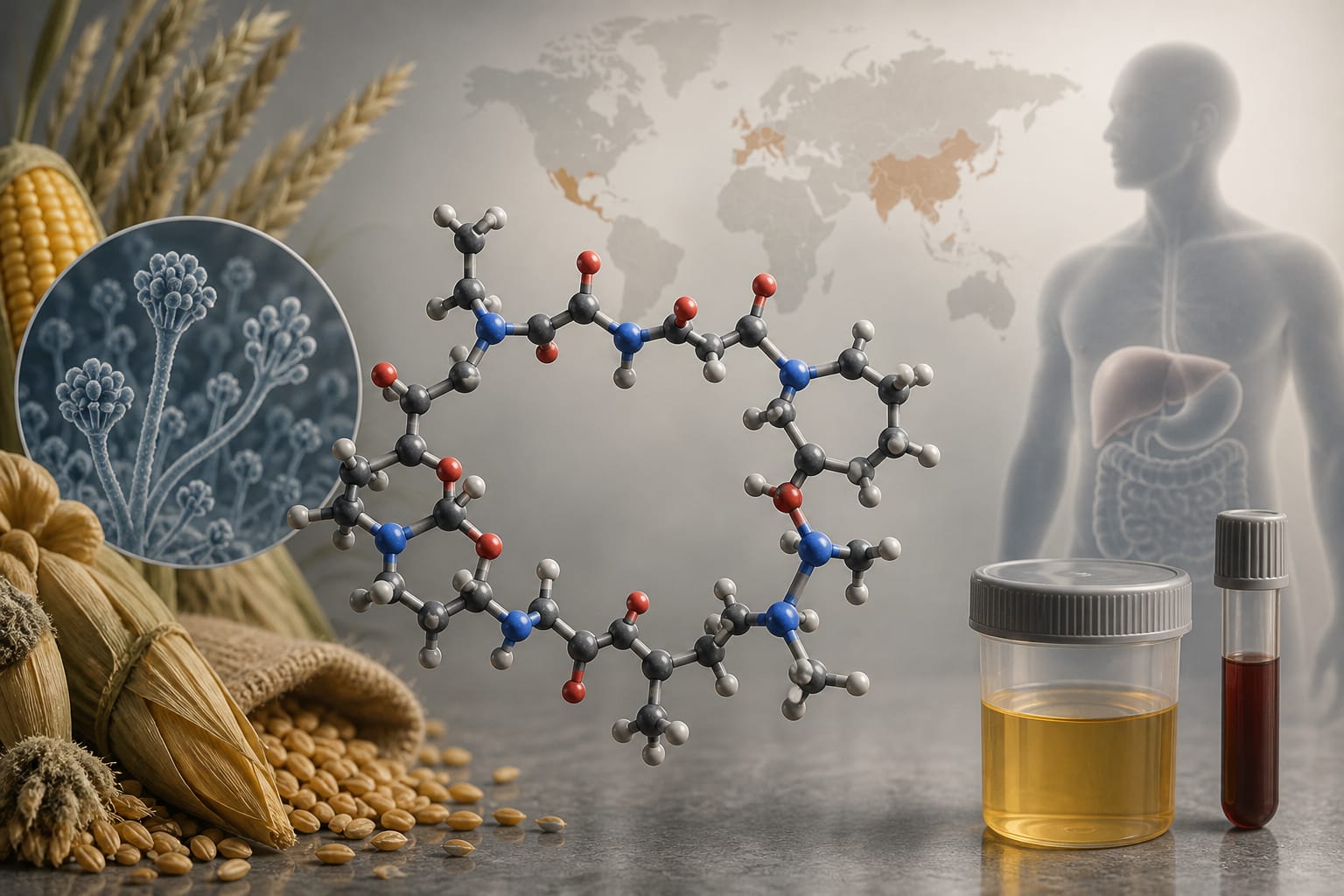
Overview of Human Biomonitoring Efforts for Beauvericin and Enniatins
-
By
-
Gsela H. Degen
-
Anamarija Romac
-
September 1, 2026
Clinical Report: Overview of Human Biomonitoring Efforts for Beauvericin and Enniatins
Background
Beauvericin and enniatins are emerging mycotoxins produced by Fusarium species, recognized as widespread contaminants in food and feed. Their cytotoxic effects at low concentrations raise concerns about dietary exposure. Understanding their bioavailability is crucial for public health.
Data Highlights
No numerical data or trial data available in the source material.
Key Findings
- BEA and ENNs are prevalent in grains and grain-derived products, with dried fruits as secondary sources.
- Acute dietary exposures to BEA and ENNs are significantly below mouse LD50 values.
- Human biomonitoring studies indicate low detection rates of BEA in urine, with ENNs variably detected in urine and blood.
- There is a lack of in vivo human toxicokinetic studies.
- Current analytical methods for detecting BEA and ENNs in human samples were first published in 2014.
Clinical Implications
Ongoing monitoring and research are necessary to assess potential health risks associated with dietary exposure.
Conclusion
Research and human biomonitoring are essential to understand the health implications of beauvericin and enniatins.
Related Resources & Content
- EFSA, Scientific Opinion on the risks to human and animal health related to the presence of beauvericin and enniatins in food and feed, 2014
- Behr et al., Current status of human biomonitoring of beauvericin and enniatins, Archives of Toxicology, 2026
- Archives of Toxicology — Assessment of the Risks Posed by Mycotoxins Enniatins and Beauvericin: Identifying Knowledge Gaps for Enhanced Human Health Risk Evaluation
- Archives of Toxicology — Metabolism and Urinary Elimination of Seven Neonicotinoids and Related Compounds Following Controlled Oral Administration
- Archives of Toxicology — Pharmacokinetics of a tebuconazole urinary metabolite after controlled oral and dermal exposure in human subjects
- Archives of Toxicology — Integrated human toxicokinetics of acetamiprid using urine, blood, and feces data in physiologically-based kinetic modelling for reverse dosimetry
- Monitoring | Parc
- Human biomonitoring initiative (HBM4EU)
- Scientific Opinion on the risks to human and animal health related to the presence of beauvericin and enniatins in food and feed - - 2014 - EFSA Journal - Wiley Online Library
- Current status of human biomonitoring of beauvericin and enniatins | Archives of Toxicology | Springer Nature Link
- Human Biomonitoring Guidance Values for Deoxynivalenol Derived under the European Human Biomonitoring Initiative (HBM4EU) - PMC
Based on findings from:
Current status of human biomonitoring of beauvericin and enniatins
Gsela H. Degen, Anamarija Romac. Archives Of Toxicology, 2026.
https://link.springer.com/article/10.1007/s00204-026-04527-4
This content is an AI-generated, fully rewritten summary based on a published scholarly article. It does not reproduce the original text and is not a substitute for the original publication. Readers are encouraged to consult the source for full context, data, and methodology.